Why Manual Note-Taking Fails Teams: A Clear Guide

Why Manual Note-Taking Fails Teams: A Clear Guide
Manual note-taking is a documented bottleneck that costs teams accuracy, time, and the ability to act on what was discussed. The core problem is not effort or intent. The human brain cannot simultaneously listen, parse, and summarize complex discussions without losing critical detail. That cognitive constraint makes manual note-taking structurally unreliable for team settings. This guide explains why manual note-taking fails teams, what happens downstream when notes are incomplete, and what leaders can do to fix the problem at its root.
Why manual note-taking fails teams at the cognitive level
The fundamental reason manual note-taking fails teams is biology, not behavior. Human brains cannot transcribe and listen at the same time without losing fidelity in one or both tasks. When a team member writes notes during a meeting, they shift cognitive resources away from active listening and toward transcription. The result is a partial record of a partial understanding.
This is called single-threaded cognitive load. The brain processes language, meaning, and context in the same working memory space it uses to form written sentences. Asking someone to do both simultaneously is not a skill gap. It is a biological ceiling.

The downstream effect is predictable. The note-taker misses nuance, skips context, and records surface-level statements instead of the decisions or reasoning behind them. The rest of the team, meanwhile, assumes the notes are complete. That gap between what was said and what was captured is where team collaboration issues begin.
Pro Tip: Assign a dedicated note-taker for each meeting rather than expecting the facilitator or a participant to do both jobs. Separating listening from documenting is the single highest-leverage change a team can make to improve note quality.
Manual note-taking also creates a workflow bottleneck after the meeting ends. Consultants and team leads spend more time editing transcripts and entering data post-meeting than they spend in the actual conversation. That is time pulled away from execution.
- Notes must be typed up, formatted, and distributed manually.
- Action items must be extracted and assigned by hand.
- Follow-up reminders depend entirely on the note-taker’s memory and initiative.
- Shared drives or email threads become the default storage, making retrieval slow and unreliable.
Each step adds friction. Collectively, they turn a 30-minute meeting into an hour of administrative work.
How does poor note-taking damage team collaboration?
Incomplete notes do not just create inconvenience. They actively damage team collaboration and decision-making over time. Manual notes are often siloed and inaccessible, forcing teams into repeated meetings or back-and-forth messages just to retrieve information that should have been documented the first time.
The collaboration damage follows a predictable pattern:
- Decisions go unrecorded. A team agrees on a direction during a meeting, but the note-taker captures only the discussion, not the conclusion. Two weeks later, no one can confirm what was decided.
- Action items get lost. Without a structured format, tasks mentioned in conversation never make it onto anyone’s to-do list. Accountability disappears because ownership was never written down.
- Context stays with one person. The team member who took notes holds the only version of what happened. If they are out sick or leave the organization, that knowledge leaves with them.
- Meetings repeat themselves. Teams revisit the same topics because the previous discussion was never properly documented. This is one of the most expensive note-taking mistakes in teams, measured in both time and morale.
- Trust erodes. When team members notice that decisions are not being followed through, they lose confidence in the meeting process itself. Engagement drops, and future meetings become less productive.
Sales representatives alone lose over 4 hours per week to manual note capture and organization. That figure represents real execution capacity that never gets applied to actual work.
The impact of manual notes on decision-making is equally direct. Notes without structure do not tell a reader what to do next. A paragraph of observations is not a decision log. A list of talking points is not an action plan. Teams mistake the presence of notes for the presence of clarity, and that confusion is where execution breaks down.
Does digitizing notes actually solve the problem?
Moving manual notes into a digital format is the most common response to failed note-taking strategies. It does not solve the problem. It relocates it.
Raw digital notes and unedited transcripts create what practitioners call “data debt.” The information exists, but it is not organized in a way that supports action. Most AI tools and digital note apps produce transcripts, not the context-specific artifacts teams actually need, such as decision logs, task assignments, or project handoffs.
The table below shows the difference between what teams typically capture and what they actually need.
| What teams capture | What teams need |
|---|---|
| Raw transcript or bullet notes | Decision log with owners and dates |
| Summary of discussion topics | Action items with deadlines assigned |
| Attendance list | Accountability record tied to outcomes |
| General meeting recap | Context-specific artifact per workflow |
The gap between these two columns is the real problem. Teams confuse transcription with execution, treating the act of capturing words as equivalent to producing something useful. It is not.
Digital tools can also create a false sense of security. Reliance on automated note-taking tools can increase meeting duration by about 12 minutes over three months because teams defer decisions, knowing the tool will capture everything. The meeting gets longer, but the quality of decisions does not improve. Automation without workflow redesign shifts the problem rather than removing it.
Effective meeting documentation requires joining captured content with task-specific context. A church board meeting needs a different artifact than a project kickoff or a pastoral care debrief. Generic transcription serves none of those use cases well.
What practical steps help teams fix their note-taking failures?
Teams that fix their note-taking failures do not just take better notes. They redesign how documentation fits into their workflow. The effectiveness of note-taking depends on structure, ownership, and integration, not just effort.
- Separate the roles. One person facilitates. A different person documents. Never assign both to the same individual in a meeting where decisions matter.
- Use a structured template. A blank page produces blank thinking. Templates that include sections for decisions, action items, owners, and deadlines force the note-taker to capture what matters.
- Produce task-specific artifacts. A sales call needs a handoff summary. A board meeting needs a resolution log. A staff meeting needs an action list. Match the output format to the workflow it feeds.
- Integrate notes into existing tools immediately. Notes that sit in a separate document or email thread get ignored. Notes that flow into project management tools, shared calendars, or communication platforms get acted on.
- Assign human accountability for the recap. One person must own the meeting recap and verbally confirm decisions before the call ends. A 90-second verbal summary at the close of every meeting dramatically improves follow-through and reduces lost action items.
Pro Tip: Before your next meeting, define the one artifact the meeting must produce. Is it a decision? A task list? A summary for someone who was absent? Knowing the output in advance shapes how notes get taken.
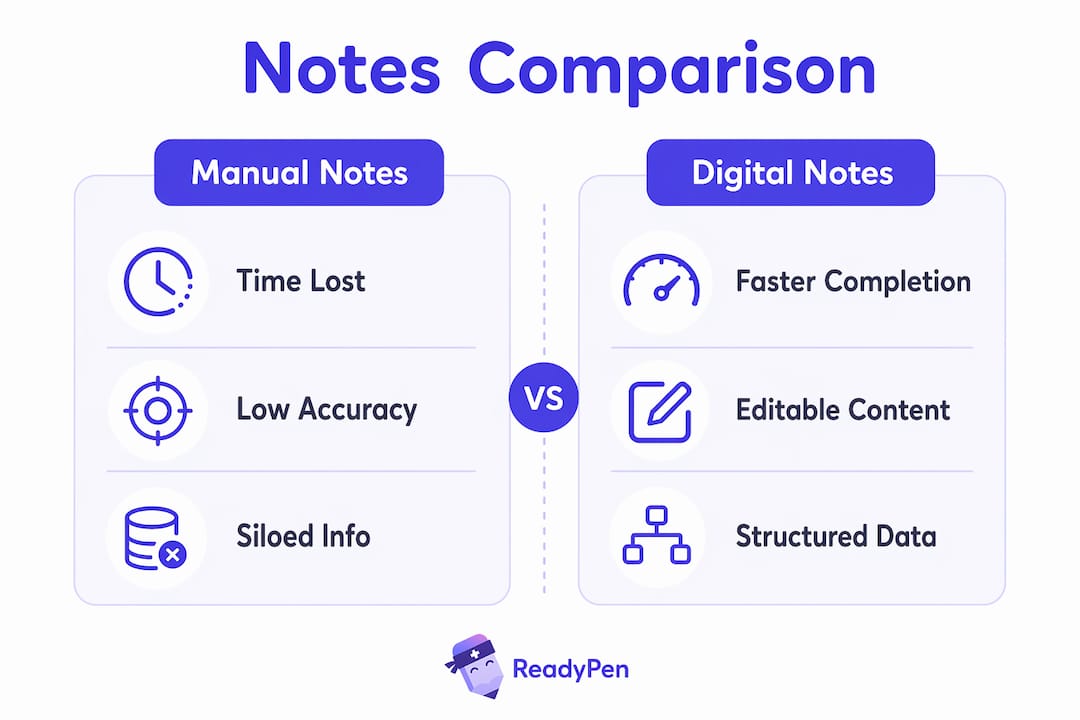
Digital note-taking enables 34% faster task completion compared to handwritten methods, but handwritten notes yield higher comprehension and memory retention. That trade-off matters for teams. Speed of capture is not the same as quality of understanding. The best systems combine structured digital documentation with human judgment about what actually needs to be recorded.
The question of who should take meeting minutes is not trivial. Assigning the right person, with the right template and a clear understanding of the required output, determines whether a meeting produces momentum or just a paper trail.
Key Takeaways
Manual note-taking fails teams because it overloads cognition, silos information, and produces records that cannot drive action without significant additional effort.
| Point | Details |
|---|---|
| Cognitive load is the root cause | The brain cannot listen and transcribe simultaneously, so manual notes are always incomplete. |
| Siloed notes break collaboration | Inaccessible or unstructured notes force repeated meetings and slow decision-making. |
| Digitizing alone is not enough | Raw transcripts create data debt; teams need context-specific artifacts, not just records. |
| Structure and ownership matter | Templates, assigned roles, and verbal recaps dramatically improve note quality and follow-through. |
| Automation needs workflow design | AI tools extend meetings when teams defer decisions; redesigning the workflow is required. |
The uncomfortable truth about meeting notes
I have watched teams invest in every note-taking tool available and still walk out of meetings with no clear record of what was decided. The problem is never the tool. The problem is that teams treat documentation as an afterthought rather than a core part of how a meeting functions.
The most common mistake I see is assigning note-taking to whoever has a laptop open. That person is usually also trying to participate in the conversation, which means they do both jobs poorly. The notes end up as a rough outline of topics discussed, with no decisions, no owners, and no deadlines. Two weeks later, the team is back in the same room having the same conversation.
Automation helps, but only when it is paired with intentional workflow design. I have seen teams adopt AI transcription and end up with longer meetings because members stopped paying attention, knowing the tool would capture everything. That is not progress. That is a different version of the same failure.
The fix is not complicated, but it requires leadership to take it seriously. Assign a dedicated note-taker. Define the output before the meeting starts. End every meeting with a verbal recap that confirms decisions and owners. These are not high-tech solutions. They are discipline. And discipline, applied consistently, produces the kind of team accountability that makes meetings worth having.
— Robbie
How Readypen helps teams move past manual documentation
Church staff and ministry teams run more meetings than most organizations, often without dedicated admin support to document them. Readypen is built specifically for that gap.

Readypen automatically generates meeting notes, summaries, and structured documents from conversations or recordings. It produces the kind of context-specific artifacts that raw transcription misses, including summaries formatted for follow-up and accountability. Teams get searchable, organized records without the hours of manual cleanup. The church meeting minutes guide on the Readypen site walks through exactly how structured documentation changes what teams can accomplish after a meeting ends. If your team is still relying on handwritten notes or unedited transcripts, Readypen is worth a close look.
FAQ
Why does manual note-taking fail in team meetings?
Manual note-taking fails because the human brain cannot listen and transcribe simultaneously without losing detail. The result is incomplete records that miss decisions, context, and action items.
What is the biggest impact of poor notes on team collaboration?
Poor notes create siloed, inaccessible information that forces repeated meetings and slows decision-making. Teams lose time and accountability when documentation does not capture what was actually decided.
Does switching to digital notes fix the problem?
Switching to digital notes alone does not fix the problem. Raw transcripts and unedited digital notes create data debt unless they are structured as task-specific artifacts with clear owners and deadlines.
How much time does manual note-taking actually cost teams?
Manual note capture and organization costs sales representatives over 4 hours per week. That figure reflects the broader administrative burden manual documentation places on any team that relies on it.
What is the most effective way to improve meeting documentation?
Separate the note-taker from the facilitator, use a structured template, and end every meeting with a verbal recap that confirms decisions and owners before the call ends.