Why Admin Tasks Overwhelm Church Staff in 2026

Why Admin Tasks Overwhelm Church Staff in 2026
Administrative overload is the leading reason church staff burn out before their ministry potential is fully realized. The volume and complexity of administrative tasks consume time and energy that pastors and ministry teams need for actual ministry work. Mid-sized churches spend an average of 20 hours per week on administrative tasks that could be automated. That figure equals half a full-time staff position lost every single week to work that never touches a single congregant’s life. Understanding why admin tasks overwhelm church staff is the first step toward fixing the problem permanently.
Why admin tasks overwhelm church staff: the structural causes
The root cause of administrative overload in most churches is structural, not personal. Church staff are not inefficient people. They are working inside systems that were never designed to scale.

Ministry multiplication without subtraction is the most common structural trap. Every new ministry program adds coordination demands: scheduling, communication, volunteer oversight, and reporting. Adding ministries without removing others leads to an unmanageable workload that quietly consumes staff capacity. The math never works in the staff member’s favor.
Responsibility gaps make the problem worse. When a staff member is held accountable for outcomes but lacks the authority to make decisions, every task requires extra steps. Responsibility without corresponding authority causes faster burnout than workload volume alone. A children’s ministry director who must get approval for every supply purchase, schedule change, or volunteer communication will spend more time navigating bureaucracy than doing ministry.
The following structural factors compound the administrative burden on church staff:
- Volunteer-led ministries that still require significant staff coordination for scheduling, training, and follow-up
- Siloed communication channels where information lives in email, text, and verbal conversations rather than one system
- Undefined role boundaries that cause tasks to fall to whoever is most available rather than most responsible
- Lack of documented processes, forcing staff to reinvent workflows for recurring tasks every time
Pro Tip: Audit every recurring task your team handles. If a task has no documented owner and no clear outcome, it is a structural problem, not a workload problem.
How does admin overload affect church staff wellbeing?
Administrative overload does not just slow churches down. It breaks the people running them. Administrative overload contributes to 40% of staff burnout in faith-based organizations. That burnout leads directly to decreased effectiveness and higher turnover, which creates even more administrative work for the staff who remain.
The burden is not distributed evenly. Associate staff carry a disproportionate share of the administrative weight with far less autonomy than senior leaders. Associate staff experience significantly more struggle than senior pastors, with a measurable health gap between the two groups. An associate pastor often functions as a machine operator inside a system they did not design and do not fully understand. That disconnect between effort and meaning accelerates exhaustion.
“Doing more with less” has been normalized since 2020, eroding church staff health and shifting energy from gift expression to energy management. A 7 percentage point decline in staff health over three years reflects a slow, quiet crisis that most senior leaders do not see until a valued team member resigns.
The downstream effects on ministry quality are real and measurable:
- Staff who spend the majority of their time on coordination tasks have less creative and relational energy for congregation care
- Chronic task overload reduces the quality of sermon prep, pastoral counseling, and community outreach
- High turnover from burnout forces churches into repeated hiring and onboarding cycles, which are themselves administrative burdens
- Staff who feel trapped in admin work lose their sense of calling, which is the core motivation that drew them to ministry in the first place
Good church admin time management practices can slow this decline, but they cannot fix a broken structure on their own.
What common inefficiencies increase the administrative workload?
Most churches do not have one big inefficiency. They have dozens of small ones that add up to hundreds of lost hours each year.
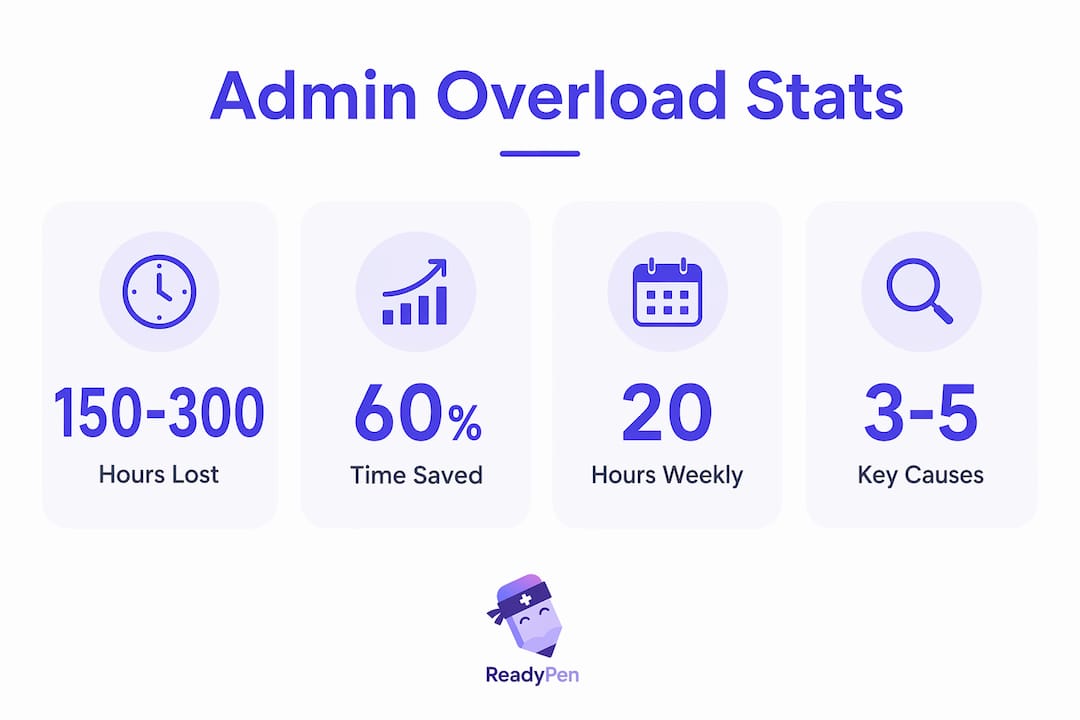
The spreadsheet trap is the most common. Multiple disconnected spreadsheets cause 150–300 hours yearly of avoidable coordination overhead and create compliance risks. That is not a minor inconvenience. It is the equivalent of four to seven full work weeks spent on tasks that a single integrated system could handle automatically. The spreadsheet model also lacks automatic priority surfacing and audit trails, which means critical tasks get missed and no one knows who was responsible.
| Inefficiency | Time Cost | Risk Created |
|---|---|---|
| Disconnected spreadsheets | 150–300 hours per year | Missed tasks, compliance gaps |
| Manual meeting documentation | 2–4 hours per meeting cycle | Incomplete records, miscommunication |
| No integrated operations platform | Ongoing coordination overhead | Information silos, duplicated effort |
| Lack of automated reminders | Variable, often high | Expired certifications, missed deadlines |
Manual meeting documentation deserves specific attention. Most church staff spend significant time writing up notes after every staff meeting, elder board session, and ministry team check-in. That time adds up fast across a full calendar year. Integrated church administrative software cuts manual work by up to 60%, saving 5–10 hours per week in the first month alone. Those hours go directly back to ministry.
Pro Tip: When presenting a case for new tools to church leadership, frame the problem with specific numbers. “We spend X hours per week on Y task” is far more persuasive than a list of software features. Leadership buy-in improves when the pain is defined in concrete, measurable terms.
What practical strategies can churches use to reduce admin overwhelm?
Reducing the administrative burden on church staff requires changes at the system level, not just the individual level. Here are five strategies that produce real results.
-
Audit and remove low-impact ministries. Every ministry program that cannot demonstrate clear fruit and defined ownership is a candidate for consolidation or elimination. Removing one underperforming program often frees more staff capacity than hiring a new part-time employee.
-
Align authority with responsibility. Every staff role should have a clear decision-making boundary. If a staff member is responsible for a ministry area, they need the authority to make day-to-day decisions without approval chains. This single change reduces bottlenecks and restores a sense of ownership that protects against burnout.
-
Implement integrated church management tools. Moving from spreadsheets and disconnected apps to a single platform eliminates the coordination overhead that siloed systems create. Look for tools that handle scheduling, communication, and documentation in one place. Good workflow optimization for church leaders starts with consolidating where information lives.
-
Automate meeting documentation. Meeting notes are one of the highest-volume, lowest-value manual tasks in any church office. AI-powered tools like Readypen generate structured meeting summaries automatically from conversations or recordings, cutting the post-meeting documentation cycle from hours to minutes. Effective meeting workflow automation is one of the fastest ways to recover staff time.
-
Set and protect energy boundaries. Sustainable ministry requires sustainable staff. Leaders should build schedules that protect deep work time for sermon prep, pastoral care, and strategic thinking. Administrative tasks should be batched into defined windows rather than scattered throughout the week.
Key Takeaways
Administrative tasks overwhelm church staff because structural inefficiencies, responsibility gaps, and manual processes consume the time and energy that ministry work requires.
| Point | Details |
|---|---|
| Structural causes dominate | Ministry multiplication without subtraction creates hidden coordination loads that exhaust staff. |
| Burnout is measurable | Administrative overload drives 40% of staff burnout in faith-based organizations, increasing turnover. |
| Spreadsheet sprawl is costly | Disconnected spreadsheets create 150–300 hours of avoidable overhead per year for church offices. |
| Automation recovers real time | Integrated tools cut manual work by up to 60%, returning 5–10 hours per week to ministry. |
| Authority must match responsibility | Giving staff decision-making power equal to their accountability reduces burnout faster than reducing workload. |
The invisible weight nobody talks about
I have sat with enough ministry leaders to know that the admin burden conversation almost never happens until someone quits or breaks down. Senior pastors are often genuinely shocked when they learn how much time their associate staff spend on coordination, documentation, and follow-up tasks that never show up in a job description.
The uncomfortable truth is that most church leaders underestimate the administrative burden on their teams because they are insulated from it. Senior leaders tend to have assistants, more autonomy, and clearer authority. Their associates are often managing the same complexity with none of those buffers.
What I have found actually works is not a new app or a better spreadsheet. It is a leadership posture shift. When a senior pastor starts asking “what is this task costing my team in time and energy?” before adding a new program or process, the culture changes. That question forces the kind of clarity that prevents the slow accumulation of invisible overhead.
The churches that handle administrative burden well are not the ones with the biggest budgets or the most staff. They are the ones where leaders treat staff capacity as a finite, sacred resource. Every hour spent on a task that could be automated or eliminated is an hour not spent on the work that actually builds the church.
— Robbie
How Readypen helps ministry teams reclaim time for ministry
Church staff run a lot of meetings. Staff check-ins, elder board sessions, ministry team huddles, and one-on-ones all generate documentation that someone has to write up afterward.

Readypen is an AI-powered meeting documentation tool built specifically for churches, pastors, and ministry organizations. It automatically generates meeting notes, summaries, and structured documents from conversations or recordings. That means your team stops spending hours on post-meeting write-ups and starts spending that time on the people and work that matter. Ministry leaders can explore AI meeting documentation for churches to see how Readypen handles the documentation cycle from start to finish. For a practical starting point, the ministry leaders page shows exactly how Readypen fits into a church office workflow.
FAQ
Why do admin tasks overwhelm church staff more than other organizations?
Churches typically operate with lean staff teams managing multiple ministry programs simultaneously, without the administrative infrastructure that similarly sized nonprofits maintain. The combination of high task volume, limited authority, and manual processes creates a burden that compounds quickly.
What is the biggest single cause of admin burnout in churches?
Responsibility without authority is the most damaging structural cause. When staff are accountable for outcomes but cannot make decisions independently, every task requires extra steps and approvals that drain time and motivation.
How many hours per week do churches lose to administrative tasks?
Mid-sized churches lose an average of 20 hours per week to administrative tasks that could be automated, the equivalent of half a full-time staff position dedicated entirely to work that does not require human judgment.
Can automation actually reduce church office paperwork significantly?
Integrated church administrative tools cut manual work by up to 60%, saving 5–10 hours per week in the first month. Meeting documentation automation alone recovers several hours per week across a typical church staff team.
How does poor documentation contribute to admin overload?
Without structured meeting records, decisions get revisited, action items get lost, and staff spend time reconstructing what was agreed in previous conversations. Good documentation efficiency practices prevent this cycle and reduce the coordination overhead that siloed information creates.
Recommended
- ReadyPen - AI Meeting Documentation for Churches | Automated Minutes & Summaries
- ReadyPen - AI Meeting Documentation for Churches | Automated Minutes & Summaries
- ReadyPen - AI Meeting Documentation for Churches | Automated Minutes & Summaries
- ReadyPen - AI Meeting Documentation for Churches | Automated Minutes & Summaries