Who Should Take Church Board Minutes? A Practical Role Guide

The best person to take church board minutes is a designated secretary or trained board member who is objective, reliable, and able to focus. The board chair, chief advocate on an issue, or an already-overloaded volunteer generally should not hold the role.
That answer sounds simple until the meeting starts. The chair is trying to guide discussion, the treasurer is presenting a report, and the secretary is absent. Someone reaches for a notebook, and the church ends up relying on whoever happens to be available. That may work for one meeting, but inconsistent minute-taking can lead to missed decisions, unclear assignments, and records that are difficult for future leaders to understand.
Church minutes do not need to be a transcript. They do need to be a faithful, useful record of attendance, decisions, motions, votes, and follow-up. The person responsible should be selected for that purpose—not simply because they have neat handwriting or volunteered first.
Choose someone who can observe before they advocate
A strong minute-taker has three qualities: attention to detail, dependable follow-through, and enough distance from the discussion to record it fairly. A designated secretary is often the natural choice because the role is clear and recurring. A trained elder, deacon, or administrative staff member can also do well when that person has sufficient capacity and understands the church’s governance process.
The minute-taker’s job is to capture what the board officially did. That usually includes who attended, which reports were received, what motions were made, who seconded them, how the board voted, which decisions were reached, and who owns each action item. The record should also note items deferred to a later meeting and the time of adjournment.
Good minutes distinguish discussion from decision. A board may spend twenty minutes considering a proposal and then vote to defer it. The minutes should not make the proposal sound approved merely because it received substantial attention. Likewise, a concise record of an approved motion is usually more useful than several pages of debate.
Pro Tip: Give the minute-taker a copy of the agenda, prior minutes, attendance list, and any expected motions before the meeting begins. Preparation reduces the need to reconstruct basic facts afterward.
Who should not take the minutes?
The board chair or moderator is usually a poor choice for routine minute-taking. The chair needs to manage the agenda, recognize speakers, keep discussion moving, and guide the board toward a clear decision. Dividing attention between those responsibilities and detailed notes makes both jobs harder.
The person making most of the motions is another weak choice. Someone advocating for a proposal is naturally focused on explaining and advancing that proposal, not on recording the full meeting objectively. The same concern applies to anyone with a significant personal stake in a controversial decision. Even when that person acts in good faith, the role creates an avoidable appearance of partiality.
Do not automatically assign the task to the busiest volunteer, either. A person already responsible for children’s ministry, facilities, communications, and finance may agree out of commitment and then miss meetings, submit notes late, or burn out. Reliability matters more than enthusiasm at the moment of assignment.
| Potential minute-taker | Best fit when | Use caution when |
|---|---|---|
| Designated secretary | The role is established, supported, and the person has capacity. | The secretary is overloaded or expected to lead the meeting too. |
| Board member | The member is objective, trained, and able to attend consistently. | The member is leading a disputed proposal or frequently absent. |
| Administrative staff member | Documentation is part of the person’s duties and workload allows it. | Technology, scheduling, or other duties compete for attention. |
| Board chair | Only as a short-term backup with another person reviewing the record. | The meeting involves complex discussion or many motions. |
| Overcommitted volunteer | Rarely; only if the assignment is temporary and expectations are clear. | The person already carries several ministry responsibilities. |
Use AI as a support, not as the accountable recorder
AI-assisted note-taking can reduce the pressure on the human minute-taker by capturing a searchable record of what was said. That gives the reviewer more time to identify the official decisions, action items, and vote outcomes instead of trying to write down every sentence during a fast-moving conversation.
ReadyPen is built for churches and can assist with meeting documentation, but the important principle is broader than any one tool: AI should support the minute-taker, not replace human judgment. Transcription can help recover a name, date, or phrase, yet it cannot independently decide whether a discussion resulted in a motion, whether a proposal was deferred, or how the final minutes should reflect the board’s intent.
A practical arrangement is to have one designated human reviewer remain accountable for the final document. That person checks attendance, motions, vote results, names, action owners, and sensitive wording before the minutes are approved or stored.
Pro Tip: Treat an AI transcript as working material, not as official minutes. The approved record should summarize decisions and responsibilities rather than reproduce every comment.
Build a simple handoff process around the role
Even the right person will struggle if the church has no process. Before each meeting, provide the agenda and any reports or proposed motions. During the meeting, make it easy for the minute-taker to ask for a motion to be repeated or a vote result to be clarified. Afterward, set a consistent deadline for a first draft while the details are still fresh.
The chair and minute-taker should also agree on a signal for moments that require special attention. A motion, amendment, decision to defer, or assignment with a deadline deserves a clear verbal statement. If the meeting moves too quickly, the chair can pause and restate the outcome for the record.
Training does not need to be elaborate. The person should understand the church’s bylaws or governance documents, the basics of parliamentary procedure used by the church, and the difference between discussion and action. Reviewing two or three past sets of approved minutes can clarify the expected level of detail.
The following workflow keeps the responsibility clear:
- Assign one primary minute-taker and one backup.
- Share the agenda, attendance information, and expected motions in advance.
- Record decisions, motions, votes, assignments, deadlines, and deferred items during the meeting.
- Review names, numbers, and outcomes against the agenda or supporting documents.
- Send the draft for the church’s normal review and approval process.
- Store the approved minutes where authorized leaders can find them.
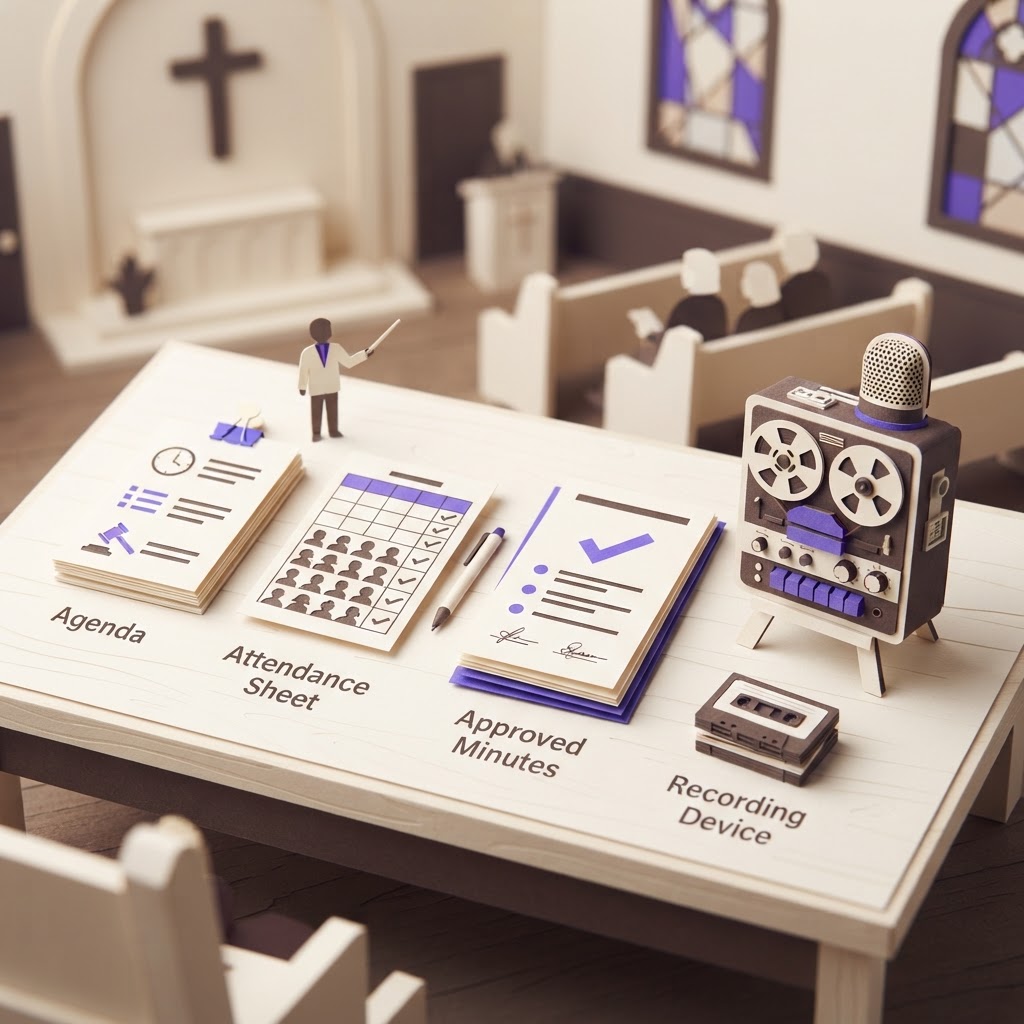
Match the role to the meeting’s demands
There is no single staffing model that fits every church. A small congregation may rotate the responsibility among trained board members. A larger church may assign it to a secretary or administrator. A church with frequent online or hybrid meetings may benefit from a transcription aid because technology management and note-taking compete for attention.
The key is to separate functions. The person operating microphones, cameras, or an online meeting platform should not also be expected to capture detailed minutes unless the setup is genuinely simple. Similarly, a person who must participate heavily in the discussion may need a separate recorder or a reliable review process.
The percentages below are illustrative rather than survey findings. They show how a church might divide responsibility when reviewing its current process, not a benchmark that every congregation should meet.
Illustrative ways churches may assign minute-taking
Illustrative data based on common assignment options; actual church practices vary.
Review the church’s bylaws or governance documents before changing the assignment. They may identify the officer responsible for recording and maintaining official minutes. Following that authority prevents confusion and makes the process easier to explain when leadership changes.
Key Takeaways
| Point | Details |
|---|---|
| Best overall choice | A designated secretary or trained board member who is objective, reliable, and able to focus on the record. |
| Roles to avoid | The chair, primary advocate for a motion, person with a strong personal stake, or volunteer already carrying too many duties. |
| What minutes should capture | Attendance, reports, motions, seconds, vote outcomes, decisions, assignments, deadlines, deferred items, and adjournment. |
| How AI fits | AI can assist with transcription and retrieval, but a human reviewer should confirm context and approve the final minutes. |
| How to improve consistency | Assign a primary and backup, share materials early, train the recorder, and use a clear review and storage process. |
Conclusion: Give the record a real owner
The right minute-taker is not simply the person who happens to be free. It is someone trusted to observe carefully, record decisions fairly, and follow through after the meeting. When the role is separated from chairing, advocating, and technology management, church minutes become more accurate and more useful. With a human owner and the right supporting process, AI can automate much of the meeting-notes work; churches can try ReadyPen free to see how it fits their documentation workflow.