What Is Ministry Team Alignment? A Church Leader's Guide

What Is Ministry Team Alignment? A Church Leader’s Guide
Ministry team alignment is the ongoing practice of ensuring church staff and volunteers operate with a shared vision, clear roles, and coordinated efforts to fulfill the mission. Most church leaders treat alignment as a one-time event, like a retreat or a planning session. That misunderstanding is exactly why so many ministry teams drift apart. True alignment is a leadership rhythm that addresses three recurring problems: unclear direction, broken trust, and confused ownership. When all three are working, your team moves faster, communicates better, and serves with greater unity.
What is ministry team alignment, and why does it matter?
Ministry team alignment is defined as the sustained process of keeping church staff and volunteers oriented around the same mission, methods, and priorities. The industry term for this in organizational leadership is organizational alignment, but in ministry contexts it carries a deeper dimension: the work is not just operational, it is vocational. That distinction matters because misalignment in a church does not just hurt productivity. It erodes trust and can fracture relationships that took years to build.
Alignment addresses three core challenges that every ministry team faces at some point. First, unclear direction leaves staff guessing about what matters most this season. Second, broken trust causes people to hold back their real concerns in meetings. Third, confused ownership means two people think they are responsible for the same thing, or no one thinks they are responsible at all.

The benefits of team alignment include faster decision-making, stronger trust, sharper focus, and less miscommunication. Those outcomes are not abstract. They show up in practical ways: fewer redundant emails, clearer Sunday morning handoffs, and staff who feel confident making decisions without checking with the senior pastor on every detail.
What are the key components and rhythms of ministry team alignment?
Alignment is built on five foundations. Shared mission understanding, clear roles, visible priorities, a consistent communication rhythm, and psychological safety form the structural core of any aligned team. Remove one, and the others start to wobble.
The practical structure looks like this:
- Shared vision: Every team member can articulate the church’s mission in their own words, not just recite a tagline.
- Clear roles: Each person knows what they own, what they support, and where their authority ends.
- Visible priorities: The team’s top three to five initiatives are written down and reviewed regularly.
- Communication rhythm: Meetings happen on a predictable schedule with a defined purpose.
- Psychological safety: Staff can raise concerns before decisions are finalized, not after.
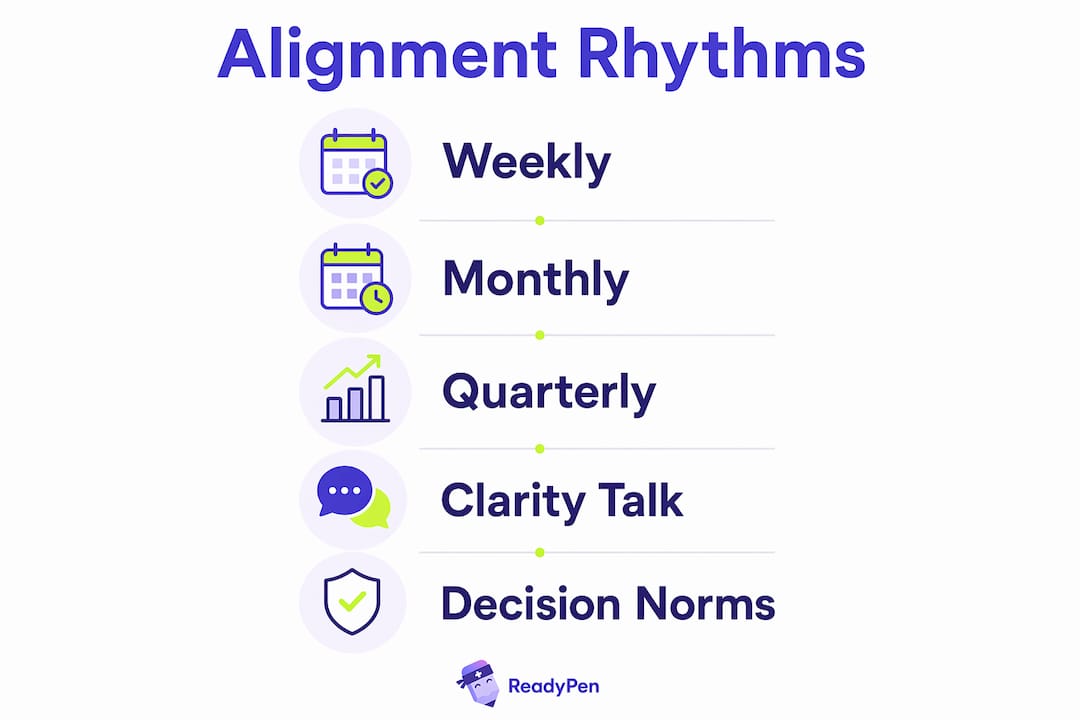
The recommended meeting cadence for ministry teams includes weekly 20-minute priority reviews, monthly one-on-ones between leaders and direct reports, and quarterly vision sessions to recalibrate strategy. Each meeting type serves a different function. Weekly meetings keep the team on the same page day to day. Monthly one-on-ones surface individual concerns before they become team problems. Quarterly sessions give everyone a chance to zoom out and ask whether the strategy still fits the mission.
One underused tool in this rhythm is the “clarity conversation.” This is a structured dialogue where a leader and a staff member map out three zones: the sweet spot (work the person loves and does well), the stretch zone (work that grows them), and the stress zone (work that drains them and falls outside their strengths). Mapping these zones reduces role overlap and gives leaders a concrete way to reassign responsibilities before resentment builds.
Pro Tip: Never add a meeting to your calendar without a defined purpose and a clear owner. A meeting without both is just a scheduled interruption.
How do common misalignments show up and what causes them?
Misalignment rarely announces itself. It shows up quietly, through symptoms that leaders often misread as personality conflicts or attitude problems.
| Symptom | Root cause |
|---|---|
| Staff withdraw from team discussions | Unclear direction: people disengage when they do not know what matters |
| Guarded agreement in meetings | Broken trust: staff withhold real concerns to avoid conflict |
| Redundant efforts across departments | Confused ownership: no one knows who has final authority |
| Frequent escalation to senior leadership | Unclear decision-making norms: the team lacks a shared playbook |
| Low follow-through on initiatives | Confused ownership: accountability is diffuse or absent |
Misalignment is primarily a structural issue, not a character flaw. That distinction is the most important thing a church leader can internalize. When a staff member goes quiet in meetings, the instinct is to wonder whether they are disengaged or difficult. The real question is whether they have enough clarity about the direction to feel confident speaking up.
Trust problems manifest as guarded agreement, where staff nod along in meetings but voice their real concerns in the parking lot afterward. This pattern is corrosive because leadership gets false signals. The room looks aligned. The team is not.
Ownership confusion is the third root cause, and it is the most operationally damaging. Clear ownership means one person holds authority, responsibility, support, and a review rhythm for each priority. When that structure is missing, flexibility becomes chaos. Two people step on each other’s work, or a critical initiative stalls because everyone assumed someone else was driving it.
Pro Tip: Diagnose the primary problem before prescribing a solution. Clarity problems need clearer communication. Trust problems need safer spaces for honest feedback. Ownership problems need explicit accountability structures. Treating the wrong root cause wastes everyone’s time.
What practical frameworks drive effective ministry team alignment?
The most direct tool for building alignment is a set of five clarity questions. These questions shift staff from thinking about their title to thinking about their contribution to the team’s shared work. Use them in one-on-ones, team meetings, or quarterly planning sessions.
- What is our mission? Can every team member state it in one sentence without looking at a document?
- What is our method? How does this team specifically pursue the mission? What makes your approach distinct?
- What moves us forward? What are the two or three priorities that, if accomplished, would represent real progress this quarter?
- How do we measure success? What does a win look like, and who decides?
- Where are we headed next? What does the team need to be doing six months from now that it is not doing today?
These questions work because they are concrete. They replace vague conversations about culture and values with specific, answerable prompts that surface gaps in understanding quickly.
Beyond the five questions, One-Page Plans are one of the most effective visual tools for keeping a team aligned between meetings. A One-Page Plan lists the team’s mission, its top priorities for the quarter, the owner of each priority, and the success metric. Every team member has a copy. Every meeting references it. The plan makes alignment visible, which makes accountability natural rather than awkward.
Decision-making norms also need to be explicit. Who has final say on budget decisions under a certain threshold? Who can approve a schedule change without escalating? When these norms are written down and shared, the team operates with confidence. When they are unspoken, every decision becomes a negotiation.
How can church leaders sustain alignment through change and challenge?
Alignment is not a destination. It is a practice, and like any practice, it degrades without repetition.
The leaders who sustain alignment over time treat their meeting rhythms the same way they treat Sunday morning preparation: non-negotiable, consistent, and always tied to a clear purpose. Weekly priority reviews keep the team oriented. Monthly one-on-ones catch drift before it becomes division. Quarterly check-ins give the team permission to recalibrate without feeling like they failed. Annual planning sessions rebuild the shared map from the ground up.
Alignment reduces the need for side-channel communication. When the team has a consistent rhythm and clear decision norms, staff stop sending the “quick question” texts and the “just checking” emails that fragment everyone’s attention. The meeting does the work the hallway conversation used to do, but with documentation and shared accountability.
One of the most common mistakes church leaders make is confusing alignment with uniformity. Alignment does not mean everyone agrees on every decision. It means the team shares a direction and has a clear process for handling disagreement.
“Alignment requires unity of purpose, not uniformity of opinion. Teams can move forward despite differences when the process for handling disagreement is clear and trusted by everyone involved.”
Alignment means unity of purpose, not uniformity of thought. A worship pastor and a children’s director can disagree on budget priorities and still be deeply aligned around the mission. The disagreement is healthy. The process for resolving it is what alignment provides.
The ministry team accountability practices that sustain alignment long-term are simple: document decisions, assign owners, review progress on a schedule, and create space for honest feedback before problems calcify into resentment.
Key Takeaways
Ministry team alignment is a permanent leadership rhythm, not a one-time event, and it requires diagnosing the correct root cause before any solution will stick.
| Point | Details |
|---|---|
| Alignment is a rhythm | Weekly, monthly, and quarterly meetings sustain alignment far better than annual retreats alone. |
| Three root causes | Unclear direction, broken trust, and confused ownership each require a different response. |
| Clarity questions work | Five structured questions shift staff from role-thinking to mission-thinking quickly. |
| Ownership must be explicit | One person needs authority, responsibility, and a review rhythm for each priority. |
| Unity, not uniformity | Aligned teams disagree well because they have clear processes for resolving conflict. |
What I have learned about alignment the hard way
Church leaders are some of the most mission-driven people I have ever worked with. That passion is also the thing that makes alignment so hard. When everyone cares deeply about the work, disagreements feel personal. A budget conversation becomes a values conflict. A scheduling change feels like a statement about priorities.
The most common mistake I see is leaders treating a structural problem as a character problem. A staff member who seems disengaged is not necessarily difficult. They may simply not know what winning looks like for their role this quarter. That is a clarity problem, and it has a clear fix.
The second mistake is waiting for the right moment to have the alignment conversation. There is no right moment. Alignment conversations are uncomfortable by design because they surface the gaps that everyone has been politely ignoring. The discomfort is the point. Lean into it early, before the gaps become grievances.
The leaders I have seen build genuinely aligned teams share one habit: they are relentlessly specific. They do not say “let’s communicate better.” They say “every Monday at 9:00 AM, we review our top three priorities for the week, and each person names one thing that could block their progress.” That specificity is what turns good intentions into durable rhythms.
If you are a church leader reading this and your team feels scattered, start with clarity. Write down your top three priorities for this quarter. Share them with your team. Ask each person to do the same. The gaps between those lists are your alignment agenda.
— Robbie
How Readypen supports your alignment rhythms
Alignment rhythms only work when decisions and commitments are documented. A great one-on-one conversation means nothing if the action items disappear by Thursday.
Readypen is an AI-powered meeting documentation tool built specifically for churches, pastors, and ministry organizations. It automatically generates meeting notes and summaries from your conversations and recordings, so your weekly priority reviews, monthly one-on-ones, and quarterly strategy sessions all produce a clear written record without anyone scrambling to take notes. Your team stays accountable to what was actually decided, not what each person remembers. Readypen also gives church leaders visibility into meeting participation patterns, so you can see where alignment is holding and where it needs attention. Less time on documentation means more time on the work that moves your mission forward.
FAQ
What is ministry team alignment?
Ministry team alignment is the ongoing process of keeping church staff and volunteers oriented around a shared mission, clear roles, and coordinated priorities. It addresses three root problems: unclear direction, broken trust, and confused ownership.
How often should a ministry team meet to stay aligned?
The recommended cadence includes weekly 20-minute priority reviews, monthly one-on-ones, and quarterly vision sessions. Each meeting type serves a distinct purpose and together they sustain alignment between major planning events.
What is the difference between alignment and uniformity?
Alignment means unity of purpose, not agreement on every decision. An aligned team has a clear process for handling disagreement, so differences of opinion do not stall progress or damage relationships.
How do I know if my ministry team is misaligned?
Common signs include staff withdrawing from discussions, guarded agreement in meetings, redundant efforts across departments, and frequent escalation of decisions to senior leadership. These symptoms usually point to a structural problem, not a character flaw.
What tools help church leaders build team alignment?
One-Page Plans, clarity conversations, and five structured clarity questions are proven frameworks for building alignment. Consistent meeting documentation reinforces accountability and keeps decisions visible between meetings.