What Is a Pastoral Team Meeting? A 2026 Guide

What Is a Pastoral Team Meeting? A 2026 Guide
A pastoral team meeting is a structured, recurring gathering where church leaders collaborate to oversee spiritual care, align on ministry vision, and make shared decisions rather than operate as individual pastors working in isolation. Most churches formalize this meeting format once they exceed roughly 600 attendees or eight staff members, at which point informal coordination breaks down and a dedicated leadership structure becomes necessary. The standard industry term for this gathering is a “senior leadership team meeting,” though “pastoral team meeting” describes the same function in ministry contexts. Getting this meeting right is the single most important operational habit a growing church can build.
What is a pastoral team meeting and who should attend?
A pastoral team meeting is defined as a collaborative gathering of spiritual leaders focused on shared shepherding, doctrine protection, and vision setting for the church. The key word is “collaborative.” This is not a briefing where the lead pastor reports to staff. Every person in the room carries ownership of the ministry’s direction.

Attendee selection is where most churches make their first mistake. Churches beyond 600–800 attendees should limit the room to ministry leaders only, excluding support staff who handle task execution. Support staff are valuable, but including them in leadership meetings blurs the line between strategic decision-making and operational reporting. The meeting loses its focus fast.
The core attendees for most growing churches include:
- Lead pastor — sets spiritual tone and final direction
- Elders or associate pastors — provide doctrinal accountability and shared shepherding
- Ministry directors — represent specific areas such as worship, youth, and outreach
- Executive or operations pastor — connects vision to execution
Pro Tip: If someone in the room cannot make or influence a ministry-level decision, they probably belong in a different meeting. Protect the room.
The role of a pastoral team is not just administrative. Structured pastoral team meetings reduce burnout risks and mission drift by fostering shared ownership and vision alignment. When the lead pastor carries the full weight of shepherding alone, burnout follows. The meeting is the mechanism that distributes that weight.
How should pastoral team meetings be structured and scheduled?
Meeting structure determines whether your team leaves energized or exhausted. The most effective church leadership teams use three distinct meeting types, each with a specific length and purpose.
- Daily check-ins (5–10 minutes) — brief touchpoints for urgent coordination, not discussion
- Weekly tactical meetings (45–90 minutes) — the core pastoral team meeting format, focused on near-term decisions and shared accountability
- Quarterly off-sites (half-day or full day) — culture, strategy, and long-range vision
Effective church leadership meetings differ in length and type precisely because each serves a different cognitive purpose. Mixing strategic planning into a weekly tactical meeting produces neither good tactics nor good strategy.
The weekly pastoral team meeting works best with a fixed agenda structure. A reliable format looks like this:
| Segment | Time | Purpose |
|---|---|---|
| Prayer and spiritual grounding | 10 minutes | Set tone and shared focus |
| Ministry updates (brief) | 10 minutes | Surface urgent issues only |
| Strategic discussion | 45 minutes | Future-focused decisions |
| Action item review | 10 minutes | Confirm owners and deadlines |
| Close and prayer | 5 minutes | Unified send-off |
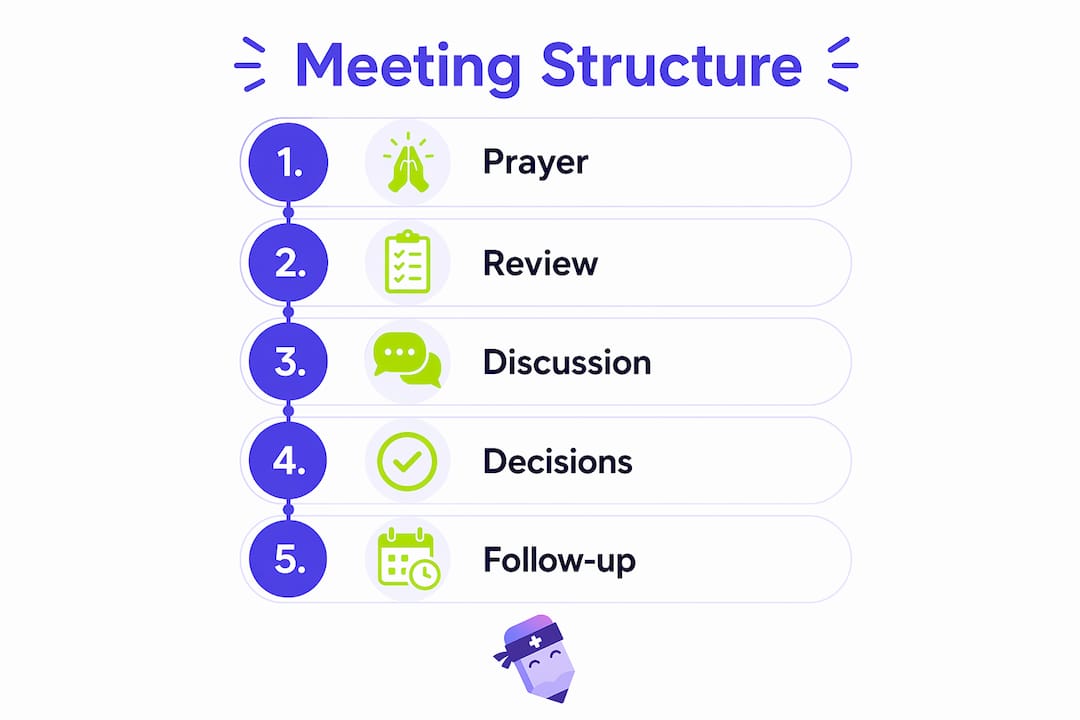
The most important rule in this structure: distribute reports before the meeting so no one reads data aloud in the room. When leaders review reports in advance, the meeting time goes entirely to discussion and decisions. That shift alone recovers 20–30 minutes per session.
Pro Tip: Send a one-page pre-meeting summary to all attendees 24 hours before. Include key metrics, prayer requests, and the discussion agenda. The meeting starts sharper when everyone arrives prepared.
What topics should pastoral team meetings prioritize?
The most common failure in leadership meetings is spending too much time on tactical status updates. About 80% of meeting time should be future-focused, covering strategic direction rather than what already happened last week. That ratio feels uncomfortable at first, especially for teams used to reporting-heavy meetings. But the discomfort is the point.
Topics that belong in a pastoral team meeting include:
- Vision alignment — Are all ministry areas moving toward the same stated direction?
- Staffing and leadership development — Who is being developed for future roles?
- Ministry health and gaps — Where are people falling through the cracks?
- Doctrinal and cultural concerns — What issues require shared elder discernment?
- Upcoming decisions — What choices need team input before the lead pastor acts?
Topics that do not belong in the meeting include detailed event logistics, budget line-item reviews, and individual staff performance issues. Those conversations belong in one-on-one meetings or departmental sessions.
Leadership silos emerge when teams neglect future-focused discussion. When each ministry director only hears about their own area, they stop thinking about the church as a whole. The pastoral team meeting is the one place where everyone sees the full picture together.
Pastoral care discussions require special handling. When a congregant’s situation comes up, the team needs enough information to pray and support well, but not so much detail that confidentiality breaks down. Meeting notes for pastoral care topics should capture care plans while respecting confidentiality. A practical rule: document the decision and the assigned owner, not the personal details that led to it.
How should pastoral team meetings be documented and followed up?
Documentation is where good meetings either hold their value or lose it. A meeting without a clear summary is a conversation. A meeting with a clear summary is a decision.
The purpose of a pastoral care meeting summary is not to record everything said. Effective meeting summaries capture key decisions, action items, owners, and deadlines in a concise and timely format. Four to six bullet points often do more work than two pages of minutes.
Best practices for pastoral team meeting documentation:
- Assign one note-taker per meeting — rotating this role prevents burnout and builds shared ownership of the record
- Distribute the summary within 24 hours — decisions fade fast; a same-day or next-morning summary keeps momentum
- Format action items clearly — each item needs a named owner and a specific deadline, not a vague “follow up soon”
- Cascade decisions to wider staff — the team decides, then communicates; staff should hear outcomes before they hear rumors
Meeting documentation best practices for ministry leaders consistently point to simplicity as the goal. A summary that takes 30 minutes to write and 5 minutes to read serves the team far better than a transcript that no one opens.
Pro Tip: Use a consistent summary template for every meeting. When the format never changes, leaders stop spending mental energy on structure and start focusing on content. Readypen offers ready-made meeting templates built specifically for church leadership teams.
Technology now makes documentation faster and more accurate. AI-powered tools can generate structured summaries from recordings or notes, cutting the documentation burden from hours to minutes. That time savings matters most for small ministry teams without dedicated admin support.
Key Takeaways
A pastoral team meeting is the primary mechanism through which a growing church distributes leadership, aligns vision, and prevents the burnout that comes from one pastor carrying everything alone.
| Point | Details |
|---|---|
| Define attendance carefully | Limit the room to ministry leaders once the church exceeds 600 attendees or 8 staff. |
| Use three meeting types | Combine weekly tactical meetings, daily check-ins, and quarterly strategy sessions for full coverage. |
| Protect future-focused time | Reserve roughly 80% of meeting time for strategic discussion, not status updates. |
| Document every decision | Distribute a concise summary with named owners and deadlines within 24 hours of each meeting. |
| Treat the meeting as a spiritual practice | Shared prayer, mutual accountability, and vision alignment reduce burnout and mission drift. |
Why most pastoral teams are still running the wrong meeting
I’ve watched church after church run what they call a “leadership meeting” that is actually a reporting session with prayer bookends. The lead pastor talks. The ministry directors listen. Everyone leaves having exchanged information but made no real decisions together. That is not a pastoral team meeting. That is a briefing.
The shift that changes everything is treating the meeting as the place where the team thinks together, not where individuals report to each other. That requires a different kind of preparation, a different agenda, and honestly, a different kind of trust. Leaders have to be willing to bring unresolved problems into the room instead of only showing up with polished updates.
The churches I’ve seen grow well past the 600-attendee threshold share one habit: they protect their leadership meeting like it is the most important hour of the week. Because it is. When that meeting is healthy, the whole organization moves with clarity. When it breaks down, ministry silos form within months. The meeting is not a symptom of church health. It is a cause of it.
— Robbie
How Readypen supports pastoral team documentation
Church leaders run a lot of meetings. Most don’t have a dedicated admin to document every decision, action item, and care plan that comes out of them.

Readypen is built for exactly that gap. It uses AI to generate structured meeting notes, summaries, and follow-up documents from conversations or recordings, so your team captures what matters without anyone spending an hour writing it up afterward. Ministry leaders can review a clean meeting summary within minutes of wrapping up, with action items already formatted and ready to share. For pastoral teams that meet weekly and need consistent, accurate records, Readypen removes the documentation burden entirely. See how it works for ministry leaders at Readypen.io.
FAQ
What is a pastoral team meeting?
A pastoral team meeting is a structured gathering of church ministry leaders focused on shared shepherding, vision alignment, and strategic decisions. It differs from a staff meeting in that it centers on leadership-level collaboration rather than operational reporting.
Who should attend a pastoral team meeting?
Ministry leaders, elders, and the lead pastor should attend. Churches beyond 600–800 attendees benefit from excluding support staff to keep decision-making focused and efficient.
How long should a pastoral team meeting last?
Weekly tactical pastoral team meetings run best at 45–90 minutes. Longer strategic sessions work better as quarterly off-sites rather than extended weekly meetings.
What is a pastoral care meeting summary?
A pastoral care meeting summary is a concise document capturing key decisions, assigned action items, owners, and deadlines from a pastoral team meeting. It prioritizes clarity and confidentiality over exhaustive detail.
How often should a pastoral team meet?
Most effective pastoral teams meet weekly for tactical coordination and quarterly for strategic planning. Daily 5–10 minute check-ins supplement the weekly meeting for urgent coordination needs.