Pastoral Time Management for Pastors: 2026 Guide

Pastoral Time Management for Pastors: 2026 Guide
Pastoral time management is the intentional stewardship of a pastor’s time to balance ministry responsibilities, personal spiritual disciplines, and family life. The industry term for this practice is “ministerial time stewardship,” though pastors and church leaders widely use the phrase “pastoral time management” to describe the same discipline. The 2025 Global Adventist Pastors’ Survey identifies poor time management as a primary contributor to stress, overwhelm, and premature ministry departure. Pastors who treat their schedule as a spiritual act, not just a productivity exercise, build ministries that last. This guide gives you proven frameworks, practical techniques, and honest perspective to manage your time without burning out.
What is pastoral time management, and why does it matter?
Pastoral time management is defined as the deliberate allocation of a pastor’s finite weekly hours to ministry work, spiritual disciplines, family, and rest, in proportion to calling and capacity. The word “stewardship” is key here. You are not managing a corporate calendar. You are managing a sacred trust.
The 2025 Global Adventist Pastors’ Survey confirms that poor time management ranks among the top drivers of pastoral burnout and vocational exit. That finding matters because it means burnout is not simply a spiritual failure. It is often a structural one, rooted in how a pastor organizes each week.

Time management in ministry is increasingly viewed as spiritual stewardship, aligning activities with God’s calling rather than chasing raw productivity. A pastor who neglects sermon prep to answer every administrative email is not being more faithful. That pastor is misallocating a finite resource. The goal of pastoral time management is not to do more. It is to do the right things, at the right time, with enough energy left to do them well.
What challenges do pastors face in managing their time effectively?
The pastoral role is one of the most structurally complex jobs in any community. A pastor serves simultaneously as preacher, counselor, administrator, community leader, and family member. Each role makes legitimate demands, and none of them come with a defined clock-out time.
“The pastor who tries to be available to everyone, at all times, for all things, will eventually be available to no one, including themselves. Boundaries are not a failure of compassion. They are the condition for it.”
The survey data shows that overcommitment and poor time boundaries are the most common patterns leading to pastoral stress. Pastors frequently underestimate how long tasks take, particularly sermon preparation, which can consume 10–20 hours per week for a single message.
Common time management challenges pastors face include:
- Unpredictable interruptions. A hospital visit, a family crisis in the congregation, or an unexpected conflict can erase an entire morning’s plan.
- Blurred role boundaries. Without clear limits, administrative tasks crowd out mission-critical work like discipleship and prayer.
- Guilt around rest. Many pastors feel that taking time off signals a lack of dedication, which leads to chronic fatigue.
- Lack of delegation. Doing everything personally feels faithful but actually limits the church’s capacity to grow.
- No formal training. Seminary prepares pastors theologically. It rarely teaches them how to build a weekly schedule.
The impact of these challenges reaches beyond the pastor. Strained family relationships, reduced sermon quality, and diminished pastoral presence in the congregation are all downstream effects of poor time stewardship. Recognizing the structural nature of these challenges is the first step toward addressing them.
Which time management techniques work best for pastors?
The most effective pastoral time management techniques share one feature: they build flexibility into the structure rather than treating every hour as a fixed appointment.
The 21-pod system
Ministry experts recommend structuring the week into 21 time blocks of roughly four hours each, covering mornings, afternoons, and evenings across seven days. This framework, known as the 21-pod system, allocates 12–15 pods to ministry work and 6–8 pods to family, personal life, and rest. The math adds up to roughly 50–60 hours of intentional weekly activity, which reflects the real demands of pastoral work without pretending those demands are a standard 40-hour week.
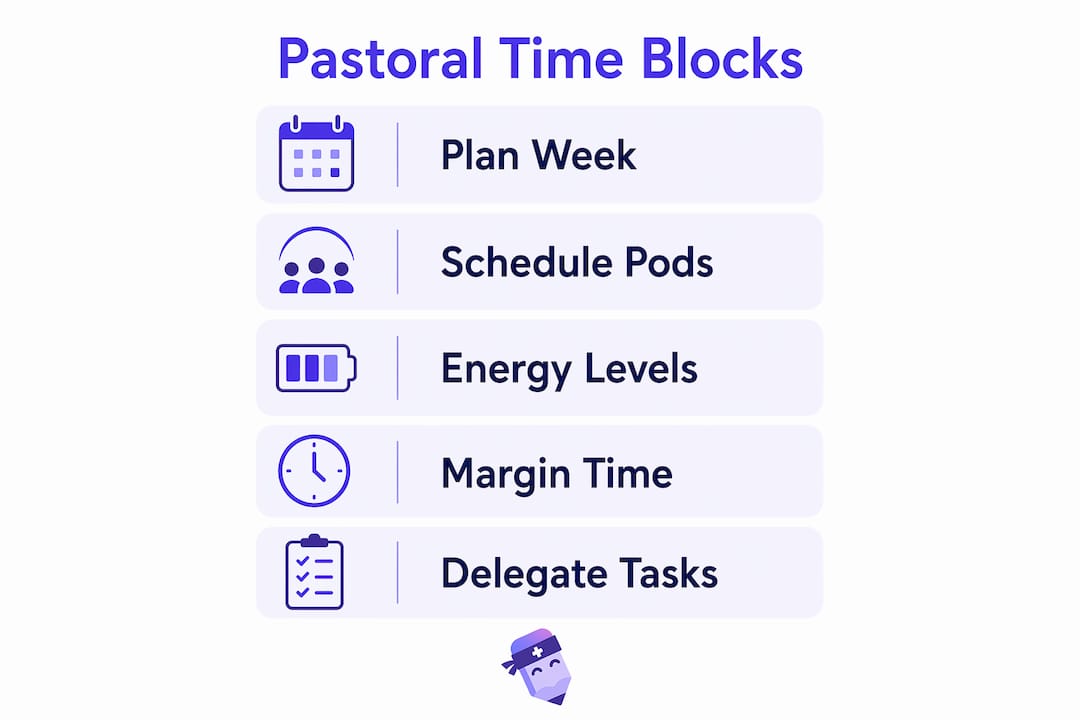
The 21-pod system works because it treats rest and family time as scheduled commitments, not leftovers. Sabbath as a fixed calendar block guards against ministry fatigue in a role that has no natural stopping point. When rest is scheduled, it actually happens.
Scheduling by energy level
Matching tasks to energy levels produces more efficient, higher-impact ministry outcomes. Pastors who identify their “Green Zone,” the hours when their mental focus is sharpest, and reserve those hours for sermon preparation and deep study, consistently report better output with less effort. Administrative tasks, phone calls, and routine meetings belong in lower-energy windows.
Building margin into every week
Leaders should reserve 15–20% of their weekly schedule as margin for unpredictable pastoral care, emergencies, and crisis response. For a pastor working 50 hours per week, that means keeping 8–10 hours unscheduled. Margin is not wasted time. It is the buffer that allows compassionate, available ministry without exhaustion.
| Technique | Best used for | Key benefit |
|---|---|---|
| 21-pod system | Full weekly planning | Balances ministry, family, and rest structurally |
| Green Zone scheduling | Sermon prep and deep work | Matches demanding tasks to peak mental energy |
| Margin building (15–20%) | Pastoral care and crises | Absorbs interruptions without derailing the week |
| Time-blocking at 50% capacity | Daily task management | Keeps schedule flexible and resilient |
Pro Tip: Block your Green Zone hours first, before any meeting requests arrive. Protect those blocks the same way you would protect a hospital visit.
How can pastors overcome common pitfalls and prevent burnout?
Burnout in ministry is rarely sudden. It accumulates through months of over-scheduling, under-resting, and refusing to delegate. The good news is that each of these patterns is reversible with deliberate structural changes.
Delegation is a core leadership responsibility that equips others and expands the pastor’s capacity. Releasing certain tasks is not laziness. It is the act of developing other leaders and freeing yourself for work only you can do. A pastor who handles every administrative detail personally is not serving the church well. That pastor is preventing others from growing into their gifts.
Practical steps to avoid the most common pitfalls:
- Set a meeting budget. Decide in advance how many hours per week you will spend in meetings, then protect the rest.
- Delegate administrative tasks. Identify three recurring tasks you could hand to a volunteer or staff member this week.
- Schedule Sabbath first. Put your day of rest on the calendar before anything else. Treat it as non-negotiable.
- Use block scheduling at 50% capacity. Blocking only about half of daily hours creates flexible schedules resilient to ministry unpredictability.
- Review your week every Friday. A 15-minute weekly review catches overcommitment before it becomes a crisis.
Pro Tip: When someone asks for a meeting, ask yourself: “Is this a conversation only I can have?” If not, delegate it. Your calendar reflects your theology of leadership.
Protecting spiritual disciplines, including prayer, Scripture reading, and Sabbath rest, fortifies leadership effectiveness far beyond conventional time management tactics. These are not items to fit in around ministry. They are the foundation that makes ministry sustainable.
What practical steps build a weekly pastoral schedule?
A weekly schedule functions like a time budget for pastors, helping you consciously allocate your 168 weekly hours. Acknowledging that limit forces honest trade-offs and surfaces misaligned habits before they become entrenched.
Follow these steps to build a schedule that actually holds:
- Audit your current week. Track every hour for one week. Most pastors discover that administrative tasks consume far more time than they realize.
- Identify your Green Zone. Note the two or three hours each day when your focus is sharpest. Reserve those for sermon prep and strategic thinking.
- Assign pods to priorities. Using the 21-pod framework, allocate blocks to ministry, family, rest, and personal spiritual disciplines before filling in anything else.
- Reserve margin. Block 15–20% of your weekly hours as open time. Label it “pastoral margin” so others understand it is not free time for meetings.
- Schedule Sabbath as a fixed block. Put it on the calendar at the start of every month. Do not move it.
- Review and adjust weekly. Spend 15 minutes each Friday assessing what worked, what got displaced, and what needs to shift next week.
Tracking time also reveals patterns that undermine good intentions. Many pastors find that workflow optimization practices like batching similar tasks together, such as all phone calls in one block and all administrative work in another, recover several hours per week without adding any new systems.
| Weekly schedule element | Recommended allocation | Purpose |
|---|---|---|
| Ministry work (pods) | 12–15 pods (48–60 hrs) | Covers preaching, counseling, leadership |
| Family and personal life | 6–8 pods (24–32 hrs) | Protects relationships and personal health |
| Sabbath rest | 1 full day (fixed block) | Prevents burnout, honors spiritual discipline |
| Margin (unscheduled) | 15–20% of total hours | Absorbs crises and pastoral care needs |
Meeting workflow practices also deserve a dedicated block. Pastors who batch meetings into two or three days per week, rather than scattering them across every day, report significantly more uninterrupted time for deep work and study.
Key Takeaways
Pastoral time management succeeds when pastors treat their schedule as a spiritual discipline, build margin for the unexpected, and delegate consistently to protect their calling and health.
| Point | Details |
|---|---|
| Define it as stewardship | Pastoral time management aligns weekly hours with calling, not just productivity goals. |
| Use the 21-pod system | Allocate 12–15 pods to ministry and 6–8 to family and rest for a balanced week. |
| Build 15–20% margin | Reserve unscheduled hours each week to absorb crises without derailing your rhythm. |
| Delegate as a leadership act | Releasing tasks to others expands ministry capacity and develops your team. |
| Protect Sabbath first | Schedule rest as a fixed, non-negotiable block before filling in any other commitments. |
Time management is a theology, not just a tactic
I have worked with enough ministry leaders to know that the pastors who struggle most with time management are often the most dedicated ones. They say yes to everything because they genuinely care. They skip rest because the need around them feels too urgent. And then, quietly, they start to disappear from the work they were called to do.
What changed things for the pastors I have seen thrive long-term was not a better app or a sharper to-do list. It was a shift in how they understood time itself. When you treat your schedule as an act of faithfulness rather than a logistical problem, the decisions get clearer. Saying no to a third committee meeting is not a failure of availability. It is a choice to protect the sermon that will reach 200 people on Sunday.
The 21-pod system resonates with pastors not because it is clever, but because it is honest. It acknowledges that ministry is a full-life calling, not a 9-to-5 job, while still insisting that rest and family are non-negotiable. That combination of realism and conviction is what makes it stick.
Delegation is the piece most pastors resist the longest. There is a deep-seated belief in many ministry cultures that the pastor should be the one doing the work. But Ephesians 4 is clear: the pastor’s job is to equip the saints for the work of ministry, not to do all of it personally. Every task you hold onto unnecessarily is a task someone else in your congregation could be growing through.
Guard your soul by guarding your calendar. The two are not separate concerns.
— Robbie
How Readypen helps pastors reclaim time from meetings
Pastors spend hours every week in meetings, and then spend more hours trying to reconstruct what was decided. That documentation gap quietly drains time that should go toward ministry, family, or rest.

Readypen is built specifically for churches and ministry teams. It automatically generates meeting notes, summaries, and structured documents from conversations or recordings, so you and your team stop losing time to manual note-taking. For pastors who are already stretched thin, that recovery of even two or three hours per week adds up fast. The ministry leader tools at Readypen are designed around the real rhythms of church life, not generic corporate workflows. If your team runs regular board meetings, staff meetings, or elder sessions, Readypen handles the documentation so you can stay present in the conversation. You can also explore church meeting minutes resources to see how structured documentation fits into a healthier weekly rhythm.
FAQ
What is pastoral time management?
Pastoral time management is the intentional stewardship of a pastor’s weekly hours across ministry work, spiritual disciplines, family, and rest. It treats the schedule as a spiritual act aligned with calling, not just a productivity system.
How many hours per week should a pastor work?
The 21-pod system recommends allocating 12–15 four-hour blocks to ministry work, totaling roughly 48–60 hours per week, while reserving 6–8 blocks for family and personal life.
What is the best time management technique for pastors?
The 21-pod system combined with Green Zone scheduling is the most widely recommended framework. It structures the full week into balanced blocks and matches demanding tasks like sermon prep to peak energy hours.
How do pastors prevent burnout through time management?
Pastors prevent burnout by scheduling Sabbath as a fixed weekly block, reserving 15–20% of hours as margin, and delegating administrative tasks to volunteers or staff rather than absorbing every responsibility personally.
Why is delegation important in pastoral time management?
Delegation is a leadership responsibility, not a shortcut. Releasing tasks to others develops ministry team members and frees the pastor to focus on work only they can do, which expands the church’s overall capacity.