Multisite Church Workflow: A Practical Guide for Leaders

Multisite Church Workflow: A Practical Guide for Leaders
A multisite church workflow is a structured system that coordinates leadership, communication, and operations across multiple physical campuses under one unified church identity. Church leaders who manage two or more locations quickly discover that good intentions alone do not keep campuses aligned. You need documented processes, clear decision rights, and the right tools. This guide breaks down what a multisite church workflow looks like in practice, how to organize multisite churches for long-term health, and which operational systems actually hold everything together when your team is spread across town or across the state.
What is a multisite church workflow, exactly?
A multisite church workflow is the full set of repeatable processes that govern how a church operates across more than one campus. Think of it as the operating system running beneath every Sunday service, staff meeting, and volunteer training session. The workflow covers staffing models, communication protocols, decision authority, and the tools your teams use daily.
The industry term for this operational framework is “multisite church management.” The phrase covers everything from how your central office communicates with campus pastors to how volunteers at a satellite location are trained. Approximately 60% of churches with 1,000 or more attendees use multisite models. Most of them struggle to scale past three campuses. The reason is almost always the same: the workflow was never clearly defined.

A well-built workflow does two things at once. It protects the church’s core identity and it gives local campuses enough room to serve their specific communities well.
How do multisite church workflows balance central control and local autonomy?
The central tension in multisite church management is not theological. It is organizational. Every multisite church must decide which elements stay the same everywhere and which elements local campuses can adapt.
Successful workflows identify centralized constants — teaching content, worship style, and branding — that every campus holds in common. Local campuses then adapt outreach methods, service times, and community programs to fit their neighborhoods. This is not a compromise. It is a design decision that prevents both brand drift and cultural irrelevance.
The organizational structure that supports this balance is called a matrix model. In a matrix structure, staff members report to both a campus pastor and a central ministry director. A worship leader at a satellite campus, for example, answers to the campus pastor for day-to-day decisions and to the central worship director for creative standards. This creates efficiency but also creates confusion if roles are not spelled out clearly.
Explicitly defining roles and decision rights between central and campus teams is the single most critical structural task. Without that clarity, staff get stuck in conflicting loyalties and the organization stalls. The Unstuck Group calls this “organizational stuckness,” and it is far more common than most church leaders admit.
Here is what a clear role structure covers:
- Authority vs. influence: Who makes the final call on budget, staffing, and programming at each campus?
- Campus pastor scope: What decisions belong entirely to the campus pastor without central approval?
- Central team scope: Which standards are non-negotiable across all locations?
- Dual-role clarity: When a staff member serves both a campus and a central function, which role takes priority?
Pro Tip: Write a one-page decision rights map for each staff role that crosses campus and central lines. Distribute it before anyone starts the job, not after a conflict surfaces.
A ministry playbook serves as the operational manual that documents all of this. It is the reference document every campus pastor, ministry director, and volunteer coordinator uses when they face a decision that has been made before.
What operational systems and tools support effective church workflows?
Operational consistency across campuses does not happen through culture alone. It requires documented systems and the right technology. A ministry playbook that covers assimilation, volunteer training, and safety protocols is the foundation. Without it, every campus reinvents the wheel and inconsistencies compound over time.
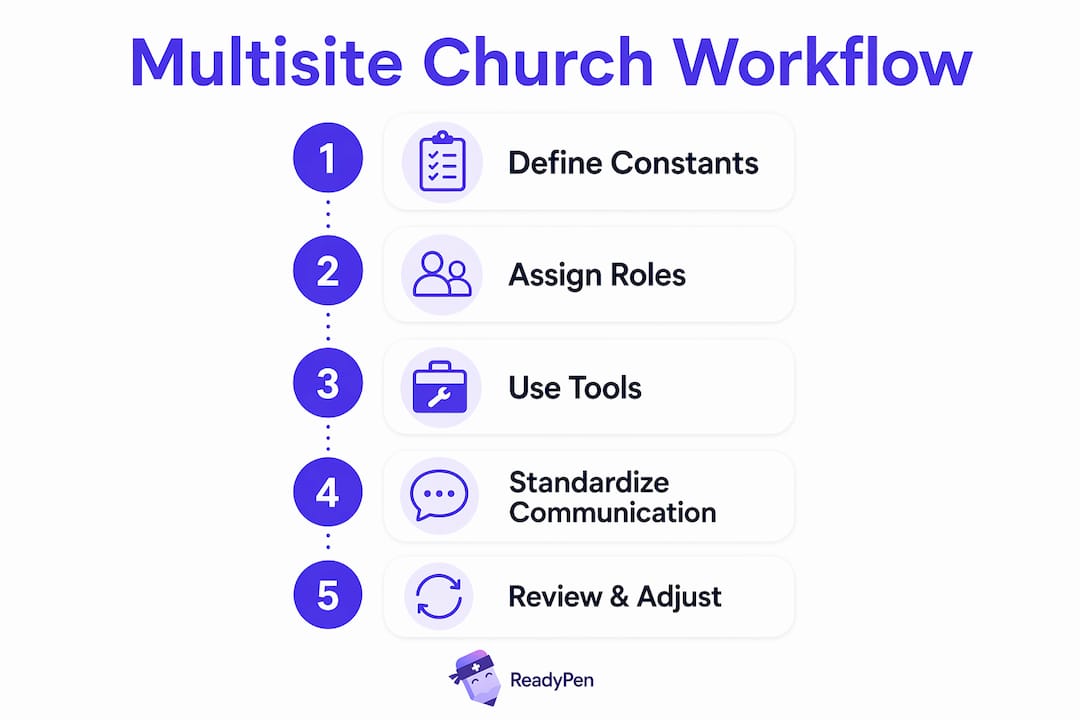
Digital tools are the second layer. Church management software and livestreaming platforms unify multisite operations and worship experiences in ways that manual coordination cannot. Platforms like Planning Center, Church Community Builder, and Pushpay give central teams visibility into attendance, giving, and volunteer hours across every location from a single dashboard.
Communication protocols are the third layer and the one most often skipped. A “no last-minute changes” policy for operational decisions gives local campuses time to adjust without scrambling. When central leadership changes a service order or a curriculum schedule with 48 hours’ notice, campus teams lose trust fast.
Here is a comparison of the three operational layers every multisite church needs:
| Layer | What it covers | Common failure point |
|---|---|---|
| Ministry playbook | Processes, safety, training, assimilation | Never written or never updated |
| Digital tools | Attendance, giving, scheduling, streaming | Campuses use different platforms |
| Communication protocols | Change timelines, meeting cadence, escalation paths | No policy exists; changes arrive last minute |
The tools your team uses for church staff communication matter as much as the org chart. A central team that communicates through email threads while campuses use group texts will always have alignment problems.
Pro Tip: Standardize one project management tool across all campuses before you launch a second location. Switching tools after the fact costs more time than the original setup.
How do multisite church workflows approach launching and staffing new campuses?
Launching a new campus without a defined workflow is the fastest way to burn out your best leaders. The staffing model is where most churches underestimate the work.
A healthy multisite launch requires a core team of at least 100 local members and a staffing ratio of 1 full-time equivalent staff member per 150 projected attendees. That ratio sounds straightforward, but it means a campus expecting 300 people on opening Sunday needs at least 2 full-time staff in place before the doors open.
Here is the sequential workflow for preparing a new campus launch:
- Identify the campus pastor. This person leads the launch team and owns local relationships. Select someone with both pastoral skill and operational discipline.
- Build the core launch team. Recruit a minimum of 100 committed local members who will serve, give, and invite before the public launch date.
- Document the ministry playbook. Adapt the central playbook to the new location’s context before the first volunteer training session.
- Staff to the projected ratio. Hire or assign 1 FTE per 150 expected attendees. Do not wait until attendance proves the need.
- Run alignment meetings. Monthly or bi-weekly alignment meetings between the campus pastor and central leadership keep the launch on track relationally and operationally.
- Set a 90-day review. Evaluate staffing, communication, and volunteer health at the 90-day mark and adjust before problems compound.
The table below shows how staffing needs scale with projected attendance:
| Projected attendance | Minimum FTE staff | Recommended core team size |
|---|---|---|
| 150 | 1 | 100 |
| 300 | 2 | 150 |
| 450 | 3 | 200 |
| 600 | 4 | 250 |
Campus pastor selection is the highest-leverage decision in the entire launch process. This person sets the relational tone, manages the local team, and represents the church’s identity in a new community. Choosing someone with strong preaching gifts but weak administrative follow-through creates predictable problems within the first year.
What communication and governance practices ensure multisite workflow success?
Governance is the part of multisite church management that most leaders avoid until a crisis forces the conversation. The core question is simple: does each campus have its own board, or does one central board govern all locations? Most healthy multisite churches operate under a single central board with clear accountability flowing down to campus pastors. Separate campus boards create competing authority structures and slow down every major decision.
Many multisite churches mistake communication gaps for structural problems. The fix is not always a new org chart. Often it is a better meeting rhythm and clearer documentation of who decided what and why. Good church meeting minutes from every alignment meeting create a paper trail that prevents the same arguments from recurring.
Effective communication practices for multisite governance include:
- Scheduled alignment meetings: Hold monthly or bi-weekly calls between campus pastors and central leadership. These are not optional check-ins. They are the primary mechanism for catching problems early.
- Two-way communication: Central leadership shares decisions with campuses before they are announced publicly. Campus pastors share local concerns before they become crises.
- No-surprise rule: Any change that affects a campus’s Sunday operations gets communicated at least two weeks in advance. This is the operational version of the no-last-minute-changes policy.
- Documented decisions: Every significant governance decision gets written down, distributed, and filed. Verbal agreements across campuses evaporate within weeks.
Intentional, consistent communication and early planning build the relational trust that makes operational unity possible. Without that trust, even a well-designed workflow breaks down under pressure.
Key Takeaways
A multisite church workflow succeeds when centralized constants, clear decision rights, and consistent communication work together across every campus.
| Point | Details |
|---|---|
| Define centralized constants | Lock in teaching, branding, and worship style at the central level before expanding. |
| Document decision rights | Write a clear authority map for every role that spans campus and central functions. |
| Staff to the ratio | Plan for 1 FTE per 150 projected attendees before a new campus opens its doors. |
| Use a ministry playbook | Document core processes before launch to prevent inconsistent procedures across locations. |
| Communicate on a schedule | Hold monthly or bi-weekly alignment meetings and enforce a no-last-minute-changes policy. |
What I’ve learned about multisite workflows the hard way
The most common mistake I see multisite churches make is releasing too much local autonomy too early. It feels generous and trusting. In practice, it creates a patchwork of campuses that share a name but not much else. Start with tighter central control and release decision rights gradually as trust is built and competency is proven. Regaining authority after you have given it away is far harder than loosening your grip over time.
The second mistake is treating communication as a soft skill rather than an operational system. Your campus pastors are not failing because they lack relational warmth. They are failing because no one told them what decisions they own, when to escalate, and how to document what happened in a meeting. Fix the system before you coach the person.
Technology helps, but only after the workflow is clear. An AI meeting documentation tool like Readypen does not fix a broken governance structure. It does, however, eliminate the hours your church admin spends on time management tasks like transcribing notes from alignment calls, so your team can focus on the actual work of ministry.
— Robbie
How Readypen keeps multisite teams aligned
Multisite church management runs on meetings. Campus pastor calls, central leadership reviews, volunteer training sessions, and governance board meetings all generate decisions that need to be documented and shared across locations.
Readypen automatically generates meeting notes, summaries, and structured documents from your conversations and recordings. Your campus pastors stop losing decisions in email threads. Your central team stops spending Sunday afternoons reconstructing what was agreed on Thursday. Every alignment meeting produces a clean, shareable record within minutes. See how Readypen works for multisite church teams and cut the documentation burden your staff carries every week.
FAQ
What is a multisite church workflow?
A multisite church workflow is the set of documented processes, communication protocols, and staffing systems that coordinate operations across multiple church campuses under one unified identity.
How many staff does a new campus need at launch?
A healthy launch requires 1 full-time equivalent staff member per 150 projected attendees, plus a core launch team of at least 100 committed local members.
What are centralized constants in a multisite church?
Centralized constants are the non-negotiable elements every campus shares, including teaching content, worship style, and branding. Local campuses adapt outreach methods and programming around these fixed points.
How often should multisite campuses hold alignment meetings?
Monthly or bi-weekly alignment meetings between campus pastors and central leadership are the standard for maintaining operational and relational unity across locations.
Why do multisite churches struggle to scale past three campuses?
Most multisite churches stall at three campuses because decision rights were never clearly defined and communication systems were not built to handle the added complexity of each new location.