Meeting Notes in Staff Reviews: A Ministry Leader's Guide

Meeting Notes in Staff Reviews: A Ministry Leader’s Guide
Meeting notes in staff reviews are defined as structured records that capture decisions made, action items assigned, and feedback given during a formal performance conversation. The role of meeting notes in staff reviews goes far beyond summarizing what was said. They function as a decision log that holds both leaders and staff accountable to what was actually agreed upon. Without them, reviews become memory contests. With them, they become the foundation for real growth and clear communication across your ministry team.
What is the role of meeting notes in staff reviews?
Meeting notes are the official record of a review conversation. They document what was decided, who owns each next step, and what the deadline is. That distinction matters because 44% of action items discussed in meetings are never completed. That number reflects what happens when conversations end without a written record of who is responsible for what.
In a ministry context, staff review documentation carries extra weight. Church leaders often wear multiple roles, and without clear notes, a performance conversation can fade into ambiguity within days. The notes become the shared reference point that both the pastor and the staff member can return to. They reduce misunderstandings and protect the dignity of everyone involved.

The standard industry term for this practice is “meeting minutes,” though in performance review settings, the more specific term “review documentation” better captures the purpose. Both terms apply here, and ministry leaders benefit from treating them as one continuous system rather than two separate tasks.
What key elements should meeting notes capture during staff reviews?
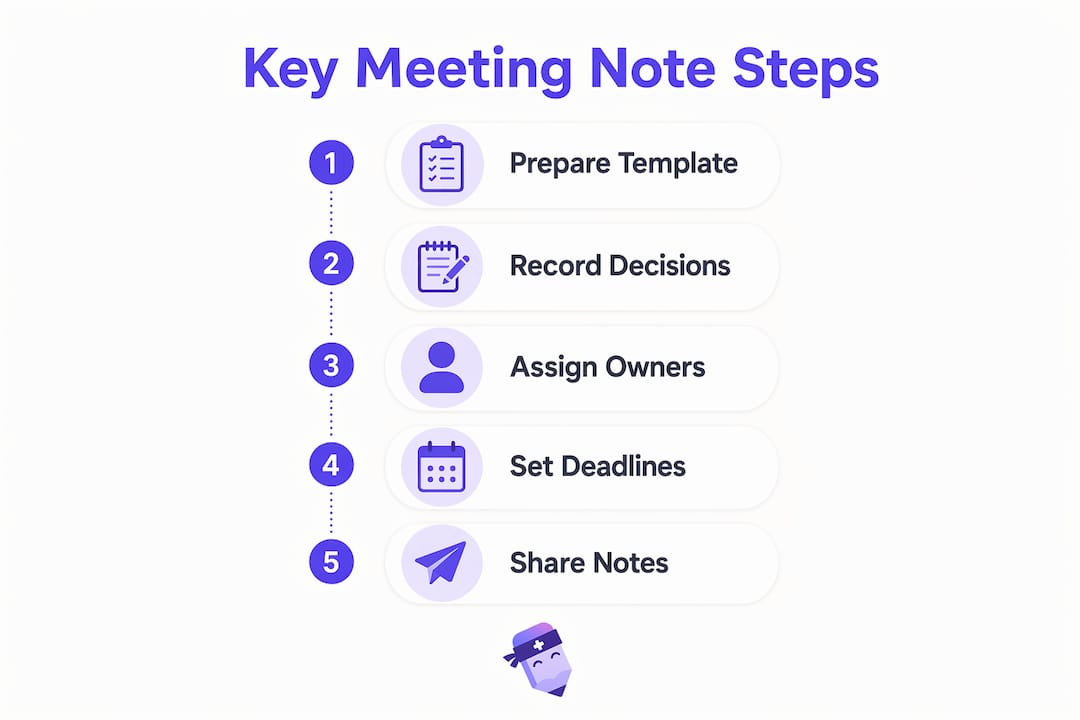
Effective staff review documentation captures more than the topics discussed. Every note from a review should include the following:
- Decisions made. Record what was formally agreed upon, not just what was discussed. If a staff member’s role is being adjusted, write it down clearly.
- Action items with named owners. Accountability disappears when tasks are assigned to “the team.” Every item needs one named person and a specific deadline.
- Employee responses. Note the staff member’s reaction, especially if they disagreed or raised a concern. This protects both parties and keeps the record honest.
- Feedback history. Pull in relevant notes from previous one-on-one meetings. A review should reflect a pattern, not just a single moment.
- Distribution plan. Decide before the meeting ends who receives the notes and when. Sharing review documents at least 24 hours before the next follow-up meeting gives staff time to prepare.
Pro Tip: Create a simple review note template before each cycle. Include fixed fields for decisions, action items, owner names, deadlines, and staff responses. A template takes five minutes to build and saves hours of confusion later.
The format matters as much as the content. Notes sent as a shared document, rather than buried in an email thread, stay accessible and editable as circumstances change. Shared document workspaces give both leaders and staff a single place to track progress between reviews.
How do meeting notes improve accountability in ministry staff reviews?
Documentation creates accountability by making expectations visible. When a staff member sees their name next to a specific task and deadline in writing, the commitment becomes real. When that document is shared with both parties, there is no room for “I thought someone else was handling it.”
Continuous, chronological documentation transforms annual reviews from stressful events into part of an ongoing feedback cycle. That shift matters deeply in ministry settings, where relationships are long-term and trust is the currency of leadership. A staff member who sees their growth tracked over months feels seen, not ambushed.
Notes also improve communication by giving both sides a shared language. Consider this principle from pastoral leadership practice:
Documentation is a management tool integral to pastoral care, shifting reviews from confrontations to ongoing dialogues supported by transparent feedback records.
That framing changes how ministry leaders approach note-taking. The goal is not to build a case against a struggling staff member. The goal is to build a record that supports their development. Notes written with that intent read differently and land differently.
Specific communication improvements that follow from good documentation include:
- Fewer “I didn’t know that was expected” moments after reviews
- Clearer conversations in follow-up meetings because both parties reference the same document
- Reduced review anxiety because staff know what to expect based on ongoing notes
- Stronger trust between pastors and staff because the process feels fair and transparent
Common pitfalls in using meeting notes for staff reviews
Most note-taking problems fall into four categories. Recognizing them early saves your ministry from repeating the same review mistakes year after year.
-
Treating notes as transcripts. Meeting notes should be decision logs, not word-for-word records of the conversation. A transcript buries the decisions inside paragraphs of dialogue. A decision log puts the key outcomes at the top.
-
Skipping ownership confirmation. Many leaders end a review feeling good about the conversation but never confirm who owns each next step. Failing to confirm task ownership is a primary cause of poor follow-through. Before the meeting ends, read the action items aloud and confirm each owner agrees.
-
Using subjective or emotional language. Notes that include phrases like “seemed unmotivated” or “had a bad attitude” create legal and relational risk. Objective, factual documentation that avoids subjective opinions is the standard in ministry accountability settings. Write what happened, not what you felt about it.
-
Poor sharing and follow-up habits. Notes that sit in a folder and never get revisited are not documentation. They are filing. The 48-hour check-in after a review meeting is a vital practice to confirm early progress and catch stalled action items before they become performance issues.
Pro Tip: After every review, send the notes to the staff member within 24 hours and ask them to confirm the action items in writing. That single step doubles the chance those items actually get done.
Practical steps to implement a meeting note system for church staff reviews
A note system that works for ministry teams does not need to be complicated. It needs to be consistent. These steps build a process your team will actually use.
- Build a review note template. Align the template with your review goals. Include fields for performance observations, decisions, action items, owner names, deadlines, and staff responses. Standardizing the format means nothing gets forgotten.
- Use shared documents. Store notes in a platform where both the leader and the staff member can access them. This removes the “I never got that” problem and keeps everyone working from the same version.
- Share notes before the follow-up meeting. Best practice for performance reviews calls for sharing formal review documents at least one day before the next meeting. This gives staff time to reflect and come prepared.
- Schedule 48-hour check-ins. After every review, set a brief follow-up within two days to confirm that action items are moving. This is not a second review. It is a quick confirmation that the plan is in motion.
- Use AI tools to reduce manual workload. Ministry leaders attend a high volume of meetings. 60% of organizational leaders attend three or more meetings daily. Manual note-taking at that pace leads to gaps and errors. AI-powered tools that generate notes from conversations or recordings keep documentation accurate without adding hours to your week.
The table below shows how each step maps to a specific outcome in your review process.
| Step | Purpose | Outcome |
|---|---|---|
| Build a template | Standardize what gets captured | Nothing important is missed |
| Use shared documents | Create a single source of truth | Both parties reference the same record |
| Share notes in advance | Give staff time to prepare | More productive follow-up conversations |
| 48-hour check-in | Catch stalled items early | Action items stay on track |
| Use AI documentation tools | Reduce manual note-taking burden | Accurate records without added workload |
For ministry leaders who want to go deeper on tracking team progress between reviews, building a habit of linking meeting notes to project milestones creates a continuous accountability trail.
Key Takeaways
Meeting notes in staff reviews work because they convert spoken commitments into written records with named owners, clear deadlines, and shared access.
| Point | Details |
|---|---|
| Notes are decision logs | Capture what was decided and who owns each next step, not what was discussed. |
| Name every action item owner | Ambiguous ownership is the leading cause of tasks not getting done after reviews. |
| Keep language objective | Factual, unemotional notes protect both the staff member and the organization. |
| Share notes within 24 hours | Fast distribution keeps the review conversation fresh and confirms shared understanding. |
| Use the 48-hour check-in | A brief follow-up two days after the review catches stalled items before they become problems. |
Why I think most ministry reviews fail before they even start
Most church leaders I have worked with are genuinely caring people who want their staff to grow. The problem is not intent. The problem is that good intentions do not survive a busy week without a written record to back them up.
I have seen pastors conduct a thoughtful, honest review conversation on a Tuesday, and by the following Monday, neither party could agree on what was actually decided. Not because anyone was dishonest. Because no one wrote it down. The review became a memory contest, and memory contests breed resentment.
What changed everything for the leaders I respect most was treating documentation as a form of pastoral care, not a bureaucratic chore. When you write down what a staff member committed to, and you share that record with them, you are honoring the conversation. You are saying, “What we discussed matters enough to preserve.” That posture changes how staff receive feedback. It stops feeling like surveillance and starts feeling like investment.
The other thing I would push back on is the idea that notes are only for problem employees. The leaders who document consistently across their whole team, not just the struggling ones, build a culture where reviews feel fair. Staff members who see that everyone gets the same structured process trust the system. That trust is worth more than any single performance conversation.
My recommendation is simple. Start with one template. Use it for every review. Share the notes within 24 hours. Check in at 48 hours. Do that for one full review cycle and watch how the conversations change.
— Robbie
How Readypen helps church teams document staff reviews
Church staff reviews generate a lot of conversation and very little time for manual note-taking. Readypen is built specifically for ministry teams who need accurate, structured meeting notes without the administrative burden.

Readypen automatically generates meeting notes, summaries, and structured documents from conversations or recordings. That means your review notes are ready before the meeting ends, complete with decisions, action items, and ownership details. Ministry leaders can review the output, make edits, and share it with staff the same day. For teams that want to see how this works in practice, the church meeting minutes guide walks through the full documentation process. You can also explore who should take meeting minutes on your team to set clear roles before your next review cycle.
FAQ
What is the main purpose of meeting notes in staff reviews?
Meeting notes in staff reviews serve as a decision log that records what was agreed upon, who owns each action item, and what the deadlines are. They transform a verbal conversation into a shared, written record that both leaders and staff can reference.
How soon should meeting notes be shared after a staff review?
Notes should be shared within 24 hours of the review meeting. Sharing quickly keeps the conversation fresh and gives staff a chance to confirm or clarify anything before action items begin.
What should you never include in staff review notes?
Avoid subjective opinions, emotional language, and interpretations of intent. Objective, factual documentation protects both the organization and the staff member and holds up better in accountability conversations.
How do meeting notes reduce review anxiety for church staff?
Continuous documentation throughout the year means staff are never surprised by a review. When feedback is recorded and shared regularly, the formal review becomes a summary of an ongoing dialogue rather than a high-stakes judgment.
What is the 48-hour check-in and why does it matter?
The 48-hour check-in is a brief follow-up conversation two days after a review to confirm that action items are moving forward. It catches stalled tasks early, before they become patterns that require a harder conversation later.