Meeting Documentation Best Practices for Ministry Leaders

Meeting Documentation Best Practices for Ministry Leaders
Meeting documentation best practices are defined as the standards and methods used to capture decisions, action items, and context from meetings in a way that drives follow-through and accountability. For church administrators and ministry leaders, poor documentation is not just an inconvenience. It means repeated conversations, missed commitments, and eroded trust among your team. The good news is that a clear, consistent system for how to document meetings transforms your gatherings from discussions into measurable progress. This guide covers the essential elements, timing, tools, and structure your ministry needs to make every meeting count.
What are meeting documentation best practices for churches?
Meeting documentation best practices center on one core principle: capture what was decided and who is responsible, not everything that was said. The industry term for this output is “meeting minutes,” a formal record that serves as the official account of a meeting’s decisions and commitments. For church teams, minutes also carry an added weight. They preserve institutional memory across volunteer transitions, pastoral changes, and seasonal ministry cycles.
The most effective approach treats meeting minutes as a closed-loop system, tracking progress and identifying blockers so that discussion becomes a clear roadmap. That framing shifts documentation from a clerical task to a leadership tool. When your elder board or ministry team can look back at last month’s notes and see exactly what was decided and what happened next, accountability becomes built into the culture.

Church leaders who adopt this mindset stop asking “Did someone write that down?” and start asking “What does the record show?”
What essential elements should church meeting notes include?
Strong meeting notes contain seven core components: meeting metadata, stated objectives, agenda items, a discussion summary, decisions made, action items, and next steps. Each component serves a specific purpose, and leaving any one out creates gaps that cost time later.
Meeting metadata includes the date, location, attendees, and the name of the note-taker. This information anchors the document in time and establishes who was present for each decision.
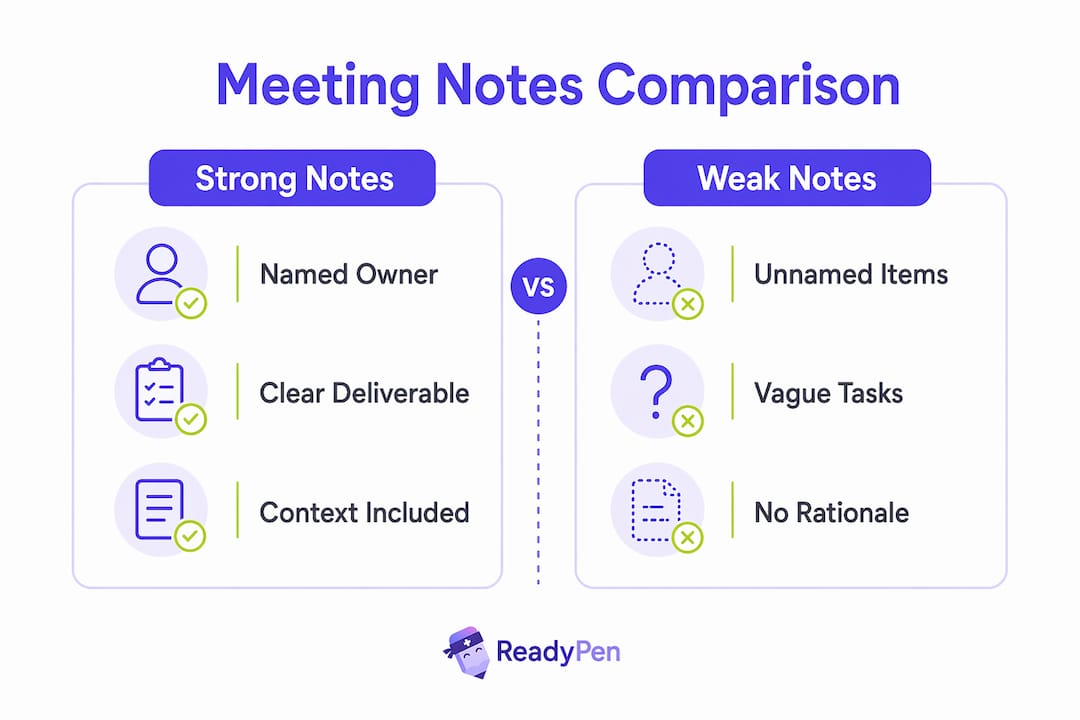
Action items are where most church documentation fails. Every action item must specify one named owner, a measurable deliverable, and a calendar-based deadline. Without those three elements, an action item becomes a vague intention. “Someone will follow up on the sound system” is not an action item. “Pastor James will get three vendor quotes for the new sound system by march 14” is.
Decision context is the element most teams skip entirely. Including the rationale or alternatives behind key decisions prevents repeated discussions and preserves organizational memory. A short one to two sentence explanation of why a decision was made gives future readers the clarity to act without calling a new meeting.
Good notes vs. poor notes: a comparison
| Element | Strong meeting notes | Weak meeting notes |
|---|---|---|
| Action items | Named owner, deliverable, deadline | “Team will handle it” |
| Decisions | Decision plus one sentence of rationale | “We decided on option B” |
| Discussion summary | Key points and outcomes only | Full transcript of conversation |
| Metadata | Date, attendees, note-taker listed | Missing or incomplete |
| Length | One page for a 60-minute meeting | Three or more pages of detail |
Pro Tip: Capture the “why” behind every major decision in one sentence. Future volunteers and staff who weren’t in the room will thank you.
How can church meetings be documented efficiently?
Efficiency in meeting documentation means capturing outcomes without transcribing conversations. Meeting notes focused on outcomes increase team reference and follow-through far more than verbatim records do. The goal is a document your team will actually read and use, not a transcript they will avoid.
A practical benchmark: effective notes for a 60-minute meeting typically include 3–5 decisions, 5–8 action items, and 2–3 open questions, all fitting within one page. If your notes run longer than that, you are capturing too much non-actionable conversation.
Pre-meeting preparation
Pre-writing 60% of your notes using a template that includes the agenda, objectives, and attendee list reduces cognitive load during the meeting itself. You arrive focused on capturing decisions, not building structure from scratch. A church board meeting template with pre-filled sections for each agenda item makes this easy to replicate every month.
During and after the meeting
Most effective note-takers do not attempt live verbatim capture. They use shorthand during the meeting and expand their notes immediately after for accuracy and clarity. The window right after a meeting closes is when context is freshest, so a 10-minute cleanup pass produces far better notes than a reconstruction attempt the next morning.
- Use shorthand for discussion points and write full sentences only for decisions and action items.
- Leave a blank line after each agenda item to add follow-up notes post-meeting.
- Flag open questions with a symbol (such as “?”) so they are easy to find during cleanup.
- Confirm action items with owners verbally before the meeting ends to catch errors before they are distributed.
Pro Tip: Read your action items aloud at the end of every meeting. This one habit catches assignment errors before they leave the room.
Why does timely distribution matter for church accountability?
Speed of distribution is one of the most underrated factors in effective meeting documentation. Meeting minutes should be distributed ideally within 2–4 hours after a meeting and no later than 24 hours. This timing increases project completion rates and prevents costly follow-up meetings. That window matters because context fades fast. A note-taker who waits three days to send minutes is sending a document that no longer matches what attendees remember.
Consistency in structure matters just as much as speed. Standardized templates reduce cognitive load for note-takers and allow team members to locate information quickly. When your worship team, deacon board, and staff meetings all use the same format, readers know exactly where to find decisions and action items without scanning the whole document. That consistency builds institutional trust over time.
For church teams with rotating volunteers or seasonal staff, consistent formatting also means that a new volunteer can read last quarter’s notes and understand exactly where things stand. That is a significant advantage when ministry leadership changes.
- Distribute notes within 2–4 hours of the meeting closing.
- Use the same template for every meeting type to reduce reader friction.
- Send notes to all attendees and any absent members who hold relevant responsibilities.
- Archive notes in a shared folder organized by ministry area and date.
What tools can church leaders use for meeting documentation?
The right tools reduce the burden of documentation without sacrificing accuracy. AI-assisted tools like Readypen are built specifically for this problem. Readypen automatically generates meeting notes, summaries, and structured documents from conversations or recordings, which means your church staff spends less time writing and more time leading. For ministry teams without dedicated admin support, that shift is significant.
AI transcription tools aid recall but should support, not replace, human editorial judgment. Human synthesis ensures notes reflect group consensus, not just raw spoken words. A transcript of a 45-minute elder board discussion is not the same as a clear record of what the board decided. Readypen handles the transcription layer while your team applies the editorial judgment to confirm decisions and assign owners.
Beyond AI tools, workflow habits matter just as much as software. A few practices that consistently improve documentation quality:
- Pre-fill your meeting note template with the agenda before the meeting starts.
- Tag decisions separately from discussion points so they are easy to filter later.
- Track action item progress in a shared document or ministry management system between meetings.
- Assign a consistent note-taker role for each recurring meeting. Rotating randomly produces inconsistent results.
Pro Tip: Integrate your meeting notes with whatever system your church already uses for task tracking. Notes that live in isolation rarely drive follow-through.
Knowing who should take meeting minutes is itself a decision worth making deliberately. The best note-taker is not always the most junior person in the room. It is the person with enough context to distinguish a key decision from a passing comment.
Key takeaways
Strong meeting documentation requires clear structure, named accountability, and fast distribution to turn church discussions into real outcomes.
| Point | Details |
|---|---|
| Name every action item owner | Assign one person, one deliverable, and one deadline per action item. |
| Capture decisions with context | Add one sentence of rationale to every major decision to prevent repeated debates. |
| Distribute notes within 24 hours | Send minutes within 2–4 hours to maximize follow-through and accountability. |
| Use a consistent template | Standardized formats reduce cognitive load and build team trust over time. |
| Support AI tools with human judgment | Use AI for transcription, then apply editorial review to confirm decisions and consensus. |
What I’ve learned from watching church teams document meetings badly
Most church teams do not have a meeting problem. They have a documentation problem. I have watched elder boards make the same decision three times in a row because no one could find the record of the first two. I have seen ministry volunteers miss deadlines not because they were irresponsible, but because the action item was buried in paragraph four of a two-page email.
The most common mistake is over-documenting. Teams that try to capture every comment end up with notes so long that no one reads them. The second most common mistake is delayed distribution. Notes sent three days after a meeting arrive after people have already moved on, so the window for course correction closes.
What actually works is simpler than most leaders expect. A one-page template, filled in before the meeting starts, with a 10-minute cleanup pass immediately after, sent within two hours. That process, done consistently, builds more accountability than any elaborate system. The teams I have seen get this right are not using the most sophisticated tools. They are using the most consistent habits.
Templating and rapid turnaround are not administrative details. They are leadership decisions. When your team sees that every meeting produces a clear, timely record, they start taking commitments more seriously. That cultural shift is the real return on investment.
— Robbie
How Readypen supports church meeting documentation
Church ministry teams run a lot of meetings. Most do not have a dedicated administrator to document all of them.
Readypen is built for exactly that gap. It automatically generates structured meeting notes, summaries, and action item lists from your conversations or recordings, so your team gets a clean, usable record without anyone spending an hour writing it up. Ministry leaders can review Readypen’s automated minutes and summaries to see how the tool fits their workflow. For teams ready to assign documentation roles clearly, the ministry leader resource covers how to set up a documentation system that scales with your church’s growth.
FAQ
What should church meeting minutes always include?
Church meeting minutes must include the date, attendees, decisions made, action items with named owners and deadlines, and any open questions. A one-sentence rationale for each major decision prevents repeated debates at future meetings.
How long should meeting notes be for a 60-minute church meeting?
Effective notes for a 60-minute meeting fit on one page and include 3–5 decisions, 5–8 action items, and 2–3 open questions. Notes longer than one page typically contain too much non-actionable conversation.
How soon should church meeting notes be distributed?
Notes should be distributed within 2–4 hours of the meeting and no later than 24 hours. Faster distribution increases follow-through and reduces the need for clarifying conversations.
Can AI tools replace a human note-taker in church meetings?
AI tools handle transcription well but require human editorial review to confirm decisions and reflect group consensus accurately. The combination of AI transcription and human synthesis produces the most reliable minutes.
What is the best way to track action items between church meetings?
Assign each action item a named owner, a specific deliverable, and a calendar deadline. Track progress in a shared document or ministry management system so the team can see status before the next meeting without waiting for a follow-up conversation.