Leadership Team Summary for Church Leaders: A Clear Guide

Leadership Team Summary for Church Leaders: A Clear Guide
A leadership team summary is a concise document that captures a leadership team’s collective decisions, mutual commitments, and strategic trade-offs. It differs from standard meeting minutes because it records what the team decided together, not just what was discussed. Church leaders who use these summaries consistently report clearer accountability, fewer repeated conversations, and stronger alignment across ministry departments. If you have ever left a leadership meeting unsure of who owns what, a well-built summary is the fix.
What is a leadership team summary, and how does it differ from meeting notes?
A leadership team summary is a commitment document, not a transcript. It records the outcomes of collective decision-making, the trade-offs the team accepted, and the specific people accountable for each next step. That distinction matters more than most church leaders realize.
Standard meeting minutes capture what was said. A leadership team summary captures what was decided and why. According to leadership development research, leadership teams share decision-making authority in ways that working groups never do. A working group shares information. A leadership team makes calls that no single department head could make alone.

The difference shows up in the document itself. A working group report might say, “The worship director updated the team on Sunday set lists.” A leadership team summary says, “The team agreed to shift Sunday service length from 75 to 60 minutes, effective the first Sunday of next month. The worship director and executive pastor will co-own the transition plan.” One records activity. The other records a binding commitment.
Church leadership teams often produce working group reports and call them leadership summaries. That is the most common mistake. If your summary reads like a department status update, it is not capturing the collective work your team actually did.
Pro Tip: Before finalizing any summary, ask: “Does this document reflect a decision only this team could make together?” If the answer is no, revise until it does.
Why does a leadership team overview matter for church effectiveness?
Aligned leadership teams perform nearly twice as well as teams operating without cohesion. That finding applies directly to church leadership, where misalignment between pastoral, administrative, and ministry leads creates confusion for staff and volunteers alike.
“Vigilant, iterative investment in refining team processes prevents cohesiveness problems lasting 30+ years. Effective leadership team communication requires continuous refinement to prevent decline in effectiveness as roles and needs evolve.” — Harvard Business School, Working Knowledge
That insight carries a warning. Leadership teams that skip the summary process do not stay static. They drift. Roles blur, priorities compete, and the team gradually stops functioning as a unit. A written summary after each meeting is the simplest tool to interrupt that drift.
For church administrators specifically, summaries serve a second purpose: they communicate decisions to the broader staff without requiring another meeting. When the elders decide to restructure the midweek program, the summary becomes the source document for every downstream conversation. Ministry staff get clarity. Volunteers get direction. The leadership team avoids repeating itself in five separate one-on-ones.
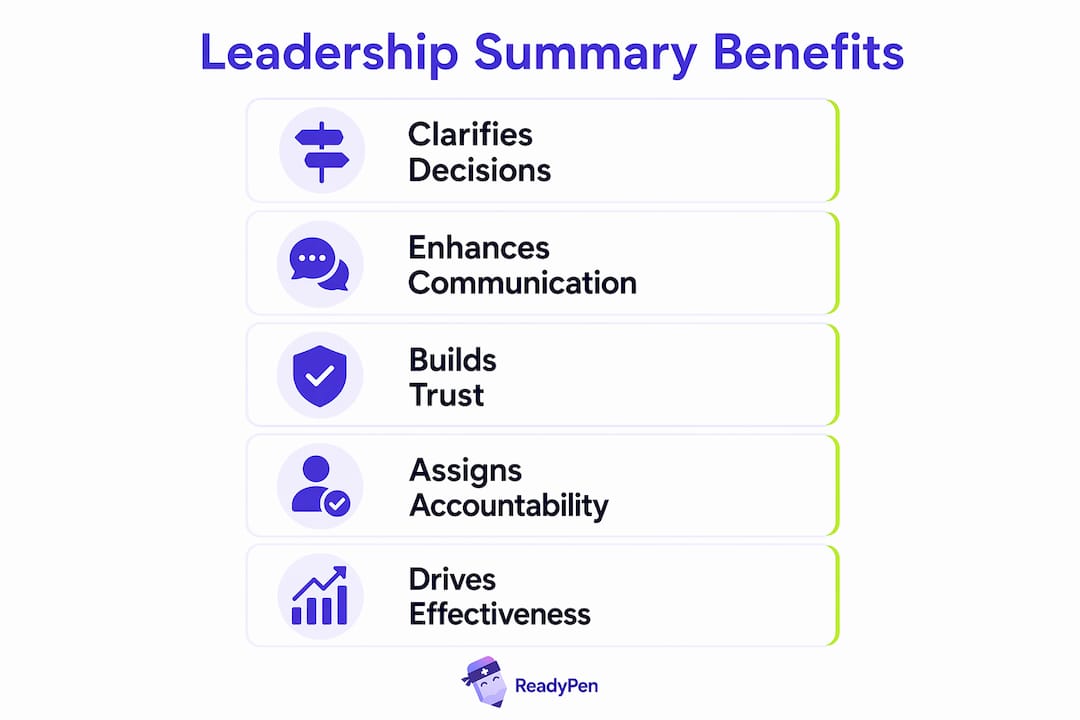
Summaries also protect morale. When staff see that leadership made a clear decision and documented it, trust builds. When decisions seem to evaporate after meetings, trust erodes. The importance of leadership team documentation is not bureaucratic. It is pastoral.
What key elements should a leadership team summary include?
The most effective summaries stay under one page. Summaries longer than one page tend to go unread. Church leaders are busy. A summary that requires 15 minutes to read will not get read before the next meeting.
A strong leadership team summary includes five core elements:
- The decision made. State it plainly. “The team approved the 2026 outreach budget at $14,000.” No hedging, no background narrative.
- The rationale. One or two sentences on why. This is the “so what” that helps staff understand the direction without needing to attend the meeting.
- The trade-offs accepted. If the team chose outreach over facility upgrades, say so. Documenting cross-functional trade-offs prevents silos from going unchallenged later.
- Named accountability. Every action item needs one name attached to it. Not “the team will follow up.” One person owns it.
- A deadline or review date. Accountability without a timeline is just a wish.
Formatting matters too. Use short paragraphs or a simple table. Bold the decision statements. Keep action items in a separate block at the bottom of the document. Church administrators who receive these summaries should be able to scan them in under two minutes and know exactly what changed.
Pro Tip: Write the decision line first, then add context below it. If you write context first, the decision gets buried and readers miss the point.
How can church leadership teams create and use summaries effectively?
Producing a good summary starts before the meeting ends. The most effective church leadership teams build summary creation into the meeting itself, not after it.
Practical steps that work:
- Assign a summary owner at the start of every meeting. Rotate this role across team members. When everyone takes a turn, everyone understands what the summary needs to capture.
- Separate debate from decision. Research on leadership team operating agreements shows that explicitly separating divergence (open debate) from convergence (final decision) reduces conflict and produces cleaner decisions to document.
- Draft the action item list before the meeting closes. Read it aloud. Confirm names and deadlines with the full team present. This eliminates the “I thought you were handling that” problem.
- Distribute within 24 hours. A summary sent three days later loses its urgency. Send it the same day or the morning after.
- Use it as the opening document at the next meeting. Start by reviewing the previous summary’s action items. This single habit closes the accountability loop and signals that the summary is a live tool, not an archive.
Technology can reduce the friction here significantly. Church teams that rely on manual note-taking often produce inconsistent summaries because the note-taker is also a participant. Automated documentation tools built for ministry settings solve this by capturing the conversation and generating a structured summary without pulling anyone out of the discussion.
What common mistakes should church leadership teams avoid?
The “minutes mentality” is the most damaging pattern in church leadership documentation. Teams that treat their summary as a record of who said what produce documents that no one reads and no one acts on.
Watch for these specific pitfalls:
- Listing discussions instead of decisions. If your summary says “the team discussed the children’s ministry staffing situation,” that is not a summary. It is a diary entry. Replace it with the actual decision or note that no decision was reached and a follow-up meeting is scheduled.
- Omitting accountability names. Summaries without named owners create ambiguity that causes drift. Every action item needs one person’s name, not a department or a committee.
- Writing for the record instead of for action. Some church leaders write summaries as if they will be audited. That produces long, cautious documents that bury the decisions in qualifications.
- Skipping trade-offs. If the team chose one path over another, document what was set aside and why. This prevents the same debate from resurfacing at the next meeting.
- Letting the process go stale. Senior leaders often underestimate the ongoing investment required to keep team processes healthy. Review your summary format every six months and adjust it as the team’s needs change.
Pro Tip: Run a quick audit on your last three summaries. Count the number of named action items with deadlines. If that number is zero or one, your summaries are not functioning as commitment documents yet.
Key Takeaways
A leadership team summary is a commitment document that records collective decisions, named accountability, and accepted trade-offs. It is the single most practical tool for keeping church leadership teams aligned between meetings.
| Point | Details |
|---|---|
| Definition clarity | A leadership team summary records decisions and commitments, not just discussions. |
| Named accountability | Every action item must have one person’s name and a deadline attached. |
| Document trade-offs | Record what the team chose not to do. This prevents repeated debates. |
| Keep it under one page | Summaries longer than one page go unread and lose their function. |
| Review at every meeting | Open each meeting by reviewing the previous summary’s action items to close the loop. |
What I have learned from watching church teams document their meetings
Church leadership teams are not short on commitment. They are short on clarity. I have watched deeply dedicated pastors and administrators leave meetings with completely different understandings of what was just decided. Nobody lied. Nobody was careless. The meeting just never produced a shared record of what happened.
The summary is not a formality. It is the moment where the team’s conversation becomes a team’s commitment. Without it, every meeting is a conversation that evaporates. With it, every meeting produces something the whole organization can act on.
The teams I have seen improve fastest are not the ones with the most talented leaders. They are the ones that built the discipline of writing down what they decided, who owns it, and when it is due. That discipline compounds. After six months, those teams spend less time relitigating old decisions and more time making new ones. Their staff feel the difference. Volunteers feel the difference. The ministry moves faster because the leadership is no longer the bottleneck.
The hardest part is not writing the summary. It is building the habit of treating it as a live document rather than a filing obligation. Once that shift happens, the summary becomes the most useful tool in the room.
— Robbie
How Readypen helps church teams document leadership decisions
Church leadership teams run a lot of meetings. Most do not have a dedicated administrator to capture every decision, name every owner, and distribute a clean summary before the next morning. Readypen was built specifically for that gap.

Readypen’s AI-powered meeting documentation generates structured summaries from your conversations or recordings automatically. It captures decisions, action items, and accountability assignments without pulling a team member out of the discussion. Church admins and pastors who use Readypen spend less time writing and more time leading. The church meeting minutes guide on the Readypen site walks through exactly how to structure documentation for ministry settings. For teams ready to see the full tool in action, the AI meeting sessions page shows how automated summaries work from start to finish.
FAQ
What is a leadership team summary?
A leadership team summary is a concise document that records a leadership team’s collective decisions, mutual commitments, and named accountability for action items. It differs from meeting minutes by focusing on outcomes and trade-offs, not discussion transcripts.
How long should a leadership team summary be?
Effective summaries stay under one page. Research shows that summaries exceeding one page tend to go unread and fail to drive follow-through after meetings.
What makes a strong leadership team summary different from meeting minutes?
Meeting minutes record what was said. A leadership team summary records what was decided, who owns each action item, and what trade-offs the team accepted. The focus is on commitment, not documentation.
How often should church leadership teams produce summaries?
A summary should follow every leadership meeting, distributed within 24 hours. The previous summary should open the next meeting as a review of outstanding commitments.
Why do leadership team summaries improve church communication?
Aligned leadership teams perform nearly twice as well as misaligned ones. Summaries give ministry staff a clear record of decisions without requiring additional meetings, which reduces confusion and builds trust across the organization.