How to Run Efficient Church Staff Meetings

How to Run Efficient Church Staff Meetings
Efficient church staff meetings are defined as structured gatherings that produce clear decisions, assigned ownership, and measurable next steps aligned to the church’s mission. Most church teams waste significant meeting time on information updates that could be handled by email, while the real work of alignment and accountability gets skipped. The fix is not shorter meetings. The fix is better ones. This guide gives you the exact framework to organize church staff meetings that protect your team’s time, sharpen focus, and move ministry forward every single week.
What makes church staff meetings efficient?
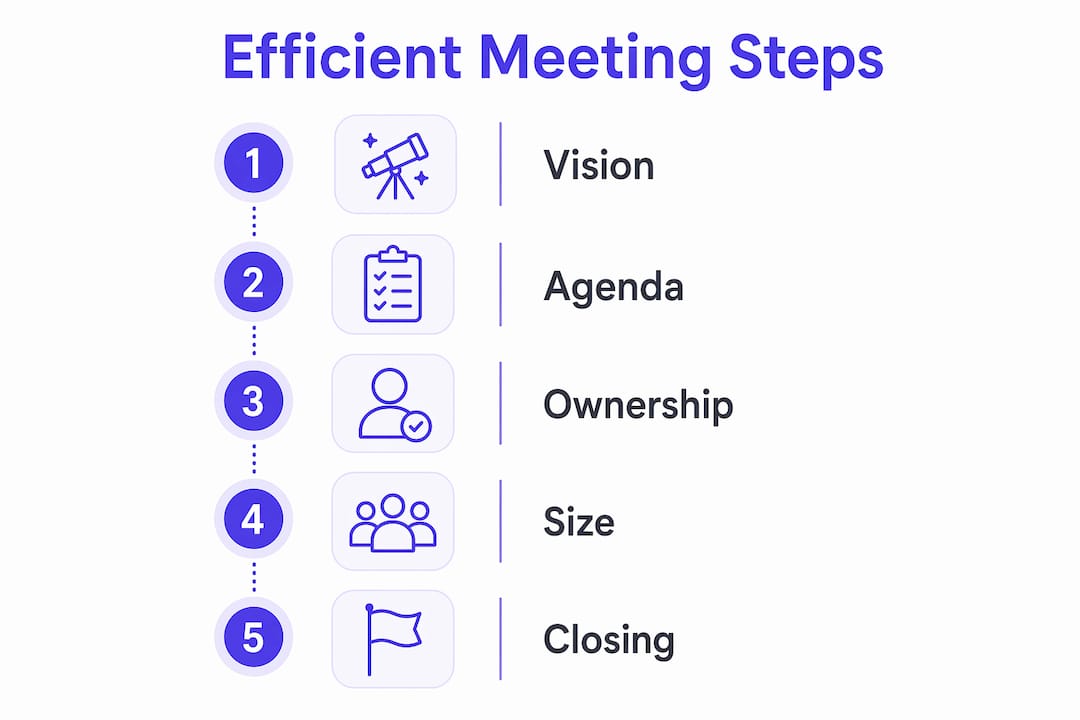
Efficient meetings are built on four non-negotiable foundations: vision clarity, focused agendas, clear ownership, and consistent rhythm. Miss any one of them and your meetings drift into status updates that drain energy without producing results.
Vision clarity turns meetings from obligation into strategic momentum. Every agenda item should connect directly to the church’s disciple-making mission. If an item does not serve that mission, it does not belong on the agenda.
Ownership is where most church meetings break down. Effective meetings answer three core questions: What decision is being made? Who owns the task? When is the deadline? Assigning a task to the whole team is the same as assigning it to no one. Every action item needs exactly one name attached to it.

Meeting size matters more than most leaders realize. Groups larger than 12 tend to stall conversation and increase side discussions. Keep your core planning group at 12 people or fewer to maintain decision speed and genuine consensus.
Pro Tip: Start every meeting with prayer and a one-sentence reminder of your church’s current one-year focus. This 90-second practice anchors the room before any agenda item is discussed.
The best meetings also end with a deliberate close. Read back every decision, name the owner, and state the deadline out loud before anyone leaves the room. That final two minutes eliminates most of the follow-up confusion that plagues church teams.
How can scheduling tools improve meeting efficiency?
Fragmented individual calendars are the single biggest structural cause of meeting conflicts in church organizations. When each staff member manages their own schedule in isolation, double-bookings, missed prep time, and last-minute cancellations become routine.
A centralized master calendar solves this at the system level. Synchronized scheduling systems reduce coordination conflicts by up to 90% and save staff 35–50% of weekly administrative time. That is not a marginal improvement. It is a structural shift in how your team operates.
| Approach | Conflict rate | Admin time saved |
|---|---|---|
| Individual calendars | High | None |
| Shared master calendar | Moderate | 15–25% |
| Synchronized digital scheduler | Very low | 35–50% |
For multisite churches, the problem compounds across campuses. Centralized digital multi-campus schedulers eliminate 95% of double-booking conflicts by using cloud-based conflict detection that updates in real time. Tools like PastorAgenda are built specifically for this use case, giving campus pastors and ministry directors shared visibility without requiring manual coordination calls.
Recurring meetings with fixed durations and buffer times prevent scheduling fatigue and protect ministry energy across the week. A 45-minute weekly staff meeting that starts and ends on time every Tuesday builds more rhythm than a 90-minute meeting that wanders.
Pro Tip: Set automated reminders 24 hours and 1 hour before each meeting. No-show rates drop significantly when staff receive a prompt with the agenda attached, not just a calendar notification.
What steps make annual church planning retreats productive?
Annual planning retreats are the highest-stakes meetings your church team holds. They set the direction for the entire year. Most fail not because of bad ideas but because of poor structure and too many priorities.
The most effective approach limits the retreat to 3–5 key goals. Annual planning retreats work best with a structured 8-step agenda completed in a half-day or overnight session. That structure typically includes:
- Opening prayer and Scripture grounding
- Review of the past year’s wins and gaps
- Restatement of the church’s core vision
- Environmental scan of community needs
- Identification of 3–5 priority goals
- Resource and budget alignment discussion
- Assignment of goal owners and 90-day milestones
- Closing prayer and commitment
Keep the planning group under 12 people. Larger groups produce louder voices and quieter contributors, which skews decisions toward the most assertive personalities rather than the best ideas.
Outside facilitation is one of the most underused investments in church planning. Senior pastors cannot effectively lead content and manage facilitation simultaneously. When the pastor is running the room, they are not fully in the room. A skilled outside facilitator frees the pastor to think, contribute, and pray without logistical distraction.
Follow-up is where retreat momentum dies. Send a one-page summary of every decision, owner, and deadline within 48 hours. That document becomes the accountability anchor for the next 90 days.
How do you build meeting discipline and engagement?
Meeting discipline is a cultural practice, not a policy. You build it through consistent expectations, modeled behavior, and a few non-negotiable norms.
The most impactful norm is device etiquette. Requiring staff to put devices down during meetings significantly improves engagement and communication. Multitasking is the primary cause of communication breakdown in team settings. When someone is half-reading an email during a discussion, they are not contributing and they are not retaining. The cost is invisible in the moment and expensive in follow-up.
Preparation is the second pillar. Well-prepared participants respect team time and reduce follow-up confusion. Preparation is an act of service to the team, not just personal readiness. When staff arrive having read the agenda and reviewed relevant materials, the meeting starts at a higher level and ends faster.
Pro Tip: Rotate the role of meeting facilitator among ministry leaders every quarter. Ownership of the meeting process builds empathy for the facilitator’s job and raises the preparation standard across the whole team.
Not every update belongs in a full staff meeting. Separate information that requires the whole group from updates that only affect two or three people. A quick Slack message or a five-minute hallway conversation handles most of what gets added to agendas unnecessarily.
How does meeting format affect church staff productivity?
The format and frequency of your meetings shape your team’s culture more than any single agenda item. Choose the wrong format and you create fatigue. Choose the right one and you build momentum.
| Format | Best use | Ideal length |
|---|---|---|
| Weekly all-staff | Alignment, prayer, announcements | 30–45 minutes |
| Weekly ministry team | Tactical updates, project check-ins | 20–30 minutes |
| Monthly leadership | Strategic decisions, budget review | 60–90 minutes |
| Annual planning retreat | Vision, goals, 90-day plans | Half-day or overnight |
Weekly fixed-length meetings build the accountability rhythm that keeps ministry moving. They work best when the agenda is tight and the facilitator is disciplined about time. Longer strategic sessions belong on a monthly or quarterly cadence, not weekly.
Multisite churches face a specific challenge: managing multiple ministry team meetings across campuses without creating scheduling fatigue or information silos. The solution is a unified scheduling system with staggered meeting times and a shared agenda template. Each campus runs its own tactical meeting, and a cross-campus leadership meeting handles alignment once a month. This structure reduces meeting bloat while keeping all campuses moving in the same direction.
Meetings fail most often due to lack of strategic rhythm and the mistake of treating information updates as strategic alignment. Tactical and strategic conversations require different formats, different group sizes, and different preparation levels. Mixing them in one weekly meeting is the fastest way to make your team dread Tuesdays.
Key takeaways
Efficient church staff meetings require clear ownership, consistent scheduling, and a format matched to the purpose of each conversation.
| Point | Details |
|---|---|
| Assign one owner per action | Every task needs one name attached to prevent accountability gaps. |
| Synchronize your calendar system | Centralized scheduling cuts coordination conflicts by up to 90%. |
| Cap planning groups at 12 | Smaller groups reach consensus faster and produce better decisions. |
| Match format to purpose | Use short weekly meetings for tactics and longer sessions for strategy. |
| Send retreat summaries in 48 hours | A one-page follow-up document keeps annual planning momentum alive. |
Why I think most church meetings fail before they start
The problem I see most often is not a bad agenda. It is the absence of any agenda at all. Leaders walk into a room with a general topic in mind and expect the conversation to organize itself. It never does.
Clarity is not accidental. It requires preparation and the discipline to protect meeting time from becoming a catch-all for every unresolved issue on the team. The churches I have seen run the best meetings treat them the way they treat a Sunday service: with a clear structure, assigned roles, and a defined outcome.
Ownership is the other factor that separates productive teams from frustrated ones. When I started watching which teams actually completed their action items, the pattern was clear. Teams that named one person per task followed through. Teams that assigned tasks to “the worship team” or “everyone” did not. The accountability diffusion is immediate and almost always invisible until the next meeting, when nothing has moved.
Synchronized calendars changed the game for multisite teams I have worked with. The coordination calls that used to eat 20 minutes before every planning session disappeared. Staff showed up knowing what was on the agenda and when it started. That sounds basic. In practice, it is rare.
One more thing: do not underestimate what a skilled outside facilitator does for a high-stakes planning retreat. Pastors are not neutral in their own vision conversations. They should not have to be. Bring someone in to run the room so the pastor can fully engage with the content. The quality of the decisions that come out of that retreat will reflect the investment.
— Robbie
Let Readypen handle your meeting documentation
Running a great meeting is hard enough without also trying to capture every decision and action item in real time. Readypen is built specifically for church teams that run a lot of meetings but do not have dedicated admin support to document everything.
Readypen automatically generates structured meeting minutes from your conversations or recordings, capturing decisions, action owners, and deadlines without anyone lifting a pen. Your team leaves the room focused on ministry, not on who is writing what down. If you want to see how it fits your workflow, the church meeting minutes guide is a practical starting point for understanding what good documentation looks like and how to make it automatic.
FAQ
What is the ideal size for a church staff meeting?
Keep planning and decision-making groups at 12 people or fewer. Groups larger than 12 tend to stall conversation and reduce decision speed.
How often should church staff meet?
Weekly all-staff meetings work best at 30–45 minutes for alignment and communication. Strategic planning sessions belong on a monthly or quarterly schedule to avoid meeting fatigue.
How do you run efficient annual church planning meetings?
Limit priorities to 3–5 goals, use a structured 8-step agenda, keep the group under 12 people, and send a one-page summary of all decisions within 48 hours of the retreat.
What is the biggest cause of inefficient church meetings?
Meetings fail most often when leaders confuse information updates with strategic alignment. These require different formats, different group sizes, and different preparation levels.
How can multisite churches manage meeting conflicts?
Centralized digital schedulers eliminate 95% of double-booking conflicts across campuses by using real-time cloud-based conflict detection and shared calendar visibility.
Recommended
- ReadyPen - AI Meeting Documentation for Churches | Automated Minutes & Summaries
- ReadyPen - AI Meeting Documentation for Churches | Automated Minutes & Summaries
- ReadyPen - AI Meeting Documentation for Churches | Automated Minutes & Summaries
- ReadyPen - AI Meeting Documentation for Churches | Automated Minutes & Summaries