How to Lead Worship Team Planning Sessions That Work

How to Lead Worship Team Planning Sessions That Work
Worship team planning sessions are structured meetings that coordinate the musical, spiritual, and logistical elements of a church service into one unified experience. When you lead worship team planning sessions well, your team shows up rehearsal-ready, spiritually aligned, and clear on their roles. The difference between a chaotic Sunday and a cohesive one is almost always made in the week before, not the hour before. This guide gives you a practical framework covering meeting structure, pastoral alignment, communication tools, and rehearsal planning so your team can serve with confidence every week.
How to lead worship team planning sessions with the right structure
The most effective worship planning meetings run 45–60 minutes, scheduled 7–10 days before the service. That timing gives your team enough runway to prepare songs, coordinate volunteers, and handle any logistical issues before Sunday arrives. Sending the agenda at least 24 hours in advance is not optional. It respects your team’s time and signals that you value their preparation.
A strong worship team meeting agenda follows four clear sections:
- Devotion or prayer (5–10 minutes): Open with spiritual grounding. This sets the tone and reminds everyone why they are there.
- Quick updates (10 minutes): Cover schedule changes, volunteer confirmations, and any announcements that affect the team.
- Strategic goal (30–35 minutes): Discuss the song set, service flow, pastoral themes, and any production needs.
- Wrap-up (5 minutes): Assign action items, confirm next steps, and close in prayer.
This structure keeps meetings focused and prevents the common drift into open-ended discussion that wastes volunteer time. Planning 4–6 weeks ahead for big-picture alignment, such as sermon series, seasonal themes, or special services, gives you the margin to plan with intention rather than react under pressure.
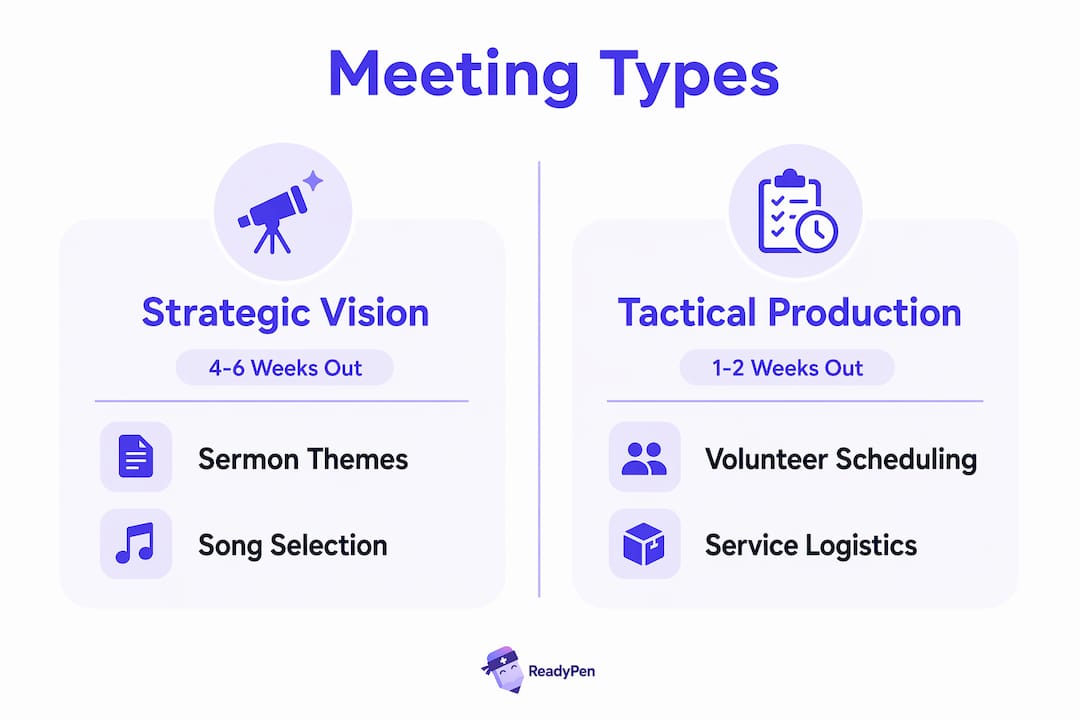
Pro Tip: Separate your strategic vision meetings from your tactical production meetings. Vision meetings happen weeks out and focus on themes and direction. Production meetings happen days out and focus on logistics and execution. Mixing the two creates confusion and burns out your team.
| Meeting type | Timing | Primary focus |
|---|---|---|
| Strategic vision | 4–6 weeks out | Sermon themes, song direction, seasonal planning |
| Planning session | 7–10 days out | Set list, volunteer roles, service flow |
| Production check | 2–3 days out | Tech needs, transitions, final confirmations |
| Rehearsal | Day before or day of | Musical execution, spiritual alignment |
How to align worship planning with your pastor’s vision
Lack of alignment between the lead pastor and the worship leader is the most common worship planning pitfall. When the worship set and the sermon feel disconnected, the congregation senses it. The fix is a “Vision First” conversation that happens before any song selection begins.
The Vision First approach works like this. The worship leader meets with the lead pastor early in the planning cycle to understand the sermon’s core message, emotional tone, and spiritual goal. From that conversation, the worship leader builds a set that prepares hearts for what the pastor is about to say. This is not about matching song titles to sermon points. It is about creating a spiritual trajectory that carries the congregation from arrival to response.
“The worship set should not just precede the sermon. It should prepare the soil so the message lands in ready hearts. That requires the worship leader and pastor to be in genuine, ongoing conversation, not a five-minute hallway check-in.”
Practical steps for maintaining this alignment include:
- Schedule a standing weekly or biweekly meeting between the worship leader and lead pastor.
- Share the planned set list with the pastor at least one week out for feedback.
- Build in a midweek checkpoint to adjust songs if the sermon direction shifts.
- Incorporate thematic prayers and Scripture readings that reinforce the sermon’s central idea.
Worship leadership is pastoral work, not just musical performance. When you plan with the congregation’s spiritual journey in mind, you stop building playlists and start building experiences. Transposing a song to a different key, adjusting the tempo, or cutting a verse can all serve the emotional arc of the service in ways that pure musical preference never will.
What communication tools actually help worship teams collaborate?
Platform fragmentation is one of the fastest ways to lose your team’s trust. When announcements go out through text messages, emails, Facebook groups, and verbal reminders all at once, critical information gets missed. The fix is a single communication hub where your team knows to look for everything.

A clear platform assignment prevents overlap and confusion:
| Platform | Best use |
|---|---|
| Planning Center | Scheduling, song lists, service orders |
| Slack or a team app | Staff and core team real-time updates |
| Formal logistics, announcements, documents | |
| Text message | Urgent, time-sensitive alerts only |
Avoid using text messages as a primary communication channel. Texts feel informal, get buried quickly, and create parallel conversations that fragment your team’s attention. When volunteers are unsure where to look for information, they disengage. Consistent platform use builds trust because it removes ambiguity.
When you introduce a new workflow or platform, give it a full two weeks before evaluating whether it works. New workflows need time to become habits, and abandoning them after one rough week guarantees your team will resist future changes. Train your volunteers on the system once, document the process clearly, and then trust them to use it. Micromanaging communication defeats the purpose of having a system at all.
Pro Tip: Use your meeting workflow documentation as the single source of truth for every planning session. When decisions are recorded and accessible, you eliminate the “I didn’t know about that” problem entirely.
How to structure worship rehearsals for musical and spiritual readiness
A focused rehearsal respects your volunteers’ time and produces better results than a long, unfocused one. The recommended breakdown for a well-structured rehearsal runs 60–85 minutes total, divided as follows:
- Prayer and alignment (10 minutes): Begin with a brief devotional and prayer. This is not filler. It sets the spiritual tone and reminds musicians that they are serving, not performing.
- Sound and setup (7–10 minutes): Handle technical needs before the musical work begins. Stopping mid-rehearsal for sound issues breaks momentum and frustrates volunteers.
- Focused song work (40–60 minutes): Work through the set in service order. Prioritize transitions, dynamic shifts, and any sections that need extra attention. Avoid over-playing songs that the team already knows well.
- Wrap-up (5 minutes): Close with prayer, confirm Sunday logistics, and release the team on time.
Rehearsals that respect people’s time improve team enthusiasm and reduce volunteer burnout. When musicians know that rehearsal starts and ends on schedule, they show up prepared and engaged. When rehearsals run long without clear purpose, attendance drops over time.
Onboarding new musicians deserves its own attention. The best practice is a gradual “first look” process where new team members attend rehearsals and services before they ever step on stage. This approach builds cultural alignment and musical confidence before the pressure of a live service. Placing someone on stage before they understand your team’s culture and expectations is a setup for a difficult experience for everyone involved.
One insight that most worship leaders learn the hard way: worship leaders often plan one step ahead of where the congregation actually is emotionally. Rehearsal is the right time to practice meeting people where they are, not where you want them to be. Build that awareness into your song work, and your Sunday transitions will feel natural rather than forced.
Key Takeaways
Effective worship team planning sessions combine clear meeting structure, pastoral alignment, disciplined communication, and focused rehearsals to produce services where every team member is prepared and every element serves the congregation.
| Point | Details |
|---|---|
| Meeting structure matters | Run 45–60 minute sessions with a four-part agenda, scheduled 7–10 days before the service. |
| Separate vision from logistics | Hold strategic meetings weeks out and production meetings days out to prevent burnout. |
| Align with pastoral vision | Start every planning cycle with a Vision First conversation between the worship leader and pastor. |
| Use one communication hub | Assign each platform a specific purpose and train volunteers to use it consistently. |
| Rehearse with purpose | Structure rehearsals in timed segments and onboard new musicians gradually before placing them on stage. |
What I’ve learned from watching worship teams plan
The teams that struggle most are not the ones with the least talent. They are the ones mixing vision conversations with production logistics in the same meeting. When a worship leader is trying to discuss the spiritual arc of a sermon series while also confirming who is running the soundboard, neither conversation gets the attention it deserves. Separating those two rhythms is the single change that produces the most immediate improvement.
I have also noticed that worship leaders underestimate how much their team watches them handle pressure. When a leader walks into a planning session scattered and unprepared, the team absorbs that energy. When the leader arrives with a clear agenda, a spiritual anchor, and a calm presence, the team follows. The meeting structure is not bureaucracy. It is pastoral care for your volunteers.
Gradual implementation works better than wholesale change. If your team has never used a structured agenda, introduce one section at a time. If you are moving to a new communication platform, give it the full two weeks before drawing conclusions. The goal is not a perfect system on week one. The goal is a team that trusts the process enough to stay engaged through the adjustment.
— Robbie
How Readypen helps worship leaders document and track planning sessions
Worship planning sessions generate a lot of decisions, and those decisions need to be captured somewhere. Readypen is built for exactly this. It automatically generates meeting notes, summaries, and structured documents from your conversations or recordings, so nothing falls through the cracks after the meeting ends.
For ministry teams without dedicated admin support, Readypen removes the burden of manual note-taking entirely. Your worship leader stays present in the meeting instead of typing notes. Your team gets a clear, organized summary they can reference all week. Visit the Readypen ministry page to see how it fits into your planning workflow. You can also explore the church meeting minutes guide for practical documentation frameworks built for church environments.
FAQ
How long should a worship team planning meeting be?
A worship team planning meeting should run 45–60 minutes, scheduled 7–10 days before the service. Send the agenda at least 24 hours in advance so team members can prepare.
How far ahead should worship services be planned?
Planning worship services 4–6 weeks ahead gives you the margin to align with sermon themes, coordinate volunteers, and handle scheduling conflicts before they become problems.
What should a worship team meeting agenda include?
A strong worship team meeting agenda covers four sections: devotion or prayer, quick updates, strategic goal discussion, and a wrap-up with assigned action items.
How do you keep worship team communication organized?
Assign each platform a specific role. Use Planning Center for scheduling, Slack for real-time team updates, and email for formal logistics. Avoid using text messages as a primary channel.
How should new musicians be onboarded to a worship team?
New musicians should attend rehearsals and services as observers before serving on stage. This gradual process builds cultural alignment and musical confidence before the pressure of a live service.