How Pastors Build Reproducible Meeting Systems

How Pastors Build Reproducible Meeting Systems
A reproducible church meeting system is a structured set of recurring meetings designed to maintain alignment, clarify decisions, and assign responsibilities within pastoral teams. Pastors who build reproducible meeting systems stop relying on memory and goodwill to keep their teams moving. Instead, they create a framework that runs consistently whether the senior pastor is present or not. This article gives you the exact structure, roles, and documentation practices to build that framework from scratch, covering everything from weekly check-ins to seasonal reviews.
What does a pastor need before building reproducible meeting systems?
Before any meeting structure holds, two things must be in place: leadership buy-in and clear role definitions. Without both, even the best agenda becomes a suggestion nobody follows.
Leadership buy-in means every team member understands why the system exists. That is not a one-time announcement. It is a repeated conversation about how structured meetings protect the mission and reduce wasted time. When leaders see meetings as spiritual touchpoints rather than administrative obligations, participation quality rises immediately.

Role clarity is equally non-negotiable. Effective meeting systems require at least two defined roles: a facilitator who guides discussion and keeps the group on track, and an administrator who captures decisions and assigns action items. These roles can rotate across team members, which builds shared ownership and prevents any one person from burning out.
The tools you need at the start are simpler than most pastors expect:
- A shared agenda template (Google Docs or a printed form both work)
- A communication channel for pre-meeting prep and post-meeting follow-up
- A documentation system that records decisions with named owners and deadlines
Pro Tip: Before your first structured meeting, send the agenda at least 48 hours in advance. Teams that arrive prepared cut meeting time by a third and make sharper decisions.
| Role | Responsibility |
|---|---|
| Facilitator | Guides discussion, keeps agenda on track, manages time |
| Administrator | Captures decisions, assigns owners, records deadlines |
| Participants | Come prepared, contribute to discussion, own their action items |
| Senior Pastor | Sets direction, resolves escalated decisions, closes in prayer |
How to structure different types of meetings for reproducibility
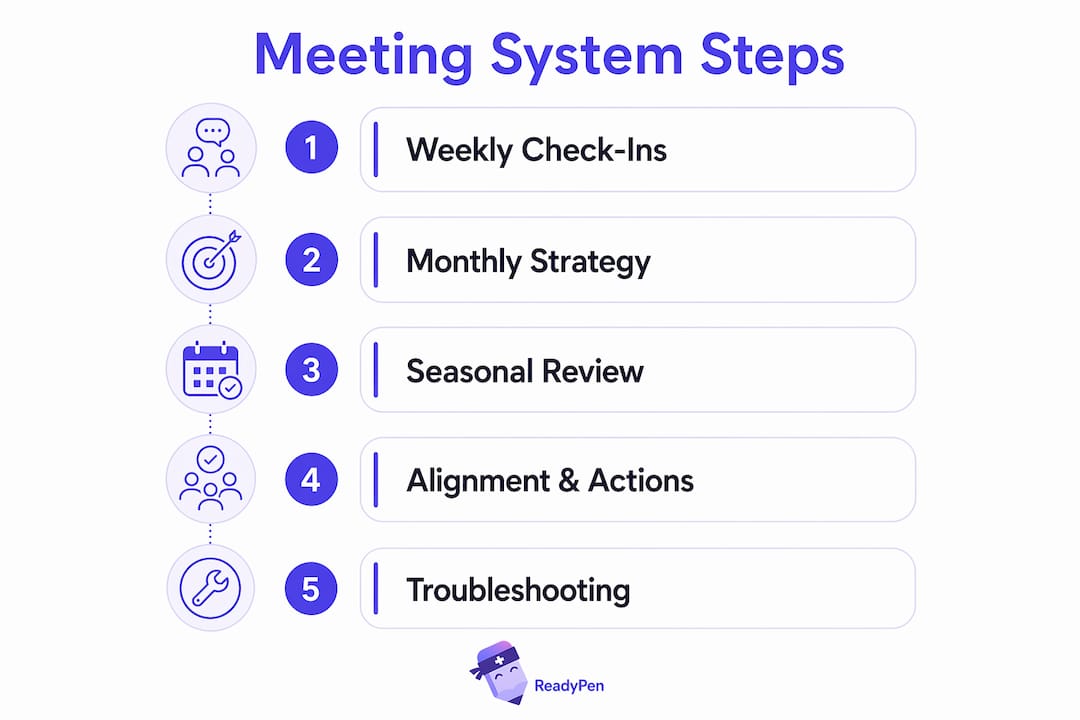
The most effective church meeting framework uses a tiered cadence of three meeting types: weekly operational check-ins, monthly strategy sessions, and seasonal reviews every four months. Each tier has a distinct purpose, and mixing those purposes is the fastest way to kill a meeting culture.
Weekly operational meetings (60–90 minutes)
Weekly meetings are not status reports. They are alignment sessions. The goal is to surface roadblocks, confirm priorities, and send every team member into the week with clarity. A reliable weekly agenda looks like this:
- Relational connection (5 minutes)
- Devotional or Scripture reflection (10 minutes)
- Data review: attendance, giving, key metrics (10 minutes)
- Project updates by ministry area (20 minutes)
- Roadblocks and decisions needed (15 minutes)
- Recap of action items with owners (10 minutes)
- Closing prayer (5 minutes)
Rotating who leads the devotional and who facilitates the recap builds engagement. Rotating leadership roles also prevents the meeting from feeling like a one-person show every week.
Monthly strategy sessions
Monthly meetings go deeper. This is where you evaluate ministry direction, review budget performance, and make decisions that are too complex for a weekly check-in. Keeping complex decisions out of weekly meetings protects the team from decision fatigue and keeps weekly momentum intact. A monthly session typically runs two to three hours and includes a review of the previous month’s action items, a forward-looking ministry assessment, and at least one focused discussion on a strategic question.
Seasonal reviews (every four months)
Seasonal reviews are the least frequent but the highest-leverage meetings in the system. Three times per year, the team steps back from operations entirely and asks whether the church is moving in the right direction. These sessions work best off-site or in a different room than the usual meeting space. The change of environment signals that this is a different kind of thinking.
Pro Tip: Never mix culture-building activities with decision-making in the same meeting block. Culture conversations require openness and reflection. Decision-making requires focus and closure. Blending them produces neither.
What steps ensure every meeting drives alignment and clear next actions?
Execution is where most meeting systems fail. A good agenda means nothing if the meeting drifts or ends without documented commitments.
Start every meeting with a brief prayer and a one-sentence purpose statement. That statement answers the question: “What does a successful meeting look like today?” It takes 30 seconds and orients every person in the room before a single agenda item opens.
Difficult church meetings follow a nine-step procedure that begins with prayer and purpose and ends with documented next steps. The steps in between include presenting facts without editorializing, structured discussion, a formal motion or decision point, a summary of what was decided, and a clear assignment of who does what by when. This structure works for conflict situations, but it also works for any meeting where stakes are high and clarity matters.
Managing participation requires active facilitation. Draw out quieter voices by asking direct questions. Cut off tangents by naming them: “That is worth a separate conversation. Let’s table it and keep moving.” The facilitator’s job is not to dominate but to protect the group’s time and focus.
Technology is the leading cause of meeting disengagement. No-tech policies or requiring physical device storage during meetings produces measurably better participation and attention. If someone needs a device for note-taking, assign that role explicitly so it does not become a cover for distraction.
High-impact meetings close with documented decisions that specify who owns each action item, what they will do, and when it is due. That documentation goes out to the full team within 24 hours of the meeting ending. Teams that receive prompt follow-up communication stay aligned between meetings without needing extra check-ins.
Pro Tip: Read the action item list aloud before closing every meeting. Each owner should verbally confirm their commitment. Public acknowledgment reduces follow-through failures significantly.
How do you troubleshoot common pitfalls in church meeting systems?
Even well-designed systems break down. The most common failure points are agenda drift, lack of preparation, and unclear action items. Each one has a direct fix.
Agenda drift happens when a single topic consumes the whole meeting. The facilitator must enforce time limits visibly. Use a timer. When time expires on an item, call it and move forward. If the topic needs more time, schedule a separate conversation.
Lack of preparation is usually a communication problem. Teams that receive agendas the morning of a meeting arrive unprepared. Sending agendas 48 hours early with pre-read materials attached changes that pattern. Structured workflow documents with assigned owners and time slots prevent verbal-only task assignment, which is the primary cause of follow-up failure.
Unclear action items are the most damaging pitfall because they create the illusion of progress without actual movement. Every action item needs three elements: a named owner, a specific deliverable, and a deadline. “Someone will look into that” is not an action item.
Additional pitfalls to watch for:
- Meetings that run long consistently signal an agenda that is too full. Cut one item per week until the meeting ends on time.
- Teams that disengage mid-meeting often need a format change, not a longer devotional. Try a standing meeting for weekly check-ins.
- Pastors who skip their own meeting system during busy seasons undermine the entire culture. Consistency is the system.
Reproducible meeting systems must be flexible enough to adapt to different church sizes and cultures, but they must always document action items with responsible owners and deadlines. A small church with three staff members runs the same three-tier cadence as a large church. The agenda length and complexity differ. The structure does not.
Pro Tip: Schedule a 15-minute quarterly review of your meeting rhythms. Ask the team: “What is working? What wastes our time?” Adjust one thing per quarter. Small changes compound into a system the team actually values.
Key Takeaways
A pastor who builds reproducible meeting systems creates a framework that runs on structure rather than personality, keeping the team aligned and the mission moving regardless of who is in the room.
| Point | Details |
|---|---|
| Use a tiered cadence | Run weekly operational, monthly strategy, and seasonal review meetings as separate tiers with distinct purposes. |
| Define roles before meeting one | Assign a facilitator and administrator for every meeting; rotate roles to build shared ownership. |
| Document every decision | Record who owns each action item, what they will do, and when it is due, then distribute within 24 hours. |
| Protect weekly meetings | Keep complex decisions out of weekly check-ins to prevent burnout and maintain momentum. |
| Review the system regularly | Audit meeting rhythms quarterly and adjust one element at a time based on team feedback. |
Why I think most pastors underestimate what a meeting system actually does
I have watched pastoral teams go from dreading their Monday morning meeting to genuinely looking forward to it. The change never came from a better devotional or a more charismatic facilitator. It came from structure.
What surprised me most is how quickly a reproducible system changes the team’s relationship to the mission itself. When people know exactly what kind of meeting they are walking into, what their role is, and what will happen with the decisions made, they show up differently. They prepare. They contribute. They follow through.
The concept of alignment versus consensus is the single most underused idea in church leadership. Pastors often spend enormous energy trying to get everyone to agree. Alignment is different. It means every person supports the direction even if their personal preference differs. A good meeting system builds that kind of unity without requiring unanimity on every point.
My honest advice: start smaller than you think you need to. One well-run weekly meeting with a consistent agenda, two defined roles, and documented action items will do more for your team than a full system overhaul attempted in a single month. Build the habit first. The system follows naturally.
— Robbie
Readypen makes meeting documentation effortless for ministry teams
Capturing decisions, action items, and summaries by hand takes time that most pastoral teams do not have. Readypen is an AI-powered meeting documentation tool built specifically for churches, pastors, and ministry organizations.
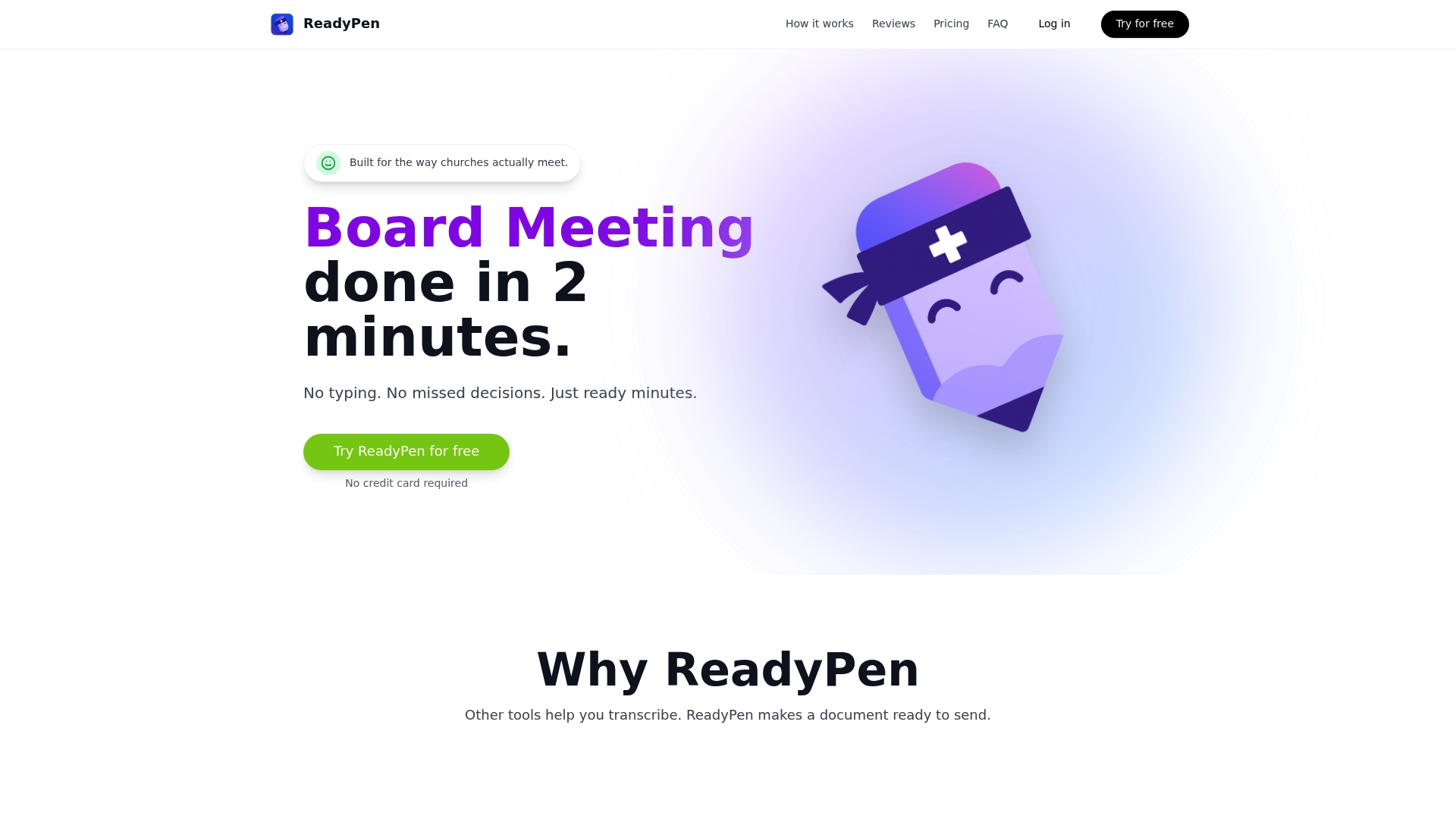
Readypen automatically generates structured meeting notes from conversations or recordings, so your administrator can focus on participating rather than transcribing. Every action item, decision, and deadline gets captured accurately and organized without manual effort. For teams building a reproducible meeting system, that means the documentation layer is handled from day one. Visit Readypen for ministry leaders to see how it fits your church’s workflow.
FAQ
What is a reproducible church meeting system?
A reproducible church meeting system is a structured set of recurring meetings with defined roles, standard agendas, and documented action items that runs consistently regardless of who is present.
How often should a pastor hold staff meetings?
Effective meeting cadences include weekly operational check-ins of 60–90 minutes, monthly strategy sessions, and seasonal reviews every four months.
How do you keep church meetings from running too long?
Enforce time limits per agenda item using a visible timer, and send the agenda at least 48 hours before the meeting so participants arrive prepared and discussions stay focused.
What is the difference between alignment and consensus in meetings?
Alignment means every team member supports the chosen direction even if personal preferences differ. Consensus requires full agreement, which is harder to achieve and often unnecessary for mission progress.
How should action items be documented after a church meeting?
Every action item needs a named owner, a specific deliverable, and a clear deadline. Structured workflow documents with these three elements, distributed within 24 hours, prevent task slippage and keep teams accountable.
Recommended
- ReadyPen - AI Meeting Documentation for Churches | Automated Minutes & Summaries
- ReadyPen - AI Meeting Documentation for Churches | Automated Minutes & Summaries
- ReadyPen - AI Meeting Documentation for Churches | Automated Minutes & Summaries
- ReadyPen - AI Meeting Documentation for Churches | Automated Minutes & Summaries