Dual-Role Dilemma: How to Lead and Document Church Meetings Seamlessly
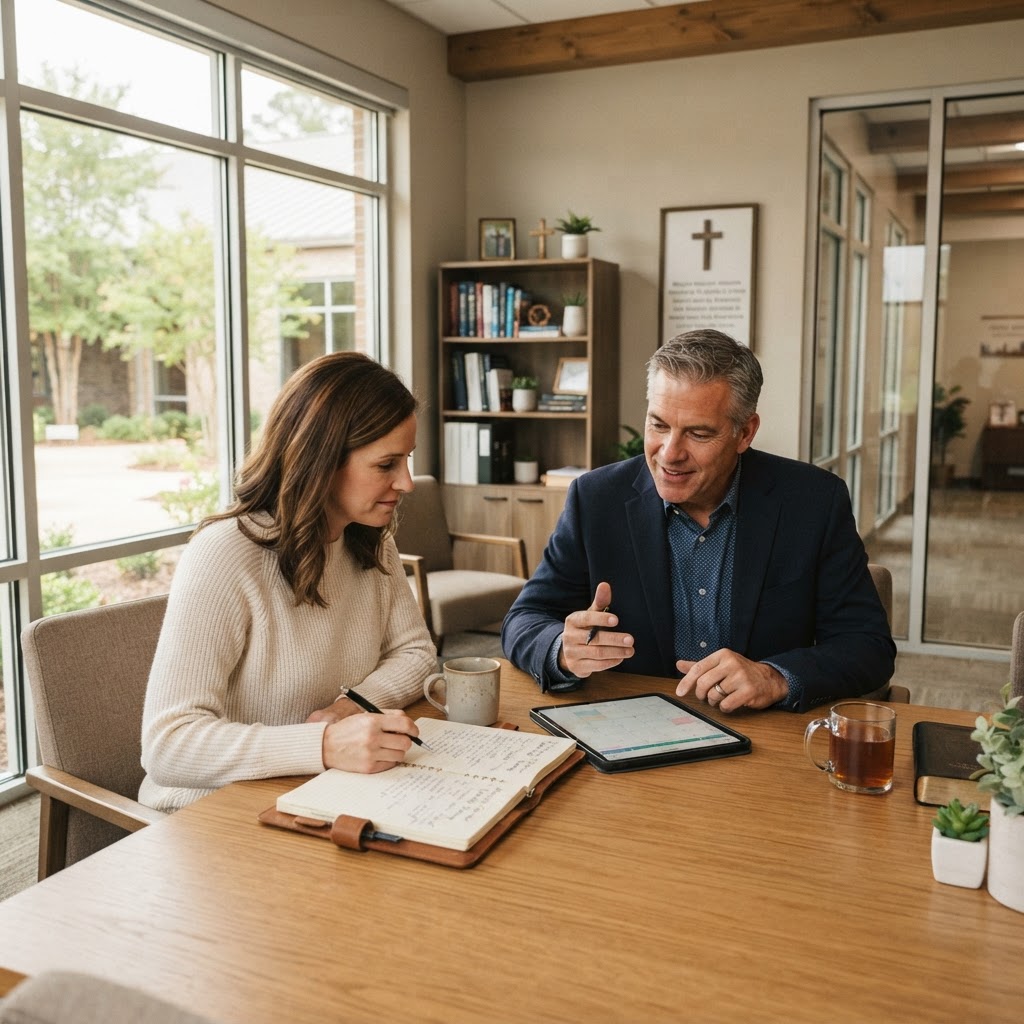
You are three minutes into your elder board meeting. You are explaining the vision for the upcoming building renovation, gesticulating to emphasize the importance of the sanctuary layout. In your peripheral vision, you see the board secretary frantically scribbling notes, trying to capture your words while simultaneously wrestling with a follow-up question from the treasurer. It is a scene familiar to every ministry leader: the exhausting tug-of-war between being fully present in a spiritual conversation and fulfilling the administrative duty of record-keeping.
When you wear two hats—the leader and the scribe—the quality of both often suffers. You either end up with a truncated, confusing set of minutes that miss the 'why' behind the 'what,' or you find yourself physically present but mentally absent, preoccupied with documenting every nuance rather than shepherding your team. The challenge is not just about typing speed; it is about cognitive load. How do you maintain the holy flow of a ministry meeting while ensuring the business of the church remains transparent, accountable, and legally sound?
The Cognitive Shift: Separating Roles with Structural Cues
The primary reason documenting a meeting while participating feels impossible is that it requires two different hemispheres of the brain. Leading requires empathy, vision, and spontaneous engagement. Documenting requires structure, detachment, and factual synthesis. To manage this, you must stop trying to do both at the same exact time. Instead, implement a system of structural cues that allow you to 'switch' modes without breaking the meeting's momentum.
The most effective strategy is the 'Gap-Recording Technique.' Instead of writing sentences in real-time, keep a small, physical notepad (or a tablet) dedicated solely to action items and core decisions. Do not attempt to summarize the discussion; your focus is purely on the output. By limiting your in-meeting writing to these anchors, you maintain your status as an active participant while gathering the skeletal structure required to flesh out the formal minutes later in the day.
Designing a High-Performance Minute Matrix
If you wait until the end of the week to write your minutes, the context is already lost. Your memory will fail to recall why the team chose Option B over Option A, or the subtle nuance of the pastoral concern expressed during the discussion. You need a matrix that functions as a roadmap during the meeting.
| Element | During Meeting Focus | Post-Meeting Expansion |
|---|---|---|
| Decision | Write the resolution text | Record the vote/concurrence |
| Action Item | Assign owner and deadline | Attach to project status |
| Key Discussion | Bullet point 2-3 key arguments | Contextualize the narrative |
| Prayer/Spiritual | Capture the prompt | Note the outcome/feeling |
By utilizing a pre-set template, you shift from being a 'writer' to an 'editor' during the actual meeting. This allows you to focus on the people in the room, knowing that the structural heavy lifting is already accounted for on your matrix.

Pro Tip: Never document word-for-word transcripts. Church minutes should focus on the 'what' and 'why' of decisions, not the 'who said what' of every minor comment, which can inadvertently create a culture of surveillance rather than collaboration.
Visualizing the Burden of Manual Documentation
When you attempt to document everything manually, your efficiency drops significantly. Research indicates that the time spent 'reconstructing' meeting memories increases exponentially the longer you wait to synthesize your notes into formal documentation. The following chart illustrates the time-to-completion based on different documentation methods in a ministry setting.
Time-to-Minute Completion (Hours Spent Per Week)
As this data suggests, relying solely on manual memory reconstruction is the single biggest thief of pastoral productivity. By using specialized tools like ReadyPen to handle the heavy lifting of transcribing and summarizing, you reclaim hours that could be better spent on counseling, sermon preparation, or community outreach.
The 'Reflect and Review' Protocol
After the meeting concludes, do not leave the room yet. The 'buffer time' is where the magic happens. Spend five minutes reviewing your notes while the energy of the room is still fresh in your mind. This is the moment to flesh out the 'why'—the reasoning behind the decisions you captured. If you try to do this the next morning, you have already lost the emotional context of the discussion.
Ensure that every action item has a person's name attached to it. A generic note like 'we need to follow up on the roof' will inevitably lead to a meeting next month where everyone asks, 'Wait, did we ever follow up on the roof?' By confirming names and deadlines immediately, you turn a passive set of notes into an active project management tool.
Handling Sensitive Pastoral Discussions
One of the hardest parts of taking minutes in a church setting is navigating sensitive pastoral matters. Some discussions require confidentiality and should not be recorded in the official minute book for liability and privacy reasons. Establish a 'Confidentiality Protocol' at the beginning of each meeting.
When the team transitions into a sensitive topic, explicitly state: 'We are moving into a confidential session, no minutes will be recorded.' This protects the secretary from the ethical burden of documenting personal crises and allows the team to be vulnerable and honest. It is okay to have 'off the record' time; in fact, it is necessary for pastoral health. Just ensure the board or committee agrees on these boundaries beforehand so no one feels that critical decisions are being made in the shadows.

Pro Tip: Keep two separate folders: one for the 'Official Minute Book' (for policy, financial, and strategic decisions) and one for 'Actionable To-Dos' (for staff and ministry teams). You rarely need the deep narrative in the minute book—keep it short, legal, and clear.
Key Takeaways
| Point | Details |
|---|---|
| Separate Roles | Don't write in real-time; use a matrix to capture anchors. |
| The Buffer Time | Spend 5 minutes immediately post-meeting to finalize context. |
| Define Boundaries | Agree upfront on what is confidential vs. what is recordable. |
| Leverage Technology | Use AI tools to handle the transcription and synthesis. |
Conclusion: Focus on Ministry, Not the Paperwork
Your role as a leader is to shepherd the flock, not to manage a mountain of meeting notes. By utilizing structured capture techniques and delegating the rote work of transcription to technology, you protect your energy for the things that truly matter—the spiritual growth of your people and the effective execution of your church's mission. You do not need to be both the stenographer and the shepherd. When you free yourself from the burden of manual documentation, you lead with more clarity and presence. If you are ready to stop typing and start leading, you can try ReadyPen free to see how we automate meeting documentation specifically for ministry teams.