Documentation's Role in Team Trust: A Leader's Guide

Documentation’s Role in Team Trust: A Leader’s Guide
Documentation is defined as the structured practice of recording decisions, processes, and expectations so every team member operates from the same shared reality. The role of documentation in team trust is not passive record-keeping. It is active infrastructure that tells your team: “We are reliable, we are accountable, and we respect your time.” Teams with high-quality documentation improve overall performance by 25% and cut new hire ramp-up time from 3.2 months to 1.4 months. That number alone should reframe how you think about a wiki, a runbook, or an onboarding guide. These are not administrative tasks. They are trust contracts.
How does documentation directly affect trust-building among teams?
Documentation builds trust through a simple mechanism: it removes the need to guess. When your team can open a shared document and find the answer, they stop relying on whoever happens to be available. That shift from person-dependent to process-dependent knowledge is the foundation of trust building in teams.
Think of a well-maintained wiki as a trust contract. It says: “What you read here is accurate, current, and agreed upon.” When that contract holds, team members make decisions with confidence. When it breaks, they start doubting everything, including each other.
“Current documentation is a proxy for product quality, signaling prioritization of user and teammate experience.” — Appwrite
The inverse is equally true. Stale or inaccurate documentation is worse than no documentation at all. A document that confidently gives wrong instructions destroys trust faster than silence. Teams that encounter outdated records stop consulting them and revert to informal channels: Slack messages, hallway conversations, and interrupting senior staff. This pattern has a real cost. When trust in documentation collapses, teams revert to interrupt-driven knowledge sharing, overloading senior staff and reducing output. Senior engineers become the human FAQ, and the team’s velocity drops.
How documentation affects trust also shows up in accountability. When decisions are recorded with their rationale, no one can quietly revise history. Architecture decision records, or ADRs, are a strong example. They capture not just what was decided but why, so future team members understand the context rather than second-guessing their predecessors.

What types of documentation are most effective for sustaining team trust?
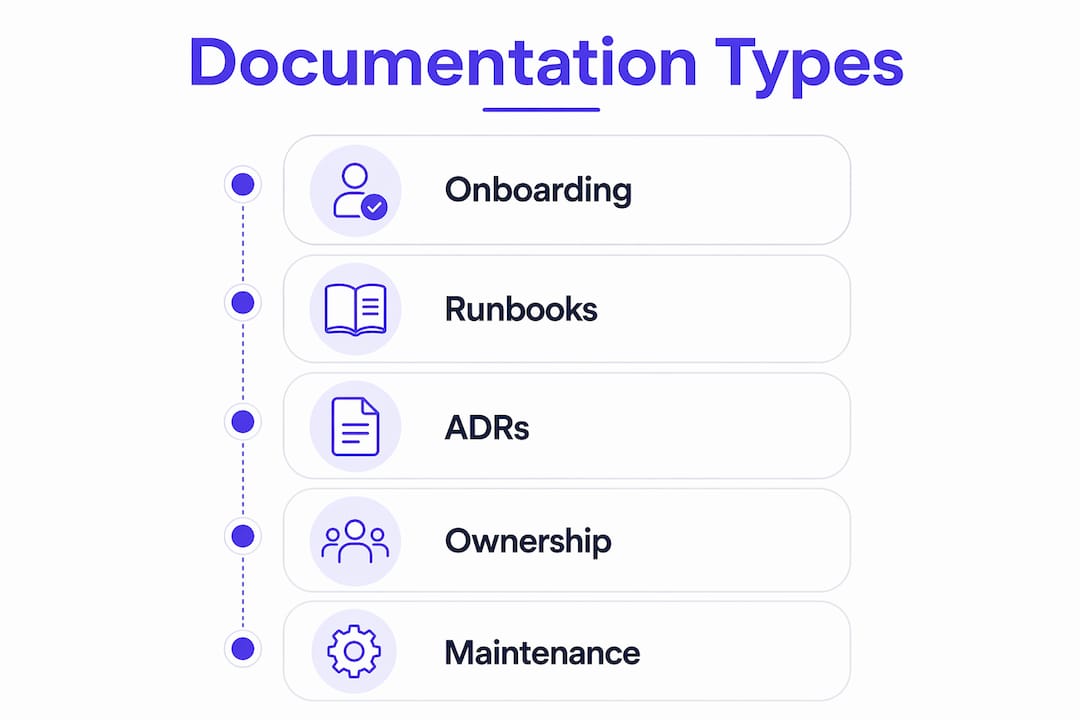
Not all documentation carries equal weight. Some types build trust immediately. Others protect it over time. The table below compares the most effective formats and their primary trust function.
| Documentation type | Primary trust function | Maintenance frequency |
|---|---|---|
| Architecture decision records (ADRs) | Captures rationale, reduces ambiguity | Per decision |
| Onboarding guides | Accelerates integration, builds process confidence | Quarterly |
| Runbooks | Provides clear steps during high-stress incidents | After each incident |
| API documentation | Maintains technical accuracy for integrations | Per release |
| Team wikis | Centralizes shared knowledge and norms | Ongoing |
Onboarding guides generate the highest return on investment of any documentation type. New engineer onboarding docs save hours multiplied by every future new hire. A new team member who finds a clear, accurate onboarding guide on day one immediately trusts the organization. A new member who gets a broken link and a shrug does not.
Runbooks serve a different trust function. They matter most under pressure. When a system fails at 2 a.m., a clear runbook tells your on-call engineer exactly what to do. That clarity prevents panic, reduces errors, and signals that the team prepared for failure. Preparation is a form of respect.
ADRs protect long-term trust by preserving institutional memory. Teams that skip ADRs force future members to reverse-engineer decisions, often incorrectly. That leads to repeated debates, wasted effort, and quiet resentment toward whoever made the original call without explanation.
Pro Tip: Assign a single named owner to every critical document. A document owned by “the team” is owned by no one. Assigning a specific human owner to every critical document ensures accuracy and prevents the stale doc trap.
What are common documentation pitfalls that undermine trust?
Documentation fails in predictable ways. Recognizing these patterns early saves your team from the slow erosion of confidence that follows.
- Stale documentation. General documentation has a functional half-life of roughly 6 weeks before it becomes outdated or misleading. A document that was accurate in January may actively mislead a new hire in March. Teams that do not schedule reviews let this happen silently.
- No clear ownership. When no one is responsible for a document, no one updates it. Docs without owners rot. They accumulate errors, lose relevance, and eventually get ignored entirely.
- Documentation volume without usability. More pages do not mean more trust. A 200-page wiki that no one can navigate is a liability. Excessive volume creates inertia. Team members stop searching because they expect to find nothing useful.
- Misalignment between docs and actual workflows. A process document that describes how things were supposed to work, not how they actually work, is a trust killer. When team members follow the doc and get the wrong result, they blame the documentation culture, not just the specific file.
- Interrupt-driven knowledge sharing as a substitute. When docs fail, senior staff absorb the load. This is not a solution. It is a symptom. Senior team members become knowledge bottlenecks, harming organizational scalability and project velocity.
Pro Tip: Run a quarterly “dead doc” audit. Search your wiki for documents that have not been updated in 90 days and either refresh them or archive them. Archived docs are honest. Stale docs are deceptive.
How can teams implement documentation practices that build lasting trust?
Building a documentation culture that sustains trust requires treating it as operational infrastructure, not an afterthought. The following framework gives you a concrete starting point.
-
Assign direct document owners. Every critical document needs one named person responsible for its accuracy and review cycle. Not a team. Not a department. One person. This single change reduces stale documentation more than any tool or template.
-
Write docs before you build. Documentation-driven development forces teams to resolve ambiguities early by writing docs before implementation. When you write the user-facing explanation before writing the code, you discover gaps in your own thinking. The doc becomes a trust contract before the feature ships.
-
Use structured, consistent terminology. NASA-style terminology consistency improves retrieval, reduces confusion, and supports long-term maintenance. Pick standard terms for your processes and use them everywhere. “Incident” means one thing. “Outage” means another. Do not use them interchangeably.
-
Automate where the work is repetitive. Tools like Doc Holiday generate release notes and API docs from code, helping lean teams sustain documentation culture without invisible overhead. Automation does not replace human judgment. It removes the excuse that documentation takes too long.
-
Schedule regular accuracy audits. Set a calendar reminder every quarter. Review your most-accessed documents first. Archive anything unowned or outdated. A smaller, accurate wiki is worth more than a large, unreliable one.
-
Treat documentation as a strategic asset. Treating documentation as operational infrastructure prevents costly behaviors like redundant meetings and reactive troubleshooting. Every hour your team spends answering the same question twice is an hour that good documentation would have saved.
The teams that get this right do not document everything. They document the right things, assign clear ownership, and review on a schedule. That discipline is what separates documentation that builds trust from documentation that collects dust.
Key takeaways
Documentation builds team trust when it is accurate, owned, and maintained. Stale or unowned documents actively destroy the confidence they were meant to create.
| Point | Details |
|---|---|
| Documentation as trust infrastructure | Treat docs as operational assets, not administrative tasks, to sustain team confidence. |
| Ownership prevents decay | Assign one named owner per critical document to prevent stale, misleading records. |
| Onboarding guides deliver the highest ROI | Clear onboarding docs cut new hire ramp-up time from 3.2 months to 1.4 months. |
| Stale docs break trust faster than no docs | Documentation has a functional half-life of roughly 6 weeks. Schedule reviews accordingly. |
| Documentation-driven development closes gaps early | Writing docs before building reveals ambiguities and creates shared understanding before code ships. |
Why documentation is really a leadership problem
I have watched teams invest in Notion, Confluence, and Google Docs, set up beautiful templates, and still end up with wikis no one trusts six months later. The tool is never the problem. The culture is.
What I have found is that documentation fails when leadership treats it as something the team should “just do” rather than something leadership actively models and protects. If your senior engineers never write docs, your junior engineers will not either. If you never block time for documentation reviews, they will not happen. The behavior at the top sets the standard for everyone below it.
The most effective change I have seen is deceptively simple: make one person responsible for one document, and hold them to it in your regular check-ins. Not as a punishment. As a professional expectation, the same way you hold someone accountable for a deliverable. When documentation accountability shows up in your team’s normal rhythm, it stops feeling like extra work and starts feeling like part of the job.
The other thing leadership consistently underestimates is the cost of not documenting. Redundant meetings, repeated onboarding conversations, and senior staff fielding the same questions every week are all invisible line items. They do not show up in a budget, but they drain your team’s time and patience. Good documentation is not a nice-to-have. It is how you protect your team’s capacity to do real work.
— Robbie
How Readypen helps your team document with confidence
Church and ministry teams run more meetings than almost any other organization type, and they rarely have dedicated admin support to capture everything that matters. Decisions get made, action items get assigned, and then the notes never get written. That gap is where trust quietly erodes.
Readypen is built specifically for this problem. It automatically generates meeting notes and summaries from conversations or recordings, so your staff never has to choose between being present in the meeting and capturing what was said. Every session produces a structured, accurate record your team can reference, share, and trust. If you want to see how structured documentation responsibility works in practice, the guide on who should take meeting minutes is a strong starting point for any ministry team building better habits.
FAQ
What is the role of documentation in team trust?
Documentation builds team trust by creating a shared, accurate record of decisions, processes, and expectations. When team members can rely on written records instead of memory or informal channels, accountability and collaboration improve.
How does outdated documentation hurt a team?
Stale documentation misleads team members, causes errors, and erodes confidence in the team’s processes. General documentation has a functional half-life of roughly 6 weeks, after which it requires review or it becomes a liability.
What documentation type has the highest impact on new team members?
Onboarding guides deliver the highest return on investment because they save hours for every future new hire. Teams with strong onboarding documentation cut new hire ramp-up time from 3.2 months to 1.4 months.
What is documentation-driven development?
Documentation-driven development means writing the documentation for a feature before writing the code. This practice forces teams to resolve ambiguities early and turns the doc into an active trust contract between builders and stakeholders.
Who should own a team document?
Every critical document should have one named individual as its owner, not a team or department. Assigning a specific human owner is the most effective way to prevent stale documentation and maintain long-term accuracy.