Top 4 Church Community Builder Alternatives 2026
Top 4 Church Community Builder Alternatives 2026
Recording accurate meeting notes and minutes for church teams without wasting hours on manual transcription is still slow and error prone. Many current tools are either too generic for church governance needs or require extra costs and manual setup to capture votes and motions properly. This guide compares pricing, feature fit, and workflows so church staff and pastors can choose an alternative that matches their process without sacrificing compliance or speed.
Table of Contents
ReadyPen
At a Glance
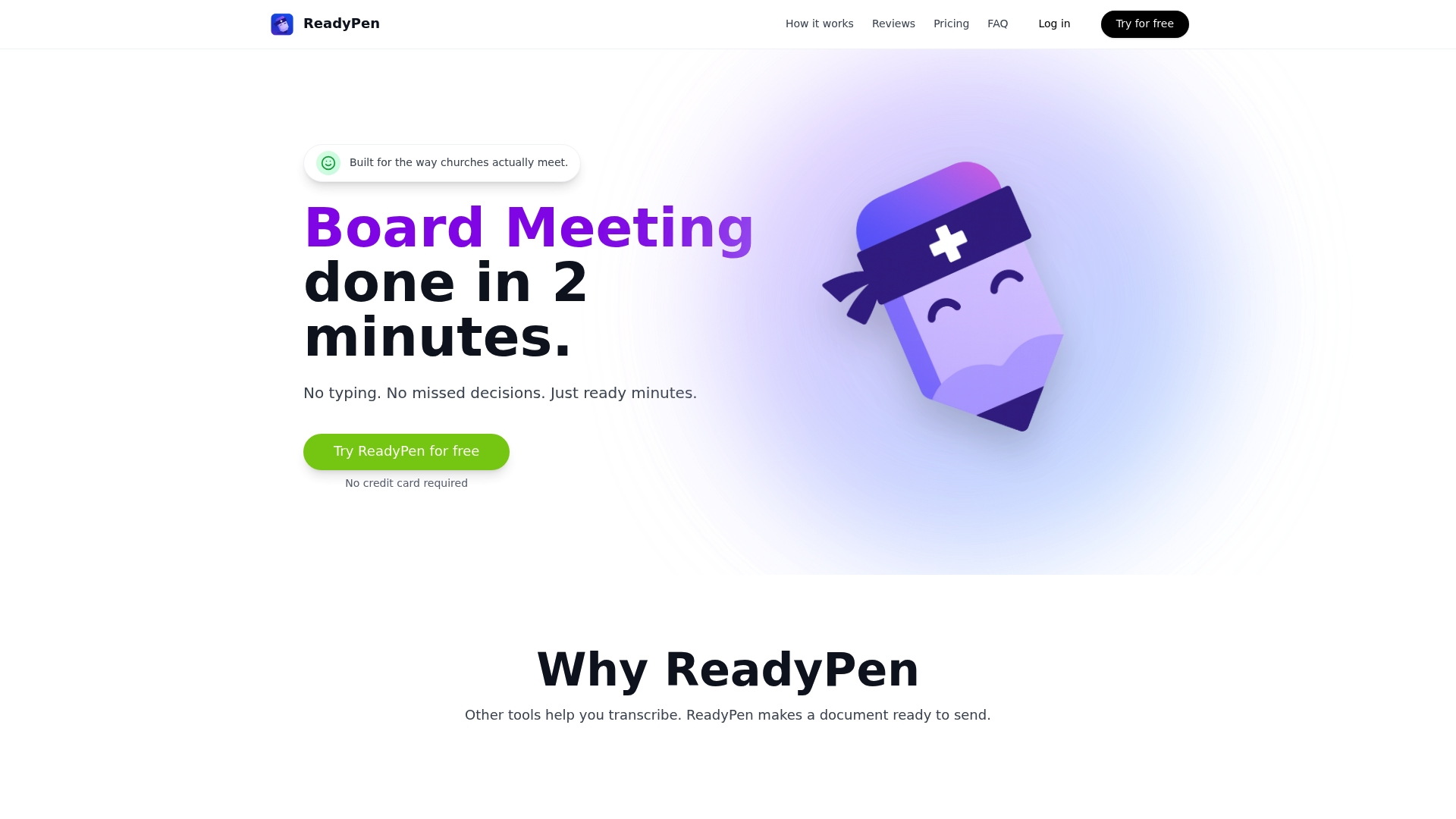
According to the company, ReadyPen can produce formatted meeting minutes from audio in under 2 minutes. That speed claim highlights a focus on fast turnarounds for routine church meetings. ReadyPen targets church governance and sermon documentation where quick, accurate records matter.
Core Features
ReadyPen offers automatic transcription and structured summaries that call out decisions and scripture references. It captures motions, votes, and action items through an auto-capture of motions feature and stores outputs in encrypted cloud storage with privacy controls. The product includes customizable meeting templates for board, vestry, finance, committee, and sermon contexts across multiple denominations.
Key Differentiator
ReadyPen is specifically tailored for churches and governance bodies and combines meeting templates with built in compliance and security. That church focus makes it practical for secretaries and pastors who must record motions and votes accurately. The product promises minute generation fast enough for same day record filing in routine use.
Pros
The tool reduces the time staff spend on minute writing by automating transcription and formatting, often completing a draft in minutes. Its templates map to common church meeting types, which helps compliance with denominational governance and record keeping. Encryption and data ownership controls address confidentiality concerns that matter for sensitive governance conversations.
Cons
- Automatic transcription may misinterpret complex or overlapping speech, which requires manual review.
Notable Integrations
ReadyPen connects with Zoom and Google Meet to ingest live sessions and recordings. Those integrations let you capture remote board or committee meetings without extra upload steps. Linking meetings reduces the friction of transferring audio files between tools.
Who It’s For
This product fits church secretaries, pastors, and governance leaders who run frequent meetings but lack dedicated minute takers. It also suits finance teams and ministry staff who need searchable sermon archives and accurate vote records. Small to mid sized congregations that prioritize compliance and privacy will find the templates helpful.
Unique Value Proposition
Preparing for an iOS App Store launch and built on Base44, ReadyPen positions itself as a church first meeting notes service with encrypted storage and customized meeting templates. That combination means your team can move from audio to compliant minutes without building workflows or hiring temporary minute takers. The vendor advertises a free tier and paid tiers that scale with meeting volume.
Real World Use Case
A church secretary links weekly board meetings to ReadyPen via Zoom and receives a draft minutes document after the meeting. The draft lists motions, votes, and assigned actions, which the secretary edits once for clarity and files with the church records. That process reduces manual note taking and shortens the time between meeting and published minutes.
Pricing
A free plan is available for limited use. Paid plans start at $18/month and rise to $40/month when billed annually, depending on size and features. The company reports one paying user contributing to monthly recurring revenue so far.
Website: https://readypen.io
Planning Center
At a Glance
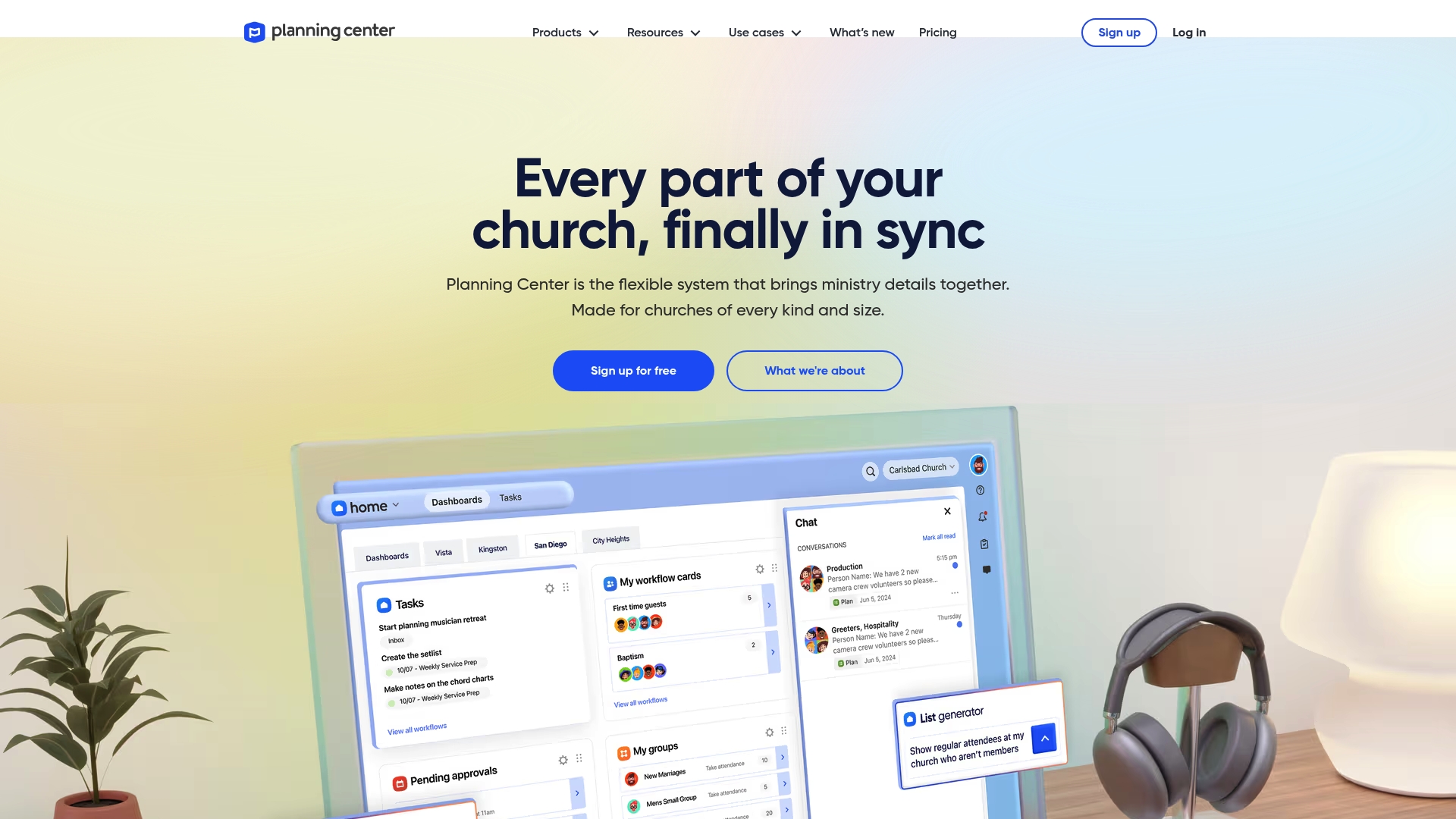
Free tier available, with paid plans from $15 to $239 per month based on team size and features. The product combines worship planning, volunteer scheduling, giving, and group management in one platform. Mobile apps and an extensive integration library support staff and congregation access on the go.
Core Features
Planning Center groups tools by ministry need so worship teams, volunteers, and administrators work from the same member records. It includes service orders, rehearsal tools, music libraries and media playback, volunteer scheduling with preferences, and donation processing that supports ACH and multiple currencies. The platform also provides mobile apps, automated follow up for signups and gifts, and ongoing product updates.
Key Differentiator
The central distinction is that Planning Center organizes multiple ministry functions inside a single account with transparent pricing and active product updates. That design reduces duplicate data entry and keeps schedules, service details, and giving records linked. The vendor emphasizes support responsiveness, which matters when volunteers or staff need quick answers.
Pros
The interface is straightforward and reduces common administrative friction for staff and volunteers. Strong third party connections mean you can attach charts and licensing information from music services or push recordings to streaming services. Customer support receives frequent praise and the platform receives regular updates to features and integrations. Pricing clarity helps finance leaders forecast costs as a ministry grows.
Cons
-
Full functionality requires internet access, so offline workflows are limited and depend on connectivity.
-
Migrating complex data from other church systems can be time consuming and may require careful setup.
-
Mobile app features differ between iOS and Android, and some tasks remain easier on a desktop.
-
Advanced integrations or specific workflows may add extra costs or technical setup work.
When It May Not Fit
If your team needs offline access for regular worship or outreach events, this may be a poor match because core tools require connectivity. Small churches with limited technical support should plan for a migration period. If your staff cannot dedicate time to initial setup and training, the learning curve for deep customization could slow adoption.
Notable Integrations
- PraiseCharts
- SongSelect
- RehearsalMix
- BoxCast
- Mailchimp
- Zapier
- Clearstream
- MinistrySafe
Who It’s For
Church staff and volunteers who want a single account that covers service planning, volunteer coordination, and giving. It fits churches that value connected records and predictable billing. Teams that rely on external music and streaming services will find the integration list useful.
Real World Use Case
Planning Center reports a church of 1,000 members uses the system to coordinate weekly services, schedule volunteers, and process online donations. That setup cut duplicate scheduling work and kept service orders, charts, and volunteer preferences in one place. Worship and admin teams used the mobile apps to confirm assignments on the day of the service.
Pricing
Free tier available with tiered paid plans. Paid plans range from $15 to $239 per month depending on team size and selected modules. The vendor states pricing is transparent with no contracts and scales with usage.
Website: https://planningcenter.com
FellowshipOne
At a Glance
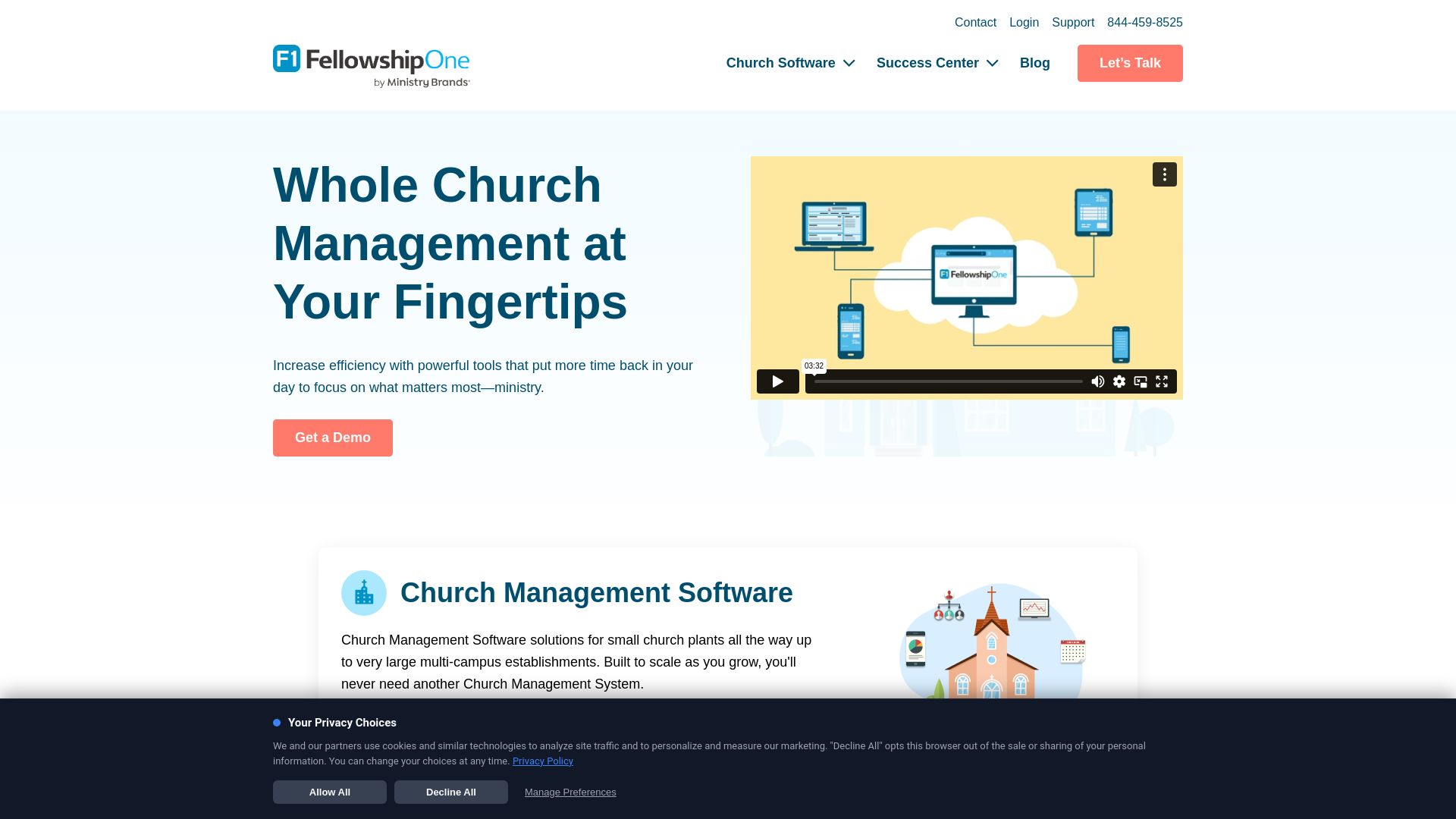
The vendor advertises that FellowshipOne is trusted by thousands of churches in the United States. That claim sits alongside a single system that groups membership records and financial tools so staff do fewer manual reconciliations. The product targets churches that want member data and money handled from the same console.
Core Features
FellowshipOne combines congregation and membership management with church accounting and payroll, so it keeps records and finances in one place. It includes online giving and electronic payment processing, alongside mobile apps for member engagement and volunteer coordination. The platform also supports worship planning, website hosting, and background check integration for volunteer and staff safety.
Key Differentiator
FellowshipOne focuses exclusively on church operations and scales features to match congregation size. Its mix of membership databases, contribution processing, and payroll inside one product reduces the need to stitch together separate packages. That alignment of people and finance functions makes it practical for churches that want fewer vendor relationships.
Pros
The product delivers broad functionality that covers membership management, giving, and payroll in one place, which reduces administrative handoffs and duplicated data entry. The mobile apps let staff update contact information and coordinate volunteers while away from the office. The vendor highlights a long history supporting churches, and the visible user community and support resources add practical help during setup and growth.
Cons
- Pricing specifics require contacting sales for a quote, so budget planning needs direct vendor engagement.
- The platform can feel complex during initial configuration, creating a steeper learning curve for staff without dedicated IT support.
- Feature set may exceed the needs of very small congregations, which could lead to paying for unused modules.
When It May Not Fit
If your church needs a strictly low cost or plug and play solution, FellowshipOne may not be the right choice because pricing is not publicly listed. If staff will not handle a multiweek setup and training period, the learning curve could delay adoption. Smaller congregations that want only simple giving and a basic directory will likely find the feature set heavier than necessary.
Notable Integrations
FellowshipOne lists Ekklesia360 for website design and hosting. That integration simplifies keeping donation pages and the public site aligned with member records and donation history.
Who It’s For
This product fits church staff and administrators who manage growing congregations and want membership, finance, and volunteer workflows under one roof. It matches churches ready to invest in setup and training to centralize records. It suits teams that prefer a church specific vendor to a general purpose donor management system.
Real World Use Case
A medium sized church uses FellowshipOne to keep member records current, process online donations, and run payroll for part time staff. Volunteers receive schedules through the mobile app while office staff reconcile giving against accounting entries in the same system. That configuration reduced duplicate data entry and shortened monthly close work for the finance team.
Pricing
Pricing is not published online. Contacting FellowshipOne sales is required to obtain a quote and plan details.
Website: https://fellowshipone.com
Subsplash
At a Glance
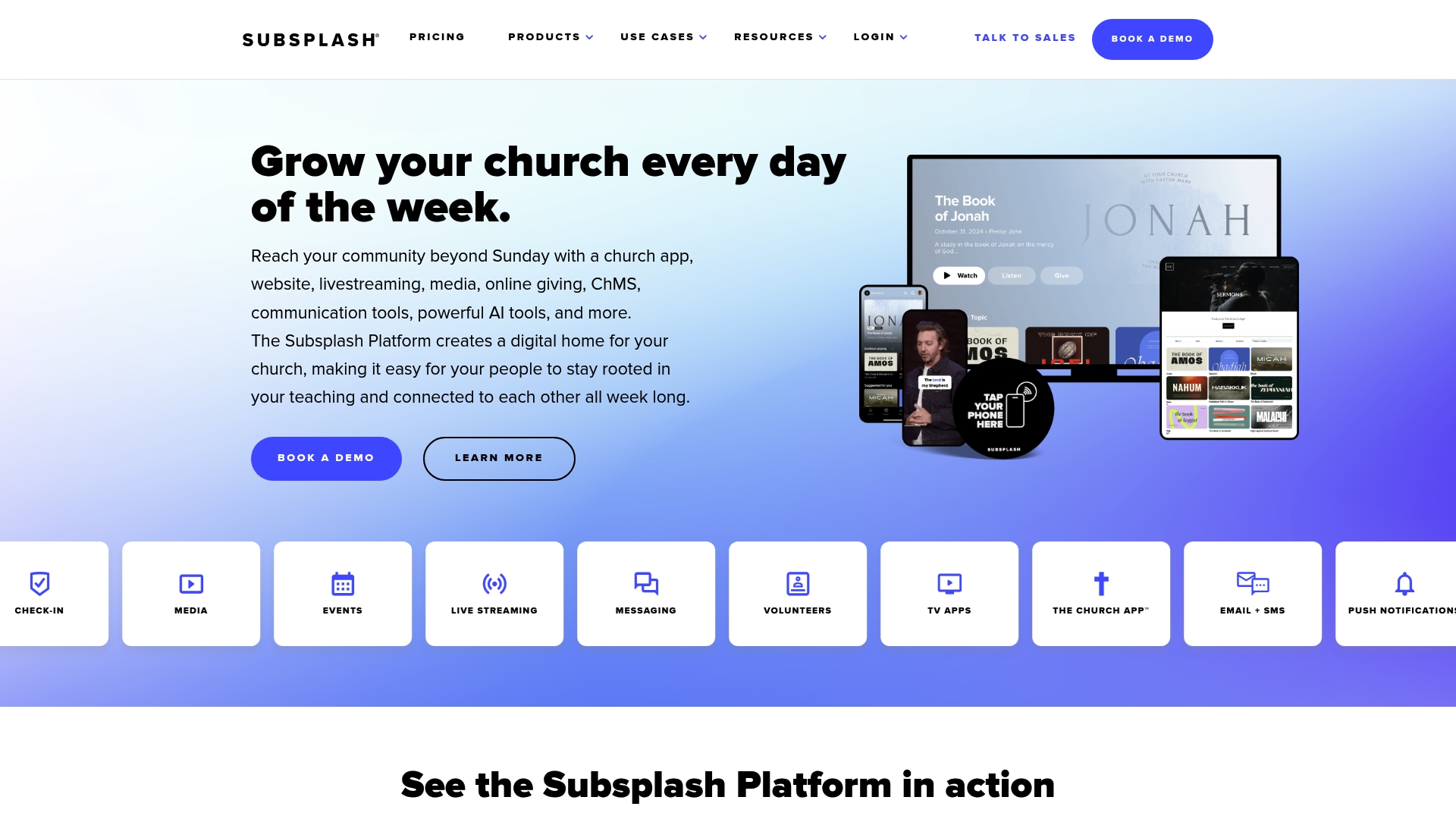
Subsplash reports being trusted by over 20,000 churches. The platform combines apps, websites, media hosting, live streaming, and giving into a single product. Pricing varies by church size and usually requires a sales consultation to get a final quote.
Core Features
Subsplash unifies app and website publishing with a media library and live streaming tools so sermons and clips move across channels from one dashboard. It includes online giving with transparent fees, content management that syncs across channels, and church management features for people and groups. The platform also offers automated sermon editing and clip creation through Pulpit AI and Trends AI.
Key Differentiator
The primary difference is the built in AI content tooling that works inside the same platform churches use for apps and giving. That lets staff produce sermon clips, graphics, and outreach content without exporting media to separate tools. The integration reduces handoffs between publishing and content creation.
Pros
Subsplash reduces the need to stitch multiple vendors together by keeping hosting, apps, and payments under one roof. The company offers free core tools for basic use and discounts on processing as churches grow, which can lower ongoing costs. Support is organized with weeklong help, dedicated coaches, and a library of resources to help staff adopt features.
Cons
- Pricing can be hard to estimate without speaking to sales. The plan structure and additional fees are not always clear from the website.
- The feature set may overwhelm smaller churches that only need a simple website and basic giving. Too many options can slow adoption when technical staff are limited.
- A strong focus on digital tools may not fit churches that prefer low tech or paper based processes.
When It May Not Fit
Subsplash can be a heavy lift for teams with no technical person. Setup and content migration take time and may require outside help. Costs can rise when you add custom API work or advanced modules, so small budgets could face unexpected fees. Churches that want just one basic tool may find the platform too broad for their needs.
Who It’s For
Church leaders and ministry staff who want a single environment for apps, media, giving, and content creation will find Subsplash useful. It fits churches ready to invest time in setup and staff training. Regional churches, church plants, and ministries aiming to grow digital outreach will see the most benefit.
Real World Use Case
The vendor reports a church replaced several separate tools with Subsplash, saved over $30,000 annually, and increased app usage threefold. That example shows how consolidating hosting, apps, and giving can cut vendor fees and raise engagement when staff commit to launching the new tools.
Pricing
Pricing varies by church size and feature needs and requires contacting sales for a custom quote. Subsplash offers free online giving as a baseline and paid packages for platform access and advanced features. Expect costs to increase when you add premium modules or request custom integrations.
Website: https://subsplash.com
Comparison of alternatives
For churches focusing on accurate and rapid meeting documentation, selecting an alternative requires weighing the unique feature sets offered by each platform discussed here. Below, we examine their specialties and suitability based on the needs commonly faced by church leadership teams.
Dedicated church management functionality
ReadyPen provides a unique focus by tailoring functionality specifically for church governance and sermon documentation. Its automatic transcription feature, combined with structured summaries and action item tracking, positions it distinctly when document precision and speed are prioritized. In contrast, FellowshipOne offers powerful integrations of financial and member databases, streamlining workflows where financial management is equally critical alongside documentation needs. Meanwhile, Planning Center emphasizes connected tools for worship, volunteer coordination, and donation collection. Subsplash stands out with features giving a strong online presence, such as automated sermon clipping and live streaming.
Integration and setup perspectives
Planning Center and Subsplash excel in their extensive compatibility with external tools and services. Planning Center integrates with music and streaming platforms, benefiting worship team management, while Subsplash unifies app and website features, providing an intuitive ecosystem for digital outreach. However, FellowshipOne requires careful planning for implementation, making it less accessible initially while supporting workflows once operational.
Best fit
- For churches prioritizing precise and fast meeting transcription and documentation, ReadyPen offers tailored solutions that minimize manual formatting and ensure a rapid turnaround.
- For congregations seeking a versatile solution for broader administrative tasks while maintaining an ease-of-access system for volunteers, Planning Center balances functionality and user-friendliness.
- When centralizing operations within a platform that combines membership management, finances, and payroll is crucial, FellowshipOne stands out as a option despite its higher setup considerations.
- If digital presence and media optimization, including sermon streaming and outreach, are at the forefront of your church’s goals, Subsplash provides specialized tools for such requirements.
Our pick
ReadyPen is the recommended choice for congregations requiring precision-driven and rapid meeting transcription automation where accuracy and compliance are of utmost importance. It is uniquely designed to simplify routine meeting documentation tasks while addressing specific needs of small to medium-sized congregations. However, for larger operational endeavors that involve more than meeting documentation, other platforms like Planning Center might serve as complementary or alternative foundations.
For churches seeking tailored tools for governance and operations, comparing these alternatives highlights their unique features and suitability for different organizational needs.
| Product | Core Feature | Key Differentiator | Best For | Pricing | Notable Limitation |
|---|---|---|---|---|---|
| Readypen | Automated transcription and meeting templates | Tailored for fast governance documentation | Church secretaries and leaders | Free, Paid $18–$40/m | May misinterpret complex speech |
| Planning Center | Worship planning and volunteer scheduling | Centralizes ministry functions into one platform | Worship teams and finance leaders | $15–$239/m | Full functionality requires internet access |
| FellowshipOne | Congregation and financial management | Combines member and financial workflows | Large, growing congregations | Price not published | Initial setup process can be complex |
| Subsplash | App, website, and media management | Integrated with AI-based content creation tools | Digital outreach-focused churches | Price not published | Advanced features may overwhelm smaller congregations |
How Can Churches Save Time on Meeting Documentation Without Complicated Software?
Church secretaries, pastors, and ministry teams often face tight schedules and no dedicated staff for detailed note-taking. This challenge grows when frequent meetings call for accurate minutes with motions, votes, and action items. Readypen answers this need by turning your meeting audio or recordings into formatted, encrypted meeting minutes in under two minutes, freeing your team from manual note work.
Whether you seek a church-specific solution with governance templates or want to reduce delays in submitting records, Readypen offers an AI-powered tool focused on fast, accurate documentation. Explore how Readypen’s tailored features meet your needs at Readypen Home.
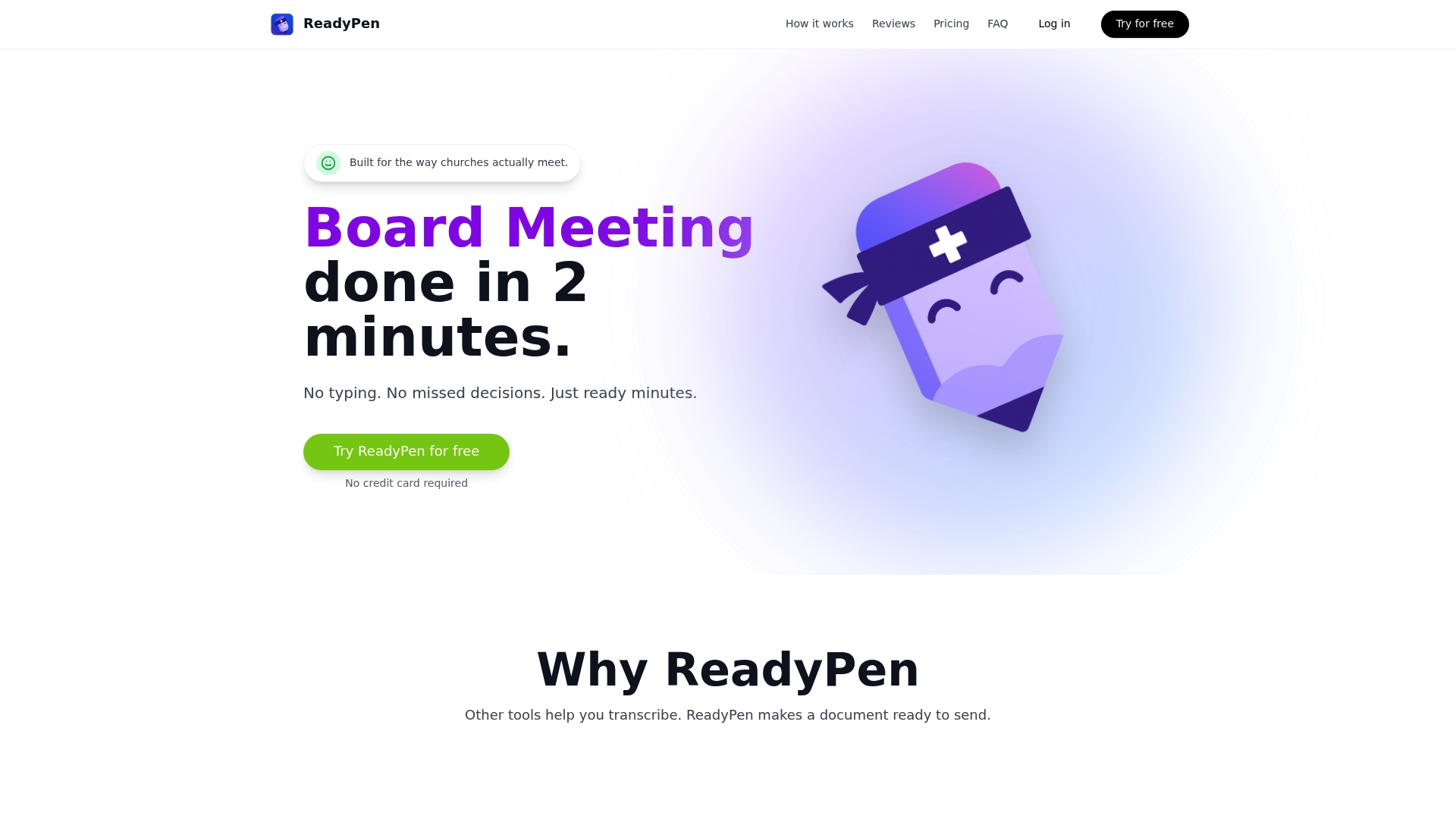
Save hours each week by automating your meeting notes. Visit Readypen.io to link your Zoom or Google Meet sessions and receive draft minutes with motions and votes correctly captured. Try Readypen now to cut the hassle of minute taking and keep your church records compliant.
FAQ
How quickly can Readypen generate meeting minutes?
Readypen can produce formatted meeting minutes in under 2 minutes. This speed enables quick turnarounds for routine church meetings, as highlighted by its focus on fast transcription and formatting.
What is the difference between Planning Center and Readypen?
Planning Center provides worship planning, volunteer scheduling, and group management in a single platform, which can be very beneficial for general church operations. On the other hand, Readypen is tailored specifically for minute-taking and church governance, making it ideal for secretaries and pastors focused solely on accurate record-keeping during meetings.
Can I customize meeting templates in Readypen?
Yes, Readypen offers customizable meeting templates that cater to various contexts like board, vestry, finance, and sermon meetings. This feature helps ensure compliance with denominational governance and record-keeping requirements specific to your church.
Does Readypen support privacy controls for sensitive meetings?
Readypen includes privacy controls and encryption for stored meeting records. This functionality allows churches to hold sensitive governance conversations without concerns about unauthorized access to their meeting minutes.
How does Readypen handle overlapping speech in meetings?
While Readypen excels at transcription, automatic transcription may misinterpret complex or overlapping speech, which will require a manual review. Users should anticipate a short editing process post-meeting to ensure clarity in meeting minutes.