Church Operations Efficiency Strategies for Ministry Leaders

Church Operations Efficiency Strategies for Ministry Leaders
Church operations efficiency strategies are the systematic approaches churches use to reduce administrative friction, document core processes, and free leaders to focus on ministry rather than management. Standard Operating Procedures (SOPs), data-driven automation, volunteer engagement frameworks, and financial oversight controls form the backbone of any well-run church administration. Churches that apply these methods consistently report smoother workflows, stronger volunteer retention, and better stewardship of resources. The result is a ministry team that spends less time firefighting and more time making disciples.
1. Church operations efficiency strategies start with documented SOPs
Churches need at least 12 core SOPs covering processes from Sunday setups to volunteer onboarding and emergency protocols. That number matters because most operational breakdowns happen in recurring, predictable tasks that nobody has written down.

SOPs convert individual knowledge into replicable systems. When a volunteer coordinator leaves, a written guide means the next person can step in without a three-month learning curve. The same applies to Sunday setup checklists, facility lockdown procedures, and new member follow-up sequences.
The most common failure mode in church administration is “management by assumption.” Tasks get presumed handled because they always have been. Written step-by-step guides eliminate that assumption by assigning clear ownership and sequence to every recurring task.
- Sunday setup and teardown procedures
- Volunteer onboarding and orientation steps
- New visitor follow-up sequences
- Emergency and safety protocols
- Financial handling and deposit procedures
- Staff and pastoral communication workflows
Pro Tip: Start by documenting the process that causes the most pain each week. One well-written SOP for your highest-friction task will deliver immediate, visible relief before you tackle the full list.
2. Integrating digital tools automates workflows and saves staff hours
Connecting church management software with accounting and communication platforms eliminates hours of manual data entry every month. Automated triggers handle welcome emails for new members, attendance dip alerts for pastoral follow-up, and volunteer reminders before each service.
The hidden cost of fragmented systems is duplicated effort. When attendance data lives in one platform, giving records in another, and volunteer schedules in a group text thread, staff spend hours reconciling information that should flow automatically. Integration solves that by making each system talk to the others.
Data fragmentation is a critical pitfall in church operations. Success requires assigning specific owners for each metric and embedding data review into leadership meetings so analytics drives real decisions rather than sitting unused.
- Automate new member welcome sequences from your church management system
- Set attendance threshold alerts to trigger pastoral outreach
- Connect giving platforms to accounting software for real-time reconciliation
- Use scheduling tools that push volunteer reminders automatically
Pro Tip: Assign one staff member as the data owner for each major metric. Without clear ownership, dashboards become wallpaper. With it, they become the basis for every leadership decision.
3. Applying logistics principles to church administration
Supply chain management frameworks designed for efficient flow management apply directly to church purchasing, communication, and resource coordination. Churches that consolidate vendor purchasing report measurable cost savings and a significant drop in administrative burden.
The core idea is simple. Logistics thinking asks: how do people, materials, and information move through our organization? Most churches have never mapped that flow. When they do, they find redundant approval steps, inconsistent communication channels, and purchasing decisions made without central oversight.
Centralized purchasing is one of the highest-leverage changes a church can make. When one person or team owns vendor relationships and supply decisions, costs drop, quality improves, and staff stop spending time on tasks that have nothing to do with ministry.
Structured communication protocols work the same way. When every team knows which channel carries which type of information, messages reach the right people at the right time. That clarity reduces the noise that buries urgent updates in group chats.
4. Effective volunteer management to sustain ministry health
Volunteer scheduling via informal texts is one of the top causes of operational friction in church teams. Centralized scheduling tools with documented processes improve accountability and reduce the burnout that drives good volunteers away.
The fix requires four deliberate steps:
- Move all scheduling to a single platform. Every volunteer sees their assignments, swaps, and reminders in one place. No more missed texts or double bookings.
- Track volunteer-to-attender ratios. When one team carries too much load, burnout follows. Monitoring ratios lets leadership redistribute responsibilities before people quit.
- Document the onboarding process. A written onboarding sequence for new volunteers sets expectations, reduces first-week anxiety, and increases the chance they return the following week.
- Review volunteer data in monthly leadership meetings. Regular leadership review of scheduling data and workload balance catches problems early. Assign follow-up actions in each meeting so nothing falls through the cracks.
Volunteer health is a leading indicator of church health. When volunteers feel organized, supported, and appreciated, they stay. When they feel confused and overworked, they disappear quietly.
5. Financial oversight best practices for integrity and resilience
Healthy church operations protect ministry by providing integrity in governance, finances, and facilities. Financial controls are not bureaucratic obstacles. They are the structures that protect the church’s reputation and its ability to serve the community long-term.
The core controls every church needs in place:
- Two-person counting. Never allow one person to handle offerings alone. Two-person counting teams reduce risk and protect individuals from suspicion.
- Timely deposits. Funds should move to the bank within 24 hours of collection. Delays create unnecessary risk.
- Transparent budget approval. Every spending decision above a defined threshold requires documented approval. This protects staff and builds board confidence.
- Regular reconciliations. Monthly bank reconciliations catch errors and irregularities before they compound.
- Governance separation. Boards set strategy through policy, while staff manage execution. When boards micromanage daily operations, strategic focus suffers and inefficiencies multiply.
Annual audits or independent financial reviews add a final layer of accountability. For smaller churches without the budget for a full audit, an agreed-upon procedures engagement with a CPA provides meaningful oversight at lower cost.
6. How to measure and improve church operational efficiency
Operational audits are the essential first step before any improvement effort. Automating a broken process makes it break faster. Auditing first reveals which processes need fixing before any new tools or systems get introduced.
The right approach depends on church size and available resources. This comparison helps leaders choose where to start:
| Strategy | Best for | Key benefit | Watch out for |
|---|---|---|---|
| Documentation-heavy (SOPs) | Small churches, new staff | Reduces training time, builds consistency | Requires upfront time investment |
| Automation-focused | Mid-size to large churches | Eliminates manual work, scales well | Needs clean data and assigned owners |
| Logistics-integrated | Multi-site or resource-heavy | Cuts costs, improves coordination | Requires process mapping first |
Evaluating church operational health through People, Programs, Place, and Planning pillars keeps spending aligned with mission. Tracking facility usage, volunteer ratios, and giving trends together gives leadership a complete picture rather than isolated data points.
Monthly leadership review meetings are the mechanism that keeps efficiency gains from eroding. Without a regular cadence, improvements drift back toward old habits. With it, data drives decisions and accountability stays visible.
Pro Tip: Run a one-page operational audit before your next planning cycle. List your top five recurring friction points, assign an owner to each, and set a 30-day review date. That single exercise often surfaces more insight than a full strategic planning retreat.
Key takeaways
Church operations efficiency depends on documented processes, assigned data ownership, and regular leadership review that keeps improvements from reverting to old habits.
| Point | Details |
|---|---|
| Start with SOPs | Document at least 12 core processes to eliminate management by assumption. |
| Integrate digital tools | Connect church management, accounting, and communication systems to cut manual work. |
| Apply logistics thinking | Centralize purchasing and map information flow to reduce costs and coordination gaps. |
| Manage volunteers with data | Track ratios and workload in monthly reviews to prevent burnout before it happens. |
| Separate governance from management | Boards set policy; staff execute. Mixing the two creates inefficiency at every level. |
Why operations are a ministry, not a burden
Most church leaders I talk with treat operations as a necessary evil. They tolerate the admin work because someone has to do it, but they never quite see it as ministry. That framing is the root of most operational dysfunction I observe.
Operations function as the unseen framework that frees leaders for ministry focus and protects the visible marks of a healthy church, including preaching, discipleship, and community care. When the back end runs well, the front end flourishes. When it doesn’t, pastors spend Sunday afternoons tracking down missing equipment instead of following up with visitors.
The theological case for good operations is stewardship. Operations must be viewed as a stewardship ministry applying godly wisdom to church management, not merely a bureaucratic necessity. Every dollar saved through consolidated purchasing is a dollar available for mission. Every hour saved through a well-written SOP is an hour a volunteer can spend with a family in need.
The churches I have seen thrive operationally share one trait. Their leaders stopped treating administration as a distraction from ministry and started treating it as an expression of it. That shift in perspective changes everything about how a team approaches documentation, financial controls, and volunteer care.
— Robbie
Readypen makes meeting documentation effortless for church teams
One of the most overlooked drains on church staff time is manual meeting documentation. Leaders spend hours each week writing up notes, summarizing decisions, and tracking action items from pastoral meetings, board sessions, and ministry team gatherings.
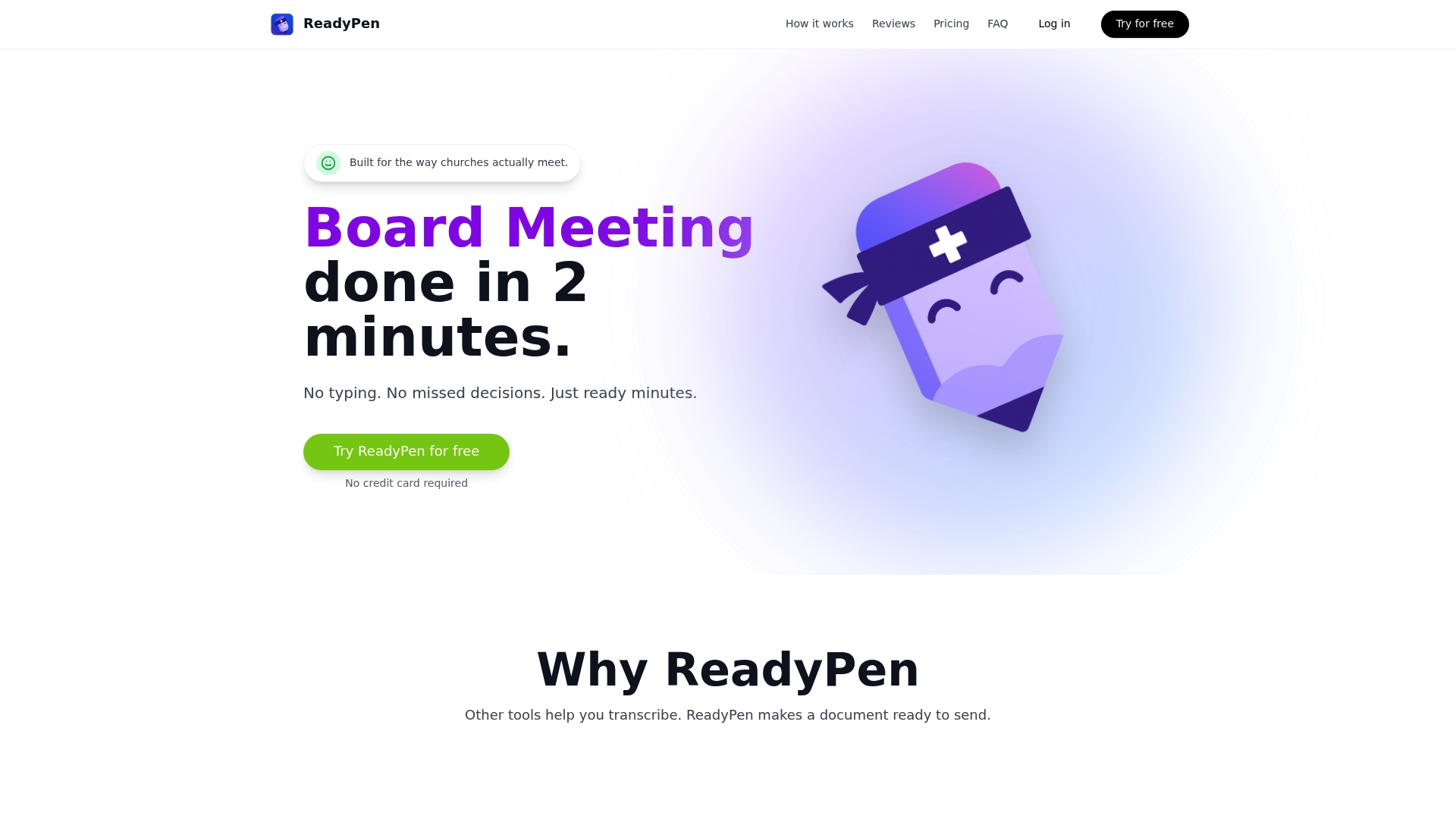
Readypen is built specifically for churches, pastors, and ministry organizations. It automatically generates meeting notes and summaries from conversations or recordings, so your team captures every decision and follow-up without anyone playing secretary. The result is accurate, searchable documentation that supports the financial oversight, volunteer management, and governance practices covered in this article. Church leaders can also use church board meeting templates to bring structure to every session from day one. If your team runs meetings but struggles to document them consistently, Readypen closes that gap.
FAQ
What are church operations efficiency strategies?
Church operations efficiency strategies are systematic approaches to documenting processes, automating workflows, and managing resources so church staff can focus on ministry rather than administrative friction. Core methods include Standard Operating Procedures, integrated digital tools, and structured volunteer management.
How many SOPs does a church need?
Churches need at least 12 core SOPs covering recurring processes from Sunday setups to volunteer onboarding and emergency protocols. Written procedures reduce training time and eliminate reliance on individual memory.
How does volunteer management affect church efficiency?
Poor volunteer scheduling is one of the top causes of operational friction in church teams. Centralized scheduling tools, documented onboarding, and regular workload reviews reduce burnout and improve volunteer retention.
What financial controls protect a church’s integrity?
Two-person counting teams, timely deposits, transparent budget approval, and monthly reconciliations form the baseline of sound church financial oversight. Separating board governance from staff management responsibilities prevents strategic focus from eroding.
Where should a church start with improving operations?
Start with an operational audit that identifies the top recurring friction points before introducing any new tools or systems. Fixing broken processes before automating them prevents inefficiency from accelerating.
Recommended
- ReadyPen - AI Meeting Documentation for Churches | Automated Minutes & Summaries
- ReadyPen - AI Meeting Documentation for Churches | Automated Minutes & Summaries
- ReadyPen - AI Meeting Documentation for Churches | Automated Minutes & Summaries
- ReadyPen - AI Meeting Documentation for Churches | Automated Minutes & Summaries