Church Growth Team Meeting Process: A Leader's Guide

Church Growth Team Meeting Process: A Leader’s Guide
A church growth team meeting process is a structured, recurring rhythm designed to align leaders, clarify priorities, and produce concrete action steps that move a church toward its mission. Without this rhythm, staff meetings drift into information dumps that leave teams unclear on what to do next. The Unstuck Group and UMC Discipleship Ministries both identify meeting structure as a primary driver of ministry alignment and team cohesion. Readypen was built specifically for this environment, automating the documentation that makes every meeting decision stick.
What does a productive church growth team meeting process require?
The prerequisites for effective meetings matter as much as the meetings themselves. Three elements are non-negotiable before any team sits down: a written agenda anchored in vision, defined decision rights, and a communication plan for what happens after the meeting ends.
Spiritual preparation comes first. UMC Discipleship Ministries recommends that ministry leaders convene early after any leadership transition to share hopes, align on mission, and begin work plans together. This is not a formality. It sets the tone that every operational decision flows from a shared theological foundation.

Meeting cadence shapes everything. The Unstuck Group outlines a practical meeting cadence that includes 30-minute All Staff, Creative Team, and Strategy Team sessions, plus a 90-minute Directional Team Lunch. Each session type serves a distinct purpose. Mixing them into one long weekly meeting is one of the most common mistakes church leaders make.
Before your next meeting, confirm these prerequisites are in place:
- A written agenda distributed at least 24 hours in advance
- Clear decision rights: who decides, who advises, and who is simply informed
- A designated note-taker or documentation tool
- A defined end time with the last 15 minutes protected for meeting landing
- Vision alignment: every agenda item connects back to a stated growth goal
| Prerequisite | Why it matters |
|---|---|
| Written agenda | Prevents topic drift and keeps discussion focused |
| Decision rights | Reduces confusion as leadership teams grow |
| Documentation plan | Captures decisions and assigns ownership immediately |
| Timeboxed sessions | 30-minute focused meetings outperform 90-minute open discussions |
| Vision anchor | Keeps operational items tied to mission, not just logistics |
Pro Tip: Use a church board meeting template before each session. Readypen offers a pre-built church meeting template that structures your agenda and auto-generates minutes from the conversation.
How to execute the church growth team meeting process step by step
A well-run church growth meeting follows five distinct phases. Each phase has a purpose. Skipping any one of them is where most meetings lose their impact.
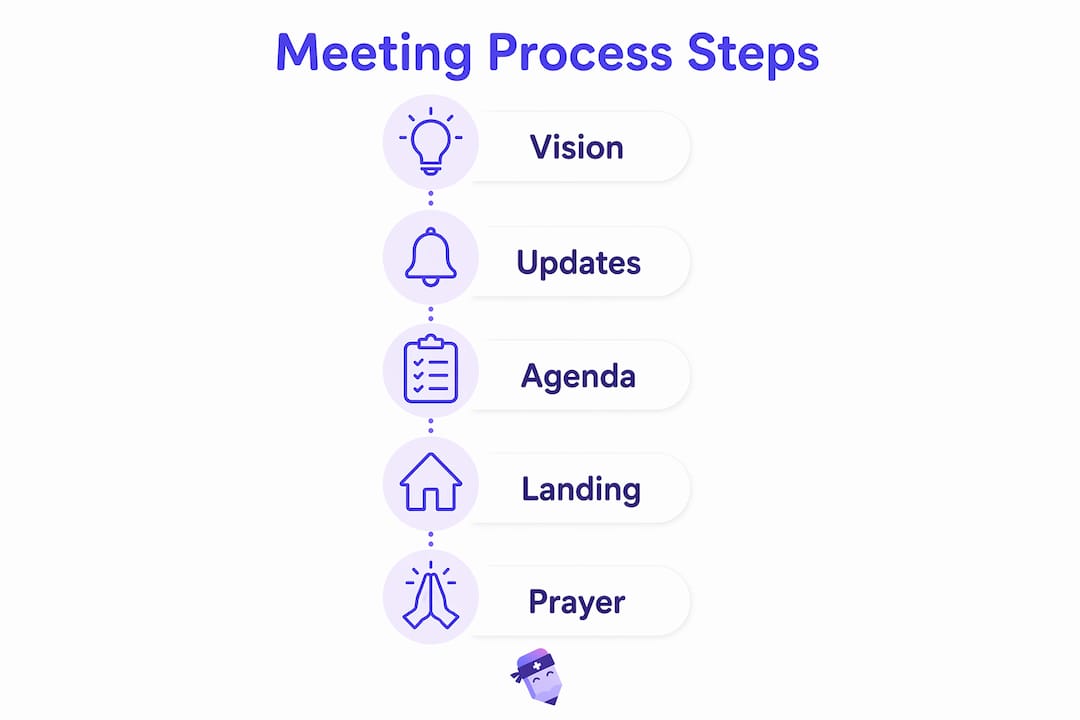
1. Open with vision, not logistics. Start every meeting with a 3-minute vision reminder. Read a mission statement, share a story of changed life, or reference a growth milestone. Auxano’s research confirms that anchoring agendas in shared vision increases meeting effectiveness and leaves teams ready to act rather than just informed.
2. Run structured updates. Each team lead gives a 2-minute status report. No problem-solving during updates. This phase is for awareness only. If an issue needs discussion, it goes on the agenda for the next phase.
3. Work through the agenda with decision rights in place. The Unstuck Group identifies decision rights clarification as a critical step as church teams grow. Before any major discussion, name the decision method: leader decides, consensus with a deadline, or majority vote with a backup plan. This prevents circular conversations that waste time.
4. Reserve 15 minutes for meeting landing. Most meetings crash land. The Unstuck Group’s research on effective church staff structure shows that dedicating the final 15 minutes to three questions transforms follow-through: What decisions were made? Who needs to know? Who owns each next step and by when?
5. Close with prayer and a clear send-off. End with a 2-minute prayer that connects the meeting’s decisions back to the church’s mission. This is not ceremonial. It reinforces that the work done in the room is ministry, not just management.
| Meeting type | Duration | Primary purpose |
|---|---|---|
| All Staff | 30 minutes | Alignment and announcements |
| Creative Team | 30 minutes | Content and communication planning |
| Strategy Team | 30 minutes | Growth initiatives and problem-solving |
| Directional Team Lunch | 90 minutes | Leadership development and vision |
Pro Tip: Build your meeting schedule around communication flow. The Unstuck Group recommends that senior leadership meets early in the week so decisions flow clearly to downstream teams before the weekend.
What common challenges hinder church growth meetings?
The most damaging meeting problem is not conflict or poor attendance. It is the absence of clear decisions at the end. Teams leave meetings with different interpretations of what was agreed, and no one is accountable for follow-through.
Four specific patterns cause this breakdown:
- No named owner. A task assigned to “the team” belongs to no one. The Unstuck Group’s podcast research confirms that explicitly assigning a single owner with a deliverable and a completion date is the single most effective accountability practice.
- No written record. Verbal decisions evaporate. Writing commitments and communicating them immediately after the meeting prevents misunderstandings from compounding week over week.
- Meeting fatigue from poor scheduling. Too many meetings without clear purpose burn out staff. A strategic cadence with distinct meeting types prevents overlap and redundancy.
- Skipping the landing phase. When the last 15 minutes get cut for time, the entire meeting loses its value. Protecting that window is non-negotiable.
“Staff meetings focused on alignment help teams leave ready to act. The goal is not to share information. The goal is to produce clarity.” — Auxano
The corrective is simple but requires discipline. After every meeting, send a written summary within one hour. Include every decision, every owner, and every deadline. Readypen’s meeting documentation guide explains exactly what that summary should contain and who should be responsible for producing it.
How does the church growth meeting process support spiritual and strategic alignment?
A church growth meeting is not just an operational session. It is a space for spiritual formation and mission alignment. Leaders who treat meetings as purely logistical miss the deeper purpose that keeps teams unified over the long term.
Seven recurring agenda topics strengthen this integration. Research from The God Message identifies seven leadership meeting topics that consistently build ministry unity: vision alignment, spiritual health, leadership development, outreach planning, problem-solving, unity building, and prayer. Rotating these topics across your meeting cadence ensures no dimension of church health gets neglected.
Strategic alignment also requires a longer planning horizon. A 90-day expansion plan with named phases, such as Audit, Build, and Launch, gives church growth efforts a measurable structure. The Unstuck Group’s ministry strategy framework reinforces this: predefining measurable wins and breaking work into prioritized 90-day cycles turns meetings into execution engines rather than discussion loops.
Outreach planning belongs in this rhythm too. Church Leaders’ research on annual outreach scheduling shows that churches rooted in prayer and leadership alignment shift from reactive to consistent growth planning. Quarterly outreach themes, such as Easter, back-to-school, and holiday seasons, become predictable and well-resourced rather than last-minute.
| Alignment area | Meeting application |
|---|---|
| Spiritual health | Open with vision story; close with mission-connected prayer |
| Leadership development | Rotate a 10-minute development topic into Directional Team Lunches |
| Outreach planning | Review quarterly outreach calendar in Strategy Team meetings |
| Decision accountability | Assign named owners and deadlines in every session |
Key takeaways
A structured church growth team meeting process produces alignment, accountability, and mission-shaped decisions only when every session includes a written agenda, defined decision rights, and a protected landing phase.
| Point | Details |
|---|---|
| Meeting cadence matters | Use distinct 30-minute session types rather than one long weekly meeting. |
| Landing phase is non-negotiable | Reserve the final 15 minutes to capture decisions, owners, and deadlines. |
| Decision rights reduce confusion | Name who decides before any major discussion begins. |
| Spiritual integration sustains growth | Rotate vision, outreach, and prayer topics across your meeting rhythm. |
| Documentation drives follow-through | Written summaries sent within one hour prevent accountability gaps. |
Why most church meeting problems are really documentation problems
I have sat in on enough church leadership meetings to know the real issue. The meeting itself is rarely the problem. The problem is what happens in the 48 hours after everyone leaves the room.
Leaders walk out with different memories of what was decided. No one sends a summary. The person who was supposed to own the outreach event assumes someone else is handling it. By the following week, the team is relitigating the same conversation. This is not a leadership failure. It is a documentation failure.
The churches I have seen run the most effective growth meetings share one habit: they treat the written record as part of the meeting itself, not an afterthought. The landing phase is not a nice-to-have. It is the moment where the meeting either produces results or dissolves into good intentions.
I also want to push back on the idea that adding more structure kills the Spirit in a meeting. The opposite is true. When leaders are not scrambling to remember what was decided, they have more mental space to be present, to pray with focus, and to lead with clarity. Structure does not crowd out spiritual depth. It creates the conditions for it.
The one thing I would tell every church administrator reading this: protect the last 15 minutes of every meeting like it is sacred. Because for your team’s effectiveness, it is.
— Robbie
Readypen makes church meeting documentation automatic
Church growth teams run a lot of meetings. Most do not have a dedicated admin to document every decision, owner, and deadline.
Readypen is AI-powered meeting documentation built specifically for churches, pastors, and ministry teams. It automatically generates meeting summaries and minutes from conversations or recordings, so your team leaves every session with a written record in hand. No manual note-taking. No missing action items. Every decision is captured with the owner and deadline already assigned. Church leaders using Readypen spend less time reconstructing what was said and more time executing what was decided. Visit Readypen.io to see how it fits your team’s meeting rhythm.
FAQ
What is a church growth team meeting process?
A church growth team meeting process is a structured, recurring rhythm of meetings designed to align church leaders, clarify priorities, and produce concrete action steps. It typically includes distinct meeting types such as All Staff, Creative Team, and Strategy Team sessions.
How long should a church growth team meeting be?
Most focused church staff meetings run 30 minutes. The Unstuck Group recommends timeboxed sessions by meeting type, with longer 90-minute Directional Team Lunches reserved for leadership development and vision work.
What is meeting landing and why does it matter?
Meeting landing is the final 15 minutes of a meeting dedicated to capturing decisions, identifying communication needs, and assigning owners with deadlines. The Unstuck Group identifies this phase as the most commonly skipped and most critical step for follow-through.
How do you assign accountability in church staff meetings?
Assign a single named owner to every action item, along with a specific deliverable and completion date. Writing these commitments and sending them to the team within one hour of the meeting prevents misunderstandings and increases follow-through.
What topics should a church leadership meeting cover?
Effective church leadership meetings rotate through seven core topics: vision alignment, spiritual health, leadership development, outreach planning, problem-solving, unity building, and prayer. Covering these consistently builds both operational clarity and ministry cohesion.